Wildlife Wednesday - Our Autumn Friend the Copperhead

Advertisement
Whether the weather is still hot or cooler, it's always easy to tell when fall has arrived in the Houston area. Shop windows feature dazzling displays of pumpkins and cornucopias. Along roads and in parks, trees are ablaze with leaves of red, yellow, or gold. Festivals such as the Texas Renaissance Festival, Wings Over Houston, and the Bayou City Art Festival are in full swing, serving as a magnet for those looking for a good time. And then, there are the copperheads. No, not bright new shiny pennies but rather the snake of snakes – the Eastern Copperhead (Agkistrodon contortrix).
In fact, for Wildlife Wednesday on October 21, come to Jesse Jones Park & Nature Center to learn more about this common ophidian resident of the park. Our special guest for this program will be "Lincoln," our ambassador Eastern Copperhead.
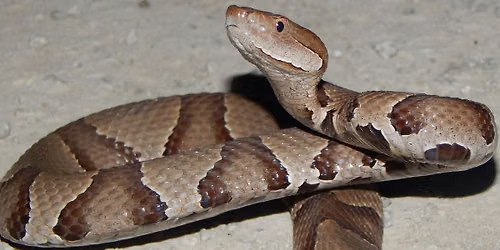
It can be truly said that the Eastern Copperhead is as much of an autumn fixture as football. This attractive snake has a broad beige or pink body covered by 13-20 hourglass-shaped dark brown bands that provide excellent camouflage among the fallen leaves and pine straw in Harris County. The bands are wide at the belly line and then narrow into the distinctive hourglass shape on the top of the snake's body over the spine.
Copperheads are generally active in the Houston area from late February to early November. However, they most often appear in autumn and spring, when daytime temperatures are moderate and evening temperatures are cool – at which time copperheads frequently warm themselves on asphalt roads, trails, or other heat-retaining objects. Many people enjoying a stroll or bicycle ride on autumn nights can vouch for their fondness for warm surfaces.
Usually between 18 and 38 inches long, the copperhead seems to rely more on its camouflage than on its fangs and venom for protection from its main predator – humans. Because they are venomous, copperheads have developed a reputation for aggressiveness, much like their congeneric cousin, the Northern Cottonmouth. However, copperheads are masters of disguise, generally avoiding a fight by hiding until danger passes, whether that peril comes from a cat, dog, or human. And that ability to remain hidden may be the key to its success.
Found in a variety of urban habitats, copperheads prefer to live in "copperhead condos." Piles of firewood, rocks, and leaves all make great homes for this beneficial snake. Beneficial? Yes, beneficial. Copperheads feast on various things, including mice and rats – the same vermin that can spread disease and cause local dining establishments to appear on television news reports – offering effective pest control.
Despite these benefits, a bite from a copperhead can indeed have serious medical consequences. So what should be done if someone encounters this common inhabitant of Harris County? Quite simply, leave it alone.
Although most bites result from someone trying to K*ll or capture a copperhead, other bites happen when a person accidentally steps on a hidden copperhead.
Should you ever suffer the unfortunate experience of receiving a bite from a copperhead, don't panic. They are responsible for few fatalities. However, as with all medical emergencies, quick treatment by medical personnel is necessary.
To learn more about copperheads, and to have a closer look at Lincoln, join us in the Nature Center building at 12 p.m. on Wednesday, Oct. 21. This program is free of charge and open to Agkistrodon lovers of all ages.
Advertisement
Where is it happening?
20634 Kenswick Dr, Humble, TX, United States, Texas 77338
Event Location & Nearby Stays:
Know what’s Happening Next — before everyone else does.
Host or PublisherJesse H Jones Park & Nature Center