Wildlife Wonderings -- Boa constrictors

For Wildlife Wonderings on Wednesday, August 5, we have a special guest -- Ravenna the Boa constrictor (Boa constrictor). Ravenna is a species of large, non-venomous, heavy-bodied snake that is frequently kept and bred in captivity. Boa constrictors are a member of the family Boidae. The species is native to tropical South America. A staple of private collections and public displays, its color pattern is highly variable yet distinctive. Four subspecies are recognized.
The Boa constrictor is a large snake, although it is only modestly sized in comparison to other large snakes, such as the reticulated python, Burmese Python, or the occasionally sympatric Green Anaconda, and can reach lengths from 3-13 ft. depending on the locality and the availability of suitable prey. Clear sexual dimorphism is seen in the species, with females generally being larger in both length and girth than males. The usual size of mature female boas is between 7-10 ft. whereas males are between 6-8 ft. Females commonly exceed 10 ft., particularly in captivity, where lengths up to 12 ft. or even 14 ft. can be seen.
The Boa constrictor is a heavy-bodied snake, and large specimens can weigh up to 60 lbs. Females, the larger sex, more commonly weigh 22-33 lbs. Some specimens of this species can reach or possibly exceed 100 lbs., although this is not usual. The size and weight of a Boa constrictor depends on subspecies, locale, and the availability of suitable prey. Other examples of sexual dimorphism in the species include males generally having longer tails to contain the hemipenes and also longer pelvic spurs, which are used to grip and stimulate the female during copulation. Pelvic spurs are the only external sign of the rudimentary hind legs and pelvis and are seen in all boas and pythons.
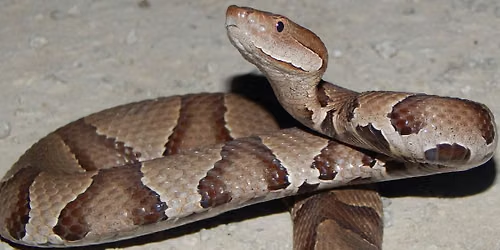
The coloring of Boa constrictors can vary greatly depending on the locality. However, they are generally a brown, gray, or cream base color, patterned with brown or reddish-brown "saddles" that become more pronounced towards the tail. This coloring gives B. constrictor subspecies the common name of "red-tailed boas." The coloring works as a very effective camouflage in the jungles and forests of its natural range.
Some individuals exhibit pigmentary disorders, such as albinism. Although these individuals are rare in the wild, they are common in captivity, where they are often selectively bred to make a variety of different color "morphs." Boa constrictors have an arrow-shaped head with very distinctive stripes on it: One runs dorsally from the snout to the back of the head; the others run from the snout to the eyes and then from the eyes to the jaw.
Boa constrictors can sense heat via cells in their lips, though they lack the labial pits surrounding these receptors seen in many members of the family Boidae. Boa constrictors also have two lungs, a smaller (non-functional) left and an enlarged (functional) right lung to better fit their elongated shape, unlike many colubrid snakes, which have completely lost the left lung.
Boa constrictors generally live on their own and do not interact with any other snakes unless they want to mate. They are nocturnal, but they may bask during the day when night-time temperatures are too low. As semi-arboreal snakes, young Boa constrictors may climb into trees and shrubs to forage; however, they become mostly terrestrial as they become older and heavier. Boa constrictors strike when they perceive a threat. Their bite can be painful, especially from large snakes, but is rarely dangerous to humans. Specimens from Central America are more irascible, hissing loudly and striking repeatedly when disturbed, while those from South America tame down more readily. Like all snakes, Boa constrictors in a shed cycle are more unpredictable, because the substance that lubricates between the old skin and the new makes their eyes appear milky, blue, or opaque so that the snake cannot see very well, causing it to be more defensive than it might otherwise be.
Their prey includes a wide variety of small to medium-sized mammals and birds. The bulk of their diet consists of rodents (such as squirrels, mice, rats and agoutis), but frogs, larger lizards (such as ameivas, iguanas and tegus) and mammals as big as monkeys, marsupials (opossums), armadillos, wild pigs, young brocket deer and ocelots are also reported to have been consumed. Domestic animals such as dogs, cats, rabbits, ducks and chickens are frequently consumed. Young Boa constrictors eat small mice, birds, bats, lizards, and amphibians. The size of the prey item increases as they get older and larger. Once a Boa constrictor has caught its prey, it will wrap its coils around the animal and constrict it until it dies by asphyxiation. The boa's powerful muscles allow it to exert a great deal of pressure, and the prey is typically killed within a few minutes.
Boa constrictors are ambush predators, so they often lie in wait for an appropriate prey to come along, then they attack a moment before the prey can escape. However, they have also been known to actively hunt, particularly in regions with a low concentration of suitable prey, and this behavior generally occurs at night. The Boa first strikes at the prey, grabbing it with its teeth; it then proceeds to constrict the prey until death before consuming it whole. Unconsciousness and death likely result from shutting off vital blood flow to the heart and brain, causing asphyxiation, rather than suffocation as was previously believed; constriction can interfere with blood flow and overwhelm the prey's usual blood pressure and circulation. This would lead to unconsciousness and death very quickly. Their teeth also help force the animal down the throat while muscles then move it toward the stomach. It takes the snake about 4–6 days to fully digest the food, depending on the size of the prey and the local temperature. After this, the snake may not eat for a week to several months, due to its slow metabolism.
Boa constrictors are ovoviviparous, giving birth to live young. They generally breed in the dry season—between April and August—and are polygynous; thus, males may mate with multiple females. Half of all females breed in a given year, and a larger percentage of males actively attempt to locate a mate. Due to their polygynous nature, many of these males will be unsuccessful. As such, female boas in inadequate physical condition are unlikely to attempt to mate, or to produce viable young if they do mate. Reproduction in boas is almost exclusively sexual. In 2010, a Boa constrictor was shown to have reproduced asexually via parthenogenesis.
During the breeding season, the female Boa constrictor emits pheromones from her cloaca to attract males, which may then wrestle to select one to breed with her. During breeding, the male curls his tail around the female's and the hemipenes (or male reproductive organs) are inserted. Copulation can last from a few minutes to several hours and may occur several times over a period of a few weeks. After this period, ovulation may not occur immediately, but the female can hold the sperm inside her for up to one year. When the female ovulates, a midbody swell can be noticed that appears similar to the snake having eaten a large meal. The female then sheds two to three weeks after ovulation, in what is known as a post-ovulation shed which lasts another 2–3 weeks, which is longer than a normal shed. The gestation period, which is counted from the postovulation shed, is around 100–120 days. The female then gives birth to young that average 15–20 in. in length. The litter size varies between females but can be between 10 and 65 young, with an average of 25, although some of the young may be stillborn or unfertilized eggs known as "slugs". The young are independent at birth and grow rapidly for the first few years, shedding regularly (once every one to two months). At 3–4 years, boa constrictors become sexually mature and reach the adult size of 6–10 feet, although they continue to grow at a slow rate for the rest of their lives. At this point, they shed less frequently, about every 2–4 months.
Boa constrictors are widely bred in captivity. Captive life expectancy is 20-30 years, with rare accounts of over 40 years. The greatest reliable age recorded for a Boa constrictor in captivity is 40 years, 3 months, and 14 days.
All Boa constrictors fall under CITES and are listed under CITES Appendix II, except B. c. occidentalis, which is listed in CITES Appendix I. In some regions, Boa constrictor numbers have been severely hit by predation from humans and other animals and over-collection for the exotic pet and snakeskin trades. Most populations, though, are not under threat of immediate extinction; thus, they are within Appendix II rather than Appendix I. Boa constrictors may be an invasive species in Florida and Aruba.
To learn more about Ravenna and Boa constrictors, some to Jesse Jones Park and Nature Center at 12 p.m. on Wednesday, August 5. The program is free of charge and open to snake enthusiasts of all ages.
Where is it happening?
20634 Kenswick Dr, Humble, TX, United States, Texas 77338
Know what’s Happening Next — before everyone else does.
Host or PublisherJesse H Jones Park & Nature Center