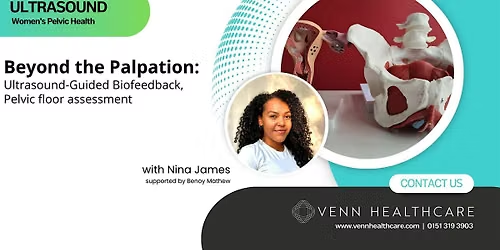
Beyond the Palpation:Ultrasound-Guided Biofeedback, Pelvic floor assessment

About this Event
Who is this course for?
Open to Pelvic health physiotherapists, Medical practitioners, Osteopaths and chiropractors, and other allied health professionals whose scope of practice includes pelvic floor assessment and rehabilitation. Particulalry those with an interest in pelvic health rehabilitation, seeking to incorporate transabdominal ultrasound into clinical assessment and rehabilitation, including biofeedback, functional pelvic floor assessment, and bladder volume measurement.
What will the course offer?
This is a a clinician-performed POCUS course focused on enhancing pelvic assessment and rehabilitation.
This practical workshop introduces clinicians to the use of transabdominal ultrasound (TAUS) for the assessment of the bladder and pelvic floor. Combining evidence-informed theory with extensive hands-on scanning, participants will develop a clear understanding of relevant anatomy, ultrasound imaging principles, and the clinical applications of TAUS in pelvic health practice.
Participants will learn how to identify the bladder and pelvic floor musculature using a curvilinear transducer, perform a functional pelvic floor assessment, and estimate bladder volume before and after voiding. The course also explores the role of ultrasound as a real-time biofeedback tool, the relationship between breathing and pelvic floor function, and the clinical relevance of bladder volume assessment in the management of overactive bladder, urinary incontinence, and urinary retention.
By the end of the workshop, participants will have gained practical experience performing core TAUS assessment techniques and interpreting common normal and abnormal movement patterns to support clinical reasoning and patient management.
Learning Objectives
By the end of this course, participants will be able to:
- Describe the anatomy of the bladder and pelvic floor muscles, including the levator ani and puborectalis/pubovisceralis.
- Explain the indications, advantages, and limitations of transabdominal ultrasound compared with transperineal, transvaginal, and transrectal ultrasound in pelvic health assessment.
- Describe the relationship between breathing and pelvic floor muscle function and the role of ultrasound as a biofeedback tool.
- Understand the principles of a PERFECT-style pelvic floor assessment using transabdominal ultrasound.
- Competently position a curvilinear transducer to visualise the bladder and pelvic floor.
- Identify normal and abnormal pelvic floor movement patterns, including lift and bulge, during functional assessment.
- Estimate bladder volume before and after voiding using transabdominal ultrasound and interpret findings in the context of overactive bladder, urinary incontinence, and urinary retention.
- Integrate ultrasound findings with clinical reasoning to support assessment and patient education in pelvic health practice.
Agenda
18.30 Welcome & Objectives
Session aims, what attendees will be able to do by the end
18.40 - 19.00 Theory: Anatomy
Bladder anatomy and position; pelvic floor muscle layers (levator ani, puborectalis/pubovisceralis); how these relate spatially on ultrasound
19.00 - 19.15 - Theory: Clinical Rationale & Applications
Why TAUS (vs. transperineal/transvaginal/transrectal) and its limitations; pelvic floor as biofeedback; breath–pelvic floor relationship; intro to PERFECT scheme; bladder volume estimation and its relevance to OAB, incontinence, and retention
19.15-19.45 Practical: Facilitator-Led Demonstration
Live demo, curvilinear probe: locating the bladder and pelvic floor; PERFECT-style pelvic floor assessment (lift vs. bulge, normal vs. abnormal patterns); bladder volume measurement pre-void; post-void measurement (build in a short pause for the model to actually void) and what this means for OAB/incontinence/retention pathologies
19.45 - 20.15 - Practical: Hands-On Practice
3 groups of 4, one machine each; each group practices locating the bladder and pelvic floor, runs a PERFECT-style assessment, and takes a bladder volume measurement, rotating scanner/model/observer roles
5 min Wrap-Up & Q&A
Recap, open questions, how to integrate into patient sessions as biofeedback
DISCLAIMER
We make every effort to ensure the information in our videos, webinars, online course and accompanying downloadable resources is accurate and correct at the date of publication. However, this should not replace your good clinical judgement and evolving evidence base and clinical trials or be regarded as a substitute for taking professional advice in appropriate circumstances from your professional organisation and insurance providers.
In particular, check with local policy on indications, contra-indications, safety procedures and after-care with your patients . Any such liability cannot be excluded at law, we (Tutors & Venn Healthcare) do not accept any liability for loss of any type caused by reliance on the information given herein.
Where is it happening?
Event Location & Nearby Stays:
GBP 75.00