Wildlife Wednesday – the Texas Coralsnake

Advertisement
Fall is known for its many colors and one of Jesse Jones Park's common snakes matches that colorful atmosphere -- the Texas Coralsnake (Micrurus tener). The Texas Coralsnake is a species of venomous snake in the family Elapidae, which also includes mambas, cobras and taipans.
The Texas Coralsnake has the traditional coloration associated with coral snakes: black, yellow, and red rings. The species is endemic to the southern United States and northeastern and central Mexico and inhabits the states of Texas, Louisiana and Arkansas, and the Mexican states of Tamaulipas, San Luis Potosí, Guanajuato, Querétaro and Morelos.
It is capable of growing to 48 inches in total length, including the tail, but most are closer to 24 inches. Males are typically smaller than females. Coralsnakes have smooth dorsal scales, a rounded head, and the eyes have round pupils. In the United States, coralsnakes can be identified by the red rings contacting the yellow rings. A common memory aid is the rhyme, "Red touch yellow, K*ll a fellow. Red touch black, friend of Jack."
Coralsnakes are shy, secretive animals, and spend most of their time hiding in leaf litter or under logs. They can often be seen crawling on the surface, after heavy rains. When grabbed suddenly, or sometimes just when touched, they may thrash about, swing around, and bite. However, even sometimes when they are calm, they can suddenly swing around and bite, for no apparent reason.
A coralsnake is proteroglyphous, meaning it has a pair of deeply grooved, semihollow, chisel-shaped, fixed fangs in the front of its upper jaw, through which the venom is injected and encouraged via a chewing motion. Coralsnakes do not necessarily need to bite and hold on for a brief time to deliver a significant amount of venom. Severe envenomations have occurred after a quick bite. Many bites from coralsnakes do not inject any venom at all and are known as a dry bite. However, a bite from any coralsnake should be considered an extremely serious medical emergency, and medical treatment should be sought immediately, because symptoms of envenomation are known to sometimes delay manifestation for as long as 24 hours, but once present, often progress very rapidly.
The primary diet of the Texas Coralsnake consists of other snakes, primarily earthsnakes, and other small fossorial species. It is also cannibalistic. It also occasionally eats small lizards such as skinks, but the consumption of rodents by coralsnakes is rare, although it may happen from time to time.
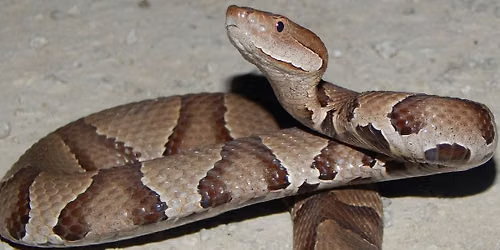
Unlike copperheads, cottonmouths or rattlesnakes -- whose young are born alive -- Texas coral snakes are egg-layers, laying clutches of 7- 9 eggs in June or July. The young coralsnakes hatch about two months later and are able to care for themselves immediately after hatching.
To learn more about this beautiful snake, join us in the Nature Center on Wednesday, Nov. 18, at 12 p.m. This program is free of charge and open to the public.
Advertisement
Where is it happening?
20634 Kenswick Dr, Humble, TX, United States, Texas 77338
Event Location & Nearby Stays:
Know what’s Happening Next — before everyone else does.
Host or PublisherJesse H Jones Park & Nature Center