Who Owns AI? Data, Land, and Planetary Futures
Schedule
Wed May 20 2026 at 04:00 pm to 05:00 pm
UTC-07:00Location
UCSD Design & Innovation Building Room 208 | La Jolla, CA
About this Event
About the Series
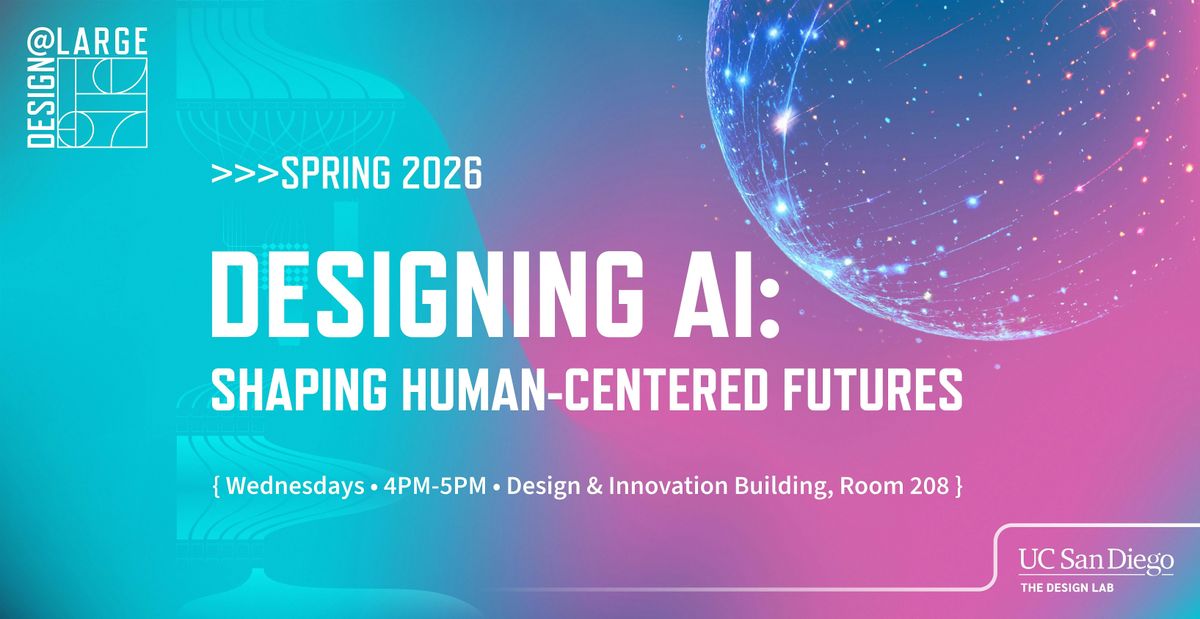
Artificial intelligence is no longer confined to research labs or technical infrastructure—it is embedded in classrooms, creative practice, healthcare systems, communication platforms, and planetary-scale infrastructures. As AI systems move from experimental tools to everyday companions, decision-makers, and mediators of social life, the question is no longer whether AI will shape our future, but how—and by whom.
At the Design Lab, we approach AI not simply as an algorithmic achievement, but as a fundamentally human-centered design challenge. Intelligent systems must be technically robust, yet responsive to lived experience; powerful at scale, yet grounded in context; innovative, yet attentive to equity and responsibility. Across seven sessions, Design@Large in Spring 2026 brings together leading voices from research, industry, education, law, health, and the arts to explore how AI is designed, deployed, governed, and experienced in real-world settings. From generative AI in education and music to embodied intelligence in XR, from disability justice and communication to sustainable computing and Indigenous data sovereignty, and from personal AI companions to value-based care in health systems, the series examines AI where it meets people, institutions, and infrastructures.
Rather than treating AI as a purely technical system, we frame it as a site of negotiation among human values, institutional incentives, cultural norms, and material conditions. Each session pairs scholars, practitioners, and industry leaders to interrogate how design decisions shape agency, creativity, trust, access, and care at scale.
Design@Large is open to the broader public and livestreamed online, while also serving as a core seminar for over 100 undergraduate and graduate students at UC San Diego. Together, we ask: What does it mean to design AI responsibly? How do we ensure that intelligent systems amplify human capability without reproducing harm? And how can design guide AI toward more just, inclusive, and sustainable futures?
About this Talk
AI systems rely on vast material infrastructures—data, energy, land, and labor—that are unevenly distributed and often obscured from view. This session examines ownership and sovereignty in AI from technical, environmental, and Indigenous perspectives. By connecting sustainable computing, climate-scale machine learning, and data sovereignty, the discussion asks who benefits from AI systems, who bears their costs, and how planetary futures are shaped through design and governance decisions.
About the Speakers
Josiah Hester is a Kānaka Maoli (Native Hawaiian) associate professor of computing at Georgia Tech, where he leads the Center for Advancing Responsible Computing and serves on the leadership team of the Brook Byers Institute for Sustainable Systems. He also co-directs the STRONG Manoomin Collective, an Indigenous-led NSF-funded effort focused on cyberinfrastructure and sovereignty. His research spans sustainable computing, with applications in health wearables, interactive devices, environmental sensing, and culturally engaged education, supported by agencies like NSF, NIH, and ARPAH. Among other awards, he was recently named a Presidential Early Career Award for Scientists and Engineers (PECASE) from the Biden administration in 2025, and his work has earned recognition in top venues and media outlets, including Scientific American, Popular Science, and the Wall Street Journal.
Bharathan Balaji is a Senior Applied Scientist at Amazon working on reinforcement learning and large-scale AI systems. He earned his PhD in Computer Science and Engineering from University of California, San Diego, where he developed foundational technologies for smart buildings, including interoperable data models now used globally by major industry vendors. His work spans machine learning, sustainability, and real-world system deployment. He has authored over 80 peer-reviewed publications across leading venues, including Nature Scientific Data, Applied Energy, and Environmental Science & Technology.
How to get to the Design and Innovation Building on the UC San Diego campus
Click here for information about transportation options to get to the Design and Innovation Building.
Where is it happening?
UCSD Design & Innovation Building Room 208, 9510 Innovation Lane, La Jolla, United StatesEvent Location & Nearby Stays:
USD 0.00