Politics of displacement: Refugee rights, education and global orders
Schedule
Thu Jun 18 2026 at 09:00 am to 05:30 pm
UTC+01:00Location
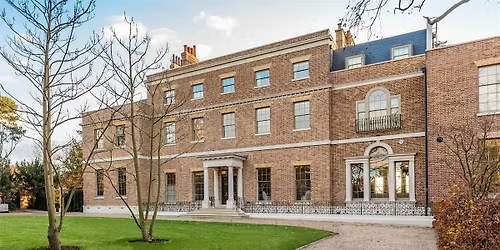
Homerton College | Cambridge, EN
About this Event
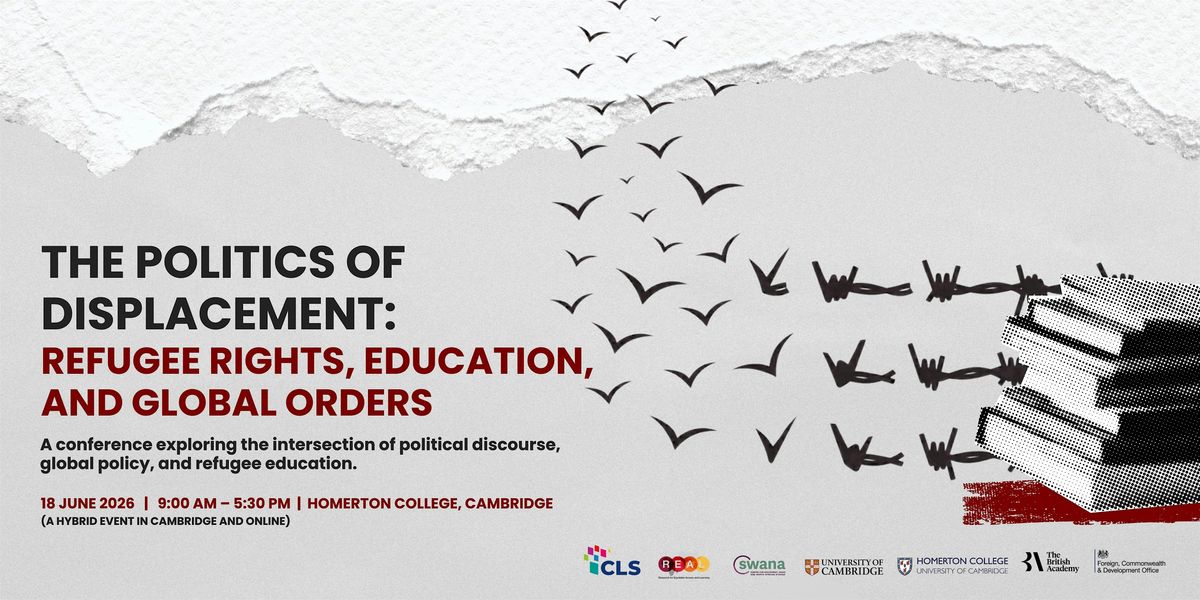
The Centre for Lebanese Studies, in collaboration with REAL Centre, Homerton College, and the Centre for Southwest Asia and North Africa at the University of Cambridge are organising a one-day conference entitled:
Politics of Displacement: Refugee Rights, Education and Global Orders
In person at Homerton College, Cambridge, UK, and online.
Refreshments and lunch provided
This conference emerges from our ongoing research and advocacy on forced migration, with particular attention to the increasingly complex relationship between political discourse, global policy frameworks, and the educational realities of displaced communities. It also builds on the University of Cambridge’s growing engagement with this agenda, particularly in light of its recent recognition as a University of Sanctuary, and its commitment to advancing critical scholarship and public engagement on questions of displacement, asylum, and refugee rights.
The conference is structured around two interrelated components. The first situates refugee issues within a wider political and policy landscape, examining the actors, institutions, and ideologies shaping contemporary debates on migration and displacement. It explores how anti-migrant and anti-refugee discourses—particularly in the UK, Europe, and North America—have increasingly influenced public debate, state policy, and international responses to displacement. Beginning with the UK context, this part of the conference will consider how political narratives around migration have shaped the positions and practices of governments, multilateral agencies, and humanitarian actors, often narrowing the space for rights-based approaches.
The second component turns specifically to the question of refugee education and reflects on the evolution of this field over the past two decades. While education has become a central pillar of humanitarian response, important questions remain regarding who shapes this field, whose interests it serves, and how far policy commitments translate into meaningful educational opportunities for displaced learners.
The conference will examine the growing role of global actors in defining educational priorities and interventions, while also presenting timely research from contexts marked by ongoing war and mass displacement, including Sudan, Tigray, Palestine, Ukraine, Lebanon, and Myanmar.
Although the conference focuses particularly on refugee education, it proceeds from the premise that educational questions cannot be meaningfully separated from the broader political conditions in which displacement is governed. It therefore seeks to foster critical dialogue on the links between political rhetoric, global governance, humanitarian policy, and the lived realities of displaced populations.
The conference responds to several urgent concerns identified through our research and collective discussions:
· Interrogate the relationship between political discourse and refugee policy, with particular attention to how anti-migrant narratives in the UK, Europe, and North America shape both national and global responses to displacement, as well as influence refugee policies and practices in the Global South.
· Critically examine the role of global governance actors in general and more specifically in education - including multilateral agencies, donor governments, and international organisations - in defining refugee education agendas, priorities, and interventions.
· Assess the gap between policy commitments and lived educational realities, drawing on empirical evidence from contexts affected by protracted conflict and displacement, including Sudan, Tigray, Palestine, Ukraine, Lebanon, and Myanmar.
· Foreground questions of power, representation, and voice, exploring the extent to which refugee communities are excluded from policy-making processes and educational decision-making.
· Advance alternative and more equitable and justice-oriented approaches to refugee education, including models that centre participation, contextual relevance, and meaningful educational choice.
· Foster dialogue between academia, policy, and practice, creating a space for critical reflection that informs both scholarship and more just and accountable policy responses.
Where is it happening?
Homerton College, Hills Road, Cambridge, United KingdomEvent Location & Nearby Stays:
GBP 0.00