Panel | Plant–Human–Land Relations

About this Event
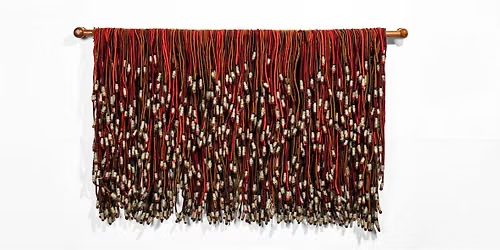
The exhibition showcases new and recent works in sculpture, drawing, printmaking, and video that address humanity’s relationship with nature.
This panel discussion will bring together artistic and scientific perspectives to explore interconnected relations between plants, people, and places. The conversation will touch upon key themes informing the exhibition, including perennial agriculture, prairie ecosystems, plant nomenclature, and environmental activism.
Co-sponsored by the WashU Center for the Environment.
About the Panelists
Lydia Cheshewalla is an Osage ephemeral artist from Oklahoma, living and working in motion throughout the Great Plains ecoregion. Through the creation of site-specific land art and ephemeral installations grounded in Indigenous land stewardship practices and kinship pedagogies, she engages in multivocal conversations about place and relationship. Cheshewalla's work has been shown at Generator Space and the Union for Contemporary Art in Omaha, as well as Comfort Station, Harold Washington Library, the Center for Native Futures, Elmhurst Art Museum, and Brushwood Center in Chicago, among others. She is currently filling the bucket with water to see if it leaks and is often found standing in fields.
Allison Miller is a professor in the Department of Biology at Saint Louis University and a member and principal investigator at the Donald Danforth Plant Science Center in St. Louis. She is also vice president of research at the Danforth Center and is a research associate at the Missouri Botanical Garden. Since September 2021 she has served as the director for the New Roots for Restoration Biology Integration Institute, a five-year, $12.5 million initiative funded by the National Science Foundation. Miller's research program focuses on understanding evolution and plasticity in perennial (long-lived) crops and emerging perennial herbaceous crop candidate species. The long-term goals of her work are to improve existing perennial crops and to develop new ones that provide viable products and ecological services that underpin sustainable agricultural systems. Ongoing projects focus on grapevines, perennial, herbaceous grasses, legumes, and sunflower relatives. Originally from the Chicago area, Miller became passionate about plants through trips to nearby prairie patches and summer vacations in northern Wisconsin. She earned BS and MS degrees in botany from Miami University in Oxford, Ohio and Colorado State University respectively, and holds a PhD in Ecology, Evolution, and Population Biology from Washington University in St. Louis. She completed postdoctoral training at the University of Colorado. Miller lives in St. Louis with her husband and two children.
Carmen Ulloa was born and raised in Ecuador. She obtained her Ph.D. at the University of Aarhus in Denmark and moved to St. Louis over 30 years ago. She is a curator and research scientist at the Missouri Botanical Garden. Ulloa's research focuses on plants of the Andes mountains. She has discovered and described various plant species new to science and published several scientific papers and authored books. She serves as main editor of the Flora Mesoamericana, a major endeavor describing all the plants from southern Mexico to Panama.
About the Moderator
Meredith Malone is the Nancy and Kenneth Kranzberg Curator and senior curator at the Kemper Art Museum at Washington University in St. Louis. She is a specialist in post–World War II art practices in Europe and the United States, and in global contemporary art. Major thematic exhibitions she has curated include Seeds: Containers of a World to Come (2025), Multiplied: Edition MAT and the Transformable Work of Art, 1959–1965 (2020), and To See Without Being: Contemporary Art and Drone Warfare (2016). Malone has also curated recent monographic exhibitions on the work of Carolina Caycedo, Adam Pendleton, Kahlil Robert Irving, Torkwase Dyson, Nicole Miller, and Chitra Ganesh. The exhibition catalog for Adam Pendleton: To Divide By won best monograph of 2024 by the Midwest Art History Society. Malone earned her PhD in art history from the University of Pennsylvania.
Where is it happening?
Event Location & Nearby Stays:
USD 0.00