Oliviero Draghi: WILDFIRES
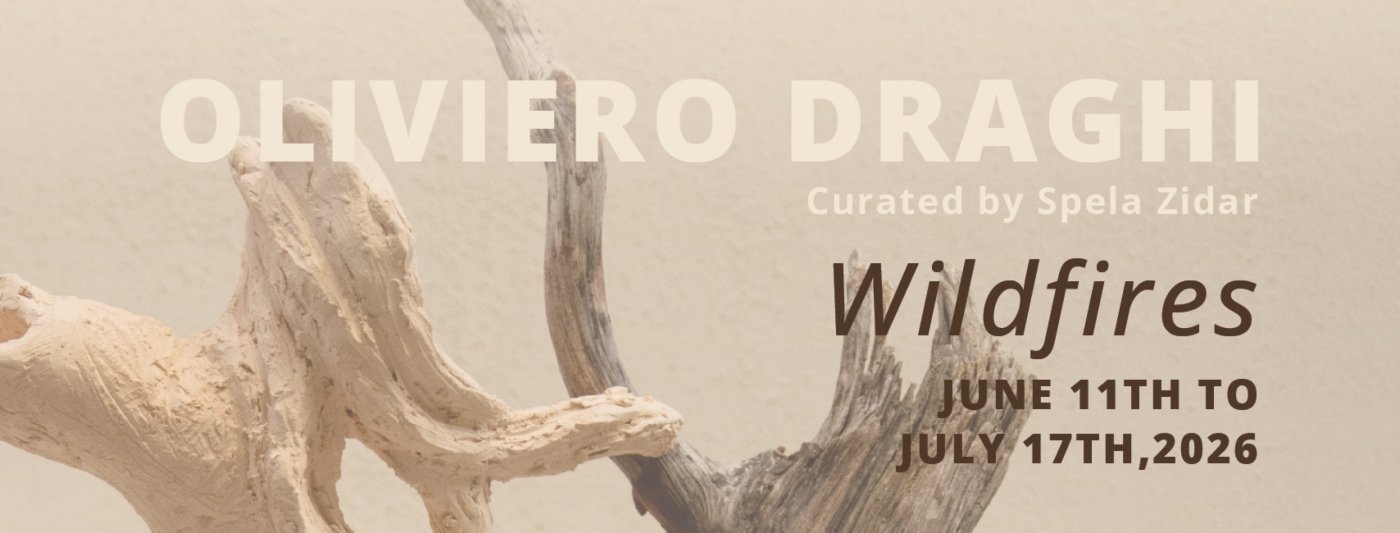
OLIVIERO DRAGHI
WILDFIRES
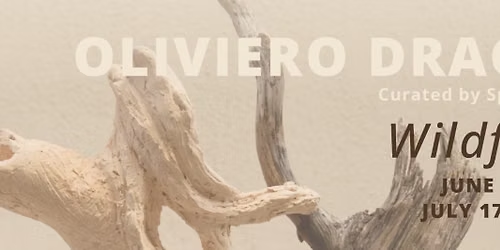
LdM Gallery is pleased to present the exhibition Wildfires by the sculptor Oliviero Draghi. Draghi's work draws inspiration from family and personal experiences, developing sculptures in a variety of styles and materials, with a keen eye for tradition.
Inspiration typically ignites through close contact with family, colleagues, and friends, as if a small spark was ignited from a safe place, catching a fire that grows, spreads, and takes shape beyond this familiar context. This creative approach is also captured in the title of the exhibition, Wildfires, the blazes that arise and grow, and which, even if the artist cannot be completely sure of their direction, must be tamed, shaped, and supported before reaching destructive force. The forms and ideas generated during these encounters are then crafted by Draghi using various materials: clay, plaster, wood, and bronze. The artist often uses different materials, giving the sensation of a wound in need of repair, but at the same time of an opening that allows the growth and development of the subject or the relationship with it.
Spela Zidar: Could you tell us about your studies and your beginnings as an artist?
Oliviero Draghi: I began my studies at the Art High School in Florence, years I remember with great enthusiasm and during which I immediately discovered my passion for sculpture.
I then moved to my beloved London to attend the Foundation Year in 3D Design at Chelsea College of Art & Design. I was deeply attracted by the multiculturalism and liveliness of the English capital. It was an intense and formative year, which allowed me to experience a teaching method very different from the Italian one, characterized by a freer and more spontaneous creativity.
Just before starting my second year in England, however, I couldn't resist the urge to return to Italy to see my old friends and family. So I took a sabbatical year from my studies and worked in the Tuscan countryside. It was during this period that I developed a great passion for plants and gardening. That same year, I also attended a videomaking course. I still preserve a lot of material from those years that I would like to reuse someday.
I subsequently began my studies at the Academy of Fine Arts in Florence, in the School of Sculpture. I felt a desire to delve deeper into what had seemed most familiar to me from the beginning.
Among the most engaging experiences of those years was my collaboration with a sculptor Igor Mitoraj on the creation of several monumental works for the set design of Manon Lescaut for the Puccini Festival. These were two very intense months, which allowed me to explore a monumental dimension and a fast-paced, collaborative work environment. After that I worked in the scenery installation for the fashion industry for several years, an experience that taught me to harness creativity through a variety of materials and solutions, broadening my way of thinking and approaching work.
I concluded my studies with a thesis in Land Art, to which I am still very attached. For four months, I worked in a forest, building, using only locally collected stones, Hortus Conclusus: a wall about 1.6 meters high enclosing a four-meter square of forest. In front of the entrance stood an oak tree that hides and protects it. My fortress, my garden in the woods.
I then began teaching drawing and sculpture at universities in Italy and abroad. During those same years, I devoted much of my time to my daughter Delia and played with her a lot. During this period, I created one of the first important series of my research, Warriors: small bronze soldiers, essential and dynamic, inspired by my childhood memories of playing instantly with toy soldiers of all kinds.
In 2012, together with some friends, I founded the art space and cultural association Campucc10 in the Oltrarno district of Florence, an experience that is still active and particularly important from a personal and professional perspective.
SZ: Is being an artist more of a vocation or a profession for you? How do you balance your artistic pursuits?
OD: I think the two aspects are intertwined, I believe it is for many, but perhaps even more so for me.
I really enjoy working with my hands and feel the need to channel my energies and let them flow further: drawing, working in the garden, cooking, modeling, building and modifying furniture. This, in my artistic work but also more generally, is strengthened and nourished through exchanges with the people close to me and who share parts of my life with me.
The more concrete dimension of my profession helps me give continuity and life to this process. Furthermore, having a gallery open to the public and having to be present daily offers me immediate feedback and exchange with the outside world, keeping my work alive and in motion.
SZ: What is your primary medium?
OD: I work mainly with clay and draw a lot, especially in small notebooks I carry with me. Drawing is quick and light, a way to observe, note, and capture whatever catches my attention.
Clay is a material I feel very close to. It allows me to work in very different ways and, almost like drawing, it's silent, allowing me to listen to the radio and what's happening around me while I work.
I use only natural clay, never plasticine or similar. I also really like the final result. For example, terracotta, with its natural and sometimes unpredictable patina, which varies from orange to whitish and allows the overlapping of different marks to shine through: fingertips, tools, and traces of the working process.
SZ: Your work unites the classical and modern. Where do you draw your inspiration from?
OD: Florence is a city that's hard not to engage with artistically. Inevitably, somehow, traces of its past have entered me, and they're still there. For example, I still feel the delicateness of the faces of Desiderio da Settignano and some of the Della Robbia’s.
Just like the archaeological finds transformed by time, or the 15th-century terracotta Madonnas that haven't been extensively restored: I feel them real, they almost breathe.
I absolutely love the hands, noses, mouths, skin, trees, and animals of people and things around me. I'm thrilled to try to create these forms with my fingers and see how close I can get to the exact form.
SZ: Who is the main audience you want to reach with your art?
OD: I don't seek a particular audience. I feel rather horizontal in this regard. I'm interested in anyone who wants to engage with my work and recognize something alive or true in it. Just anyone really.
Having my studio-gallery overlooking the street has taught me a lot. People come in looking for art and people who aren't looking for it at all. There are attentive, curious, distracted, sometimes even ironic or amused glances. That all interests me. The works, once they leave the studio, encounter different people, and everyone experiences them in their own way.
SZ: You also work as a teacher, collaborating with various schools and special projects. How important is this activity to you, and how much do you integrate it into your creative journey?
OD: Explaining the simple, elementary things of making a drawing or sculpture, taking a piece of clay and starting to model, taking a sheet of paper and drawing in front of or next to the students, becomes an exercise for me too. It helps me to retrace steps and look at things with different eyes each time, to keep learning. It has certainly helped me approach drawing, which was initially a more difficult medium for me.
Working on the design of the works and stimulating the students' creativity helps me seek different solutions and see things from new perspectives.
During the lessons, I've made copies of sculptures and sketches of views of Florence, things I probably wouldn't have done for my own work, but which have become important as exercise, study, and a source of inspiration.
With the inmates, I'm building a series of quick portraits over time, done with them and alongside them. The same happens with the other students. When possible, I develop a series of portraits that are a mix of two or more people.
SZ: Is there a project you're particularly proud of/that you particularly enjoy?
OD: I find it difficult to choose a favorite project. All the works I create span important periods in my life and end up being linked to particular people, places, or experiences. I can't choose.
Among those I haven't yet mentioned, I would like to mention Heads, inspired by the energy and vitality of my daughter Delia. The project then expanded to include portraits of people, animals, and particularly significant moments in life.
Florentines took shape after my father's death. It doesn't directly represent that loss, but rather revolves around it, through the faces of friends and peers who, like me, grew up in Florence.
Pieces developed from a tension between materials I already felt familiar with and others I longed to experiment with, and from an exploration of the feminine world. This dialogue then became increasingly intertwined with the presence of my current partner, until she became a central part of it.
My Summer Remnants, my most recent project, collects fragments of a seaside place I return to every year and to which many of my family memories are linked. It was born from the encounter between the materials, the memories accumulated over time, and my partner's creative impulse. This latest project reflects a desire to combine the familiar with the new through a more instinctive process.
Where is it happening?
Event Location & Nearby Stays: