Lunch & Learn: Trauma, Language & Reclaiming the Self

About this Event
What if some of the behaviors we call symptoms are actually survival strategies that have outlived the conditions that created them?
A garden does not become overgrown overnight.
What appears above the surface is connected to roots, soil, environment, seasons, and everything that has happened before.
Trauma can work the same way.
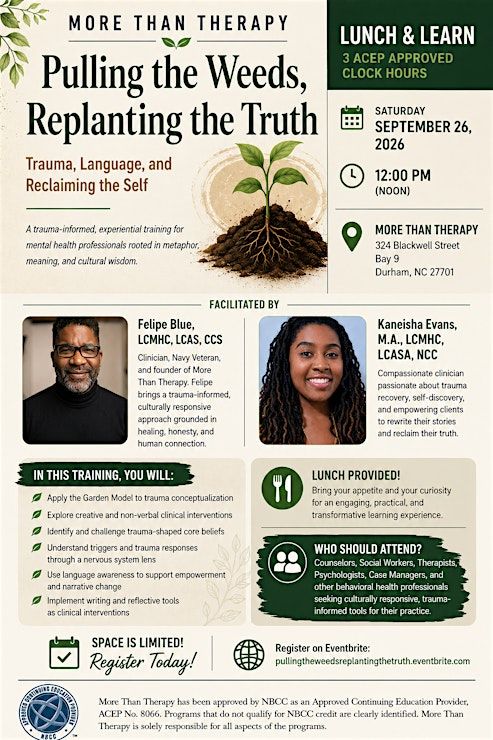
In Pulling the Weeds, Replanting the Truth, participants will learn to use the Garden Model as an accessible metaphor for understanding trauma. Roots represent formative experiences and wounds; soil represents the nervous system, attachment, and relational conditions; weeds represent survival strategies; and new growth represents healing, reclaimed truth, and a restored sense of self. The model is designed to help externalize distress, reduce shame, and create space for growth without bypassing pain.
Rather than viewing trauma responses simply as pathology, this training invites clinicians to understand them through the lens of adaptation and survival. Strategies that may now create distress or disconnection may once have helped a person remain safe. Recognizing that distinction can shift clinical work away from judgment and toward compassionate, intentional change.
This is not designed to be a passive, sit-and-listen training.
Participants will engage in small-group discussions, clinical case mapping, reflective writing, dyad exercises, exploration of creative interventions, nervous-system mapping, language-reframing activities, and clinician self-reflection. The presentation includes eight breakout experiences throughout the training.
What You'll Learn
By the conclusion of this training, participants will be able to:
- Apply metaphor-based approaches, including the Garden Model, to the conceptualization of trauma.
- Integrate creative and non-verbal processing techniques into clinical practice.
- Identify trauma-shaped core beliefs and inherited narratives that influence clients' understanding of themselves, others, and the world.
- Differentiate triggers from trauma responses through a nervous-system-informed lens.
- Use language awareness to support empowerment and narrative change.
- Implement therapeutic writing and reflective assignments as clinical interventions.
Topics We'll Explore
The training moves through seven interconnected areas of clinical practice:
The Garden Model & Trauma Conceptualization
Learn to conceptualize roots, soil, weeds, survival strategies, and possibilities for new growth while helping clients understand the difference between what helped them survive then and what supports functioning now.
Beyond Talk Therapy
Explore creative approaches including visual art, music and rhythm, storytelling, symbols, objects, and other forms of indirect processing that can provide alternative pathways into therapeutic work.
Meaning-Making & Core Beliefs
Move beyond the event itself to explore the meanings and beliefs clients developed from their experiences, including beliefs about self, others, safety, belonging, and the world.
Writing as a Clinical Tool
Explore reflective writing, narrative rewriting, and unsent letters while considering pacing, containment, informed consent, and emotional safety.
Triggers & the Nervous System
Develop greater precision around the language of triggering, conditioned threat responses, nervous-system states, grounding, orienting, self-talk, and co-regulation.
Language, Narrative & Reclaiming the Self
Examine totalizing language, identity fusion, inherited narratives, and the internalized voices that influence how clients describe themselves. Participants will practice helping clients develop more accurate and compassionate narratives without minimizing painful experiences or resorting to forced positivity.
Ubuntu & Culturally Responsive Healing
Consider trauma and recovery within relational, communal, cultural, and systemic contexts. The training incorporates Ubuntu alongside Afrocentric healing perspectives involving ancestral memory, oral tradition, communal ritual, creativity, and collective witnessing.
This Training Is Designed For
This experience may be especially valuable for:
- Licensed professional counselors and clinical mental health counselors
- Clinical social workers
- Marriage and family therapists
- Addiction professionals
- Psychologists
- Behavioral health professionals
- Clinical supervisors
- Graduate-level counseling and helping professionals
- Clinicians working with trauma, grief, attachment wounds, identity concerns, or complex life experiences
- Professionals seeking culturally responsive and experiential approaches to trauma-informed care
This Is More Than a Training
Participants will also be invited to consider the clinician's own garden.
Trauma work asks something of the people who witness it. The training therefore addresses vicarious trauma, secondary traumatic stress, compassion fatigue, supervision, community, rest, creativity, and clinician sustainability.
The goal is not simply to leave with more information.
The goal is to leave asking:
What will I do differently with the person sitting across from me tomorrow?
The closing reflection specifically asks participants to identify one thing from the training that could change, even slightly, how they sit with a client in their next session.
Pulling the Weeds, Replanting the Truth invites clinicians to acknowledge the roots, understand the weeds, tend the soil, and create conditions where something new can grow.
Because healing does not happen in isolation.
I am because we are. — Ubuntu
Where is it happening?
Event Location & Nearby Stays:
USD 0.00