István Muzslay SJ and the Mission of the Central European Research Institute in Leuven
Schedule
Tue, 02 Jun, 2026 at 06:30 pm
UTC+02:00Location
Blijde Inkomstraat, 3000 Leuven, Belgium | Leuven, BU

Advertisement
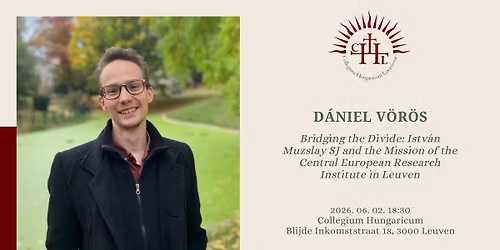
Join us for a public lecture exploring the history of our institution and the influential work of Fr. István Muzslay SJ, a Hungarian Jesuit priest, in Belgium. The lecture will be presented by Dáneil Vörös, the director of our college, who is a doctoral candidate at both Pázmány Péter Catholic University and KU Leuven.🎟️Free entry | Registration required: https://forms.gle/M4CZJnwkBoTTRvvUA
More About the Event:
"In my lecture, I focus on the activities of István Muzslay SJ (1923–2007) in Leuven, specifically the Institut de Recherches de l’Europe Centrale, which he founded in 1962. As the director of the Home Cardinal Mindszenty student residence—a prototype for later Hungarian Jesuit colleges (szakkollégium)—Muzslay established the Institute within the sphere of influence of the Catholic University of Leuven, and subsequently as an integral part of it. The institute aimed to provide scholarly information on the political, economic, religious, and cultural challenges and opportunities of Central European countries, filling a gap within the Western Cold War context. Its unique interdisciplinary character was partly derived from Muzslay’s approach of involving students from diverse academic backgrounds living at the student residence in research and editorial work, offering them paid employment and publication opportunities. To realise its objectives, the Institute published a journal titled Documentation sur l’Europe Centrale (DEC) starting in 1963, initially as a bimonthly and later as a quarterly periodical. The journal spanned 20 volumes until 1982 and played a role in the Western dissemination of knowledge about Central Europe. Despite its significance, neither the Institute nor the DEC has been the subject of comprehensive historical research to date. Drawing on archival materials and memoirs, my presentation examines the factors and actors that led to the establishment of the Institute; defines its operational profile (objectives, target audience, and funding); and analyses the channels and extent to which it reached its Western audience. I interpret the Institute and the DEC within the theoretical framework of East-West knowledge transfer, viewing the "Iron Curtain" as a semi-permeable membrane that allowed for the selective flow of certain agents, information, and products between the Eastern and Western blocs. My lecture situates the Institute and its journal within this system of semi-permeable knowledge transfer."
Advertisement
Where is it happening?
Blijde Inkomstraat, 3000 Leuven, Belgium, Blijde-Inkomststraat 68, 3000 Leuven, België, Leuven, BelgiumEvent Location & Nearby Stays:

Know what’s Happening Next — before everyone else does.