Good Muslim, Bad Muslim

About this Event
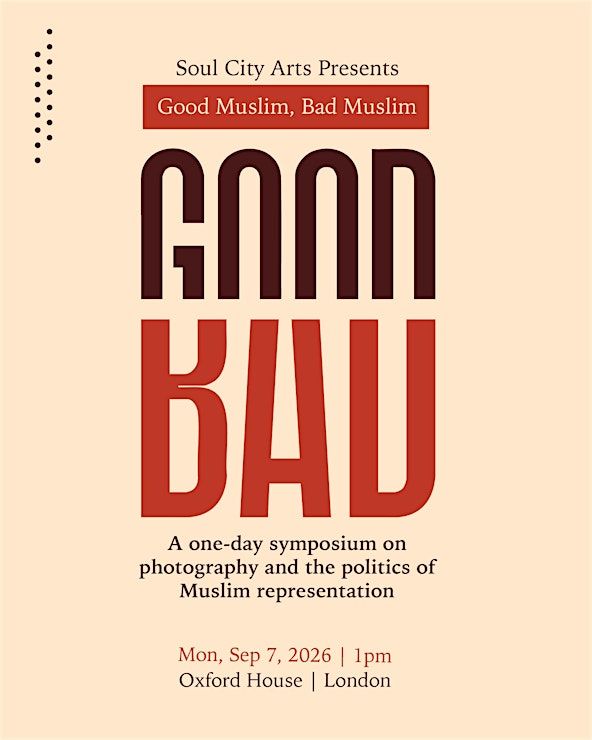
Soul City Arts invites you to attend Good Muslim, Bad Muslim, a one-day photography symposium led by Mohammed Ali Aerosol with the support of Dr. James Hodkinson and curated by Mohamed Somji.
Why the symposium:
Muslims in the West are perpetually summoned to appear: to be counted, included, diversified, made legible. This symposium begins by asking what the demand for representation itself costs. Whether the framing comes from outside or from within, the frameworks through which Muslim experience is rendered visible tend to flatten more than they reveal. The “acceptable” Muslim is curated for comfort; the box is ticked; the image is sanitised; the complexity is lost.
A critical conversation:
Bringing together artists, curators, and academics working against these conditions, the symposium treats photography as a site of refusal and reimagination, a medium uniquely placed to disrupt commercial templates, social media flatness, and the prescriptive norms that have come to stand in for Muslim life. Authenticity cannot be commissioned or institutionally sanctioned. It emerges from individual experience, lived contradiction, and the artist’s insistence on questioning the very paradigms through which they are asked to be seen.
Agenda
🕑: 12:45 PM - 01:15 PM
Arrivals and registration, networking and refreshments
🕑: 01:20 PM - 01:30 PM
Soul City Arts introduction
Info: Mohammed Ali of Soul City Arts introduces the session and the motivations behind programming the symposium. He will be joined via live-video link by Dr. James Hodkinson of the University of Warwick.
🕑: 01:35 PM - 02:05 PM
Finding the Good Muslim - Asim Rafiqui
Host: Asim Rafiqui
Info: In this opening keynote, Asim Rafiqui interrogates the figure of the "good Muslim" as constructed by Western media and photojournalism: the integrated, apolitical, individualised subject whose visibility depends on silence about empire, occupation, and the imperial geographies from which Muslim communities so often emerge.
Drawing on more than two decades of work as a photographer and writer across South Asia, the Middle East, and beyond, Rafiqui examines how photography and journalism collaborate in this construction — selecting visible markers of "Muslimness," excising history and politics, and offering up "trajectories of integration" that are equally trajectories of disappearance. The talk sets the terms for the symposium's wider interrogation of who gets to appear, on whose terms, and at what cost.
🕑: 02:10 PM - 02:40 PM
New Western Views - Marwan Bassiouni
Host: Marwan Bassiouni
Info: Since 2018, Marwan Bassiouni has been photographing landscapes from inside mosques across the Netherlands, the UK, Switzerland, Canada and the USA, each image holding a mosque's interior and the world beyond its window in a single frame. The mosques themselves are never generic: each has taken on the architectural character of the country that houses it, a national expression of Muslim identity distinct to each place. Paired with the landscape beyond, architecture and place together sketch a quiet portrait of coexistence: Muslim presence as simply part of the national fabric.
The project sits close to this symposium's own question: what does representation look like once it stops working to persuade, and starts simply describing a world that already exists? Each viewer brings their own reflection to what they see. There is no spectacle here, no case being made, only a different way of seeing that was always available.
🕑: 02:45 PM - 03:25 PM
Thread and Trace - Nilupa Yasmin and Miriam Ali, moderated by Dr.Fatima Rajina
Host: Nilupa Yasmin
Info: A prayer rug worn soft by a grandfather's decades of use. A mother's wedding saree, unpicked and rewoven into a photographic self-portrait. Miriam Ali (Where You Once Prayed for Me) and Nilupa Yasmin (Grow Me a Waterlily) both work with inherited textiles and prayer rugs, not photographed at a distance but handled, worn and rewoven into their images, as archives of faith and family that resist the spectacle so often demanded of Muslim image-making. Fatima Rajina, whose research traces how dress and material culture carry migration, memory and religious identity across generations, moderates the conversation. Between them, the two artists consider what it means to make work from inside devotion rather than about it, where the object outlives the person who wore it into meaning.
🕑: 03:25 PM - 03:35 PM
Break
🕑: 03:35 PM - 04:15 PM
In Conversation with Mahtab Hussain
Host: Mahtab Hussain
Info: Since 2008, Mahtab Hussain has spent nearly two decades photographing British Muslim communities, from the young working-class men of You Get Me?, marked by media generalisation and the search for identity amid what he calls male redundancy, to What Did You Want To See?, his 2025 exhibition at Ikon Gallery which turned the camera back on Britain's own surveillance apparatus, incorporating discoloured tarmac from Birmingham's removed Project Champion CCTV cameras and 160 photographs of the city's mosques.
His ongoing project Muslims in America extends this inquiry across the Atlantic, tracing a generation who, he says, no longer wish to be invisible to survive. In conversation with Mohamed Somji, Hussain discusses a practice built on being watched and watching back: what it means to photograph a community that has spent decades being surveilled, generalised and framed by others, and what changes when the camera is turned around.
🕑: 04:20 PM - 05:00 PM
The Case for Opacity with Shaista Chishty
Host: Shaista Chishty
Info: Social media is often celebrated as a means for negatively racialised groups to challenge stereotypes, while anti-racism discourse increasingly assumes that representational visibility equates to political power. Chishty questions that assumption. Drawing on her work as photographer & researcher, she argues that visibility is a trap: rather than recognition & freedom, it exposes Muslims to increased surveillance, scrutiny & control, often reinforcing the very good Muslim, bad Muslim binary it claims to resist.
Tracing a line from the camera's historical use as a technology of state surveillance to its present-day use by marginalised people themselves, she argues that to be seen is to be made knowable, governable & docile. Against this, Chishty turns to Édouard Glissant's demand for the right to opacity, the right to be unknown & a refusal of legibility, as a radical alternative: not visibility but opacity as political act, a powerful form of resistance to surveillance and Islamophobia.
🕑: 05:05 PM - 05:25 PM
Break/Asr Prayer
🕑: 05:30 PM - 06:20 PM
Commissioning, Curating, Refusing: The Work Behind the Image - Panel
Host: Rehan Jamil
Info: Behind every image of Muslim life that reaches an audience sits a chain of decisions: what gets pitched, what gets commissioned, what gets edited out, what gets exhibited, and what gets refused. This panel brings together practitioners, curators, programmers and producers who have spent their careers working inside and across that chain to ask what it takes to make and place this work honestly. How do you commission against the grain? What does a critical curatorial practice look like when the institution itself is part of the problem? When is walking away the right answer?
Drawing on bodies of work and direct experience of the infrastructures that shape Muslim representation in Britain, the panel moves past diagnosis and asks instead what's actually being done in response, and what more needs to be done.
🕑: 06:25 PM - 07:05 PM
What We Don't Say - Closed-Door Listening Circle
Info: Ahead of the symposium, practitioners were invited to submit a short, anonymous reflection on a single question: a tension in their own work they haven't resolved, a moment they changed or softened it knowing who might see it. A curated sequence of these testimonies is read aloud, without interruption, followed by small-group conversations where attendees can respond directly to what they've heard, question it, or sit with disagreement, rather than a single debate playing out across the whole room. This session runs under closed-door terms: no recording, no attribution, no press, in keeping with the symposium's argument that the pressure shaping Muslim representation is often internalised long before any institution or audience ever sees the work.
🕑: 07:10 PM - 07:25 PM
Closing Remarks - Professor Mahmood Mamdani
Host: Professor Mahmood Mamdani
Info: A short closing reflection via videolink, from the author of Good Muslim, Bad Muslim, on the ideas the symposium takes its name from. He is well known as the father of the current mayor of New York.
Where is it happening?
Event Location & Nearby Stays:
GBP 11.55