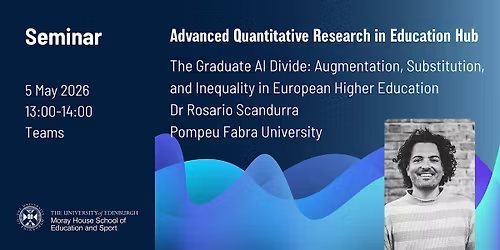
AQRiE Online Seminar: The Graduate AI Divide
Schedule
Tue May 05 2026 at 01:00 pm to 02:00 pm
UTC+01:00Location
Moray House School of Education and Sport, University of Edinburgh | Edinburgh, SC

About this Event
Abstract: Higher education is considered the primary “lifetime assurance” against labour market disruptions under current increasing automation. Graduates undertake complex, non-routine cognitive tasks that AI cannot easily replicate, positioning them to benefit marginally from technological advancements rather than be displaced. This paper challenges that perspective by demonstrating that the capacity of the tertiary-educated workforce to be augmented—rather than replaced—by AI is unevenly distributed, heavily influenced by social determinants and occupational stratification. Augmentation occurs when AI tools enhance worker productivity by automating routine aspects of tasks while preserving higher-level human judgment. Conversely, substitution appears when AI replaces the core cognitive elements of a job. The specific outcome depends not only on formal qualifications but also on how workers apply their skills, the flexibility of their tasks and digital integration in the workplace. I use the OECD-PIAAC 2023 dataset, linked to country-level AI adoption indicators, and this study develops the first individual-level measure of the likelihood of augmentation among graduates in 14 European countries. The findings reveal that, despite holding identical degrees, STEM graduates employed in large urban firms are considerably more likely to view AI as a tool for augmentation, whereas humanities graduates in smaller, peripheral companies face a heightened risk of being replaced. Country-level differences and AI governance frameworks influence this divide; however, they do not eliminate it tout court. Core Europe market economies demonstrate lower levels of inequality, yet a large portion of intra-country variation remains unexplained. This underscores the influence of regional labour market structures, employer ecosystems, and university-industry networks in shaping graduate experiences. This study offers pioneering cross-national evidence of an AI-related divide among European graduates, bearing significant implications for higher education and labour market policy.
Speaker: Dr Rosario Scandurra is a quantitative sociologist studying the links between inequality, education, skills formation and transitions to the labour market. He currently holds a Ramón y Cajal Senior Researcher position at the Barcelona School of Management, Pompeu Fabra University and he is affiliated with the Globalisation, Education and Social Policies (GEPS) centre and the Global Studies research group at Universidade Aberta in Lisbon. He has participated in more than 20 international projects and authored 48 peer-reviewed articles.
The email address to contact in case of enquiries: [email protected].
This seminar will be held in online format; access details will be sent after registration.
Please read our Privacy Statement at the bottom of this page.
Where is it happening?
Moray House School of Education and Sport, University of Edinburgh, Holyrood Road, Edinburgh, United KingdomEvent Location & Nearby Stays:
USD 0.00