The Merits of Matriarchy plus Reflections of Our Environment

About this Event
Come along for two talks, some discussion, a bite to eat and social drinks.... Everyone is invited to bring an item of food to put on the table, eat what they like and help take away what they like at the end so nothing goes to waste.
The next event is a double bill which starts at 7pm and ends at 9.30pm; you are welcome to come and go as you please...
The Merits of Matriarchy by Simon Byrom
In 2012 I visited what is claimed to be the oldest and last surviving matriarchal community in China, when cycling across the country, in a region famed for the mythical land of Shangri-la, where it is said Heaven exists on Earth. I had never previously considered the notion of a matriarchal community and only happened upon the place by chance, when journeying across Yunnan province, in the south west of the country.
In all, I only stayed a few days, but my visit left such an impression, subsequently consolidated through hours of research, that I can confidently state this insight has fundamentally changed my world view. Having come to the realisation that until this encounter all my life had been experienced through the prism of Patriarchy, with a HIStory extending back thousands of years, I now consider a matriarchal perspective to be so important as to be crucial to the evolution of Humankind!
For more information on the talk please visit:
https://raggeduniversity.co.uk/2026/06/15/21st-july-2026-the-merits-of-matriarchy-by-simon-byrom/
- and after a short break -
Exploring Education as Human Development – Reflections of Our Environment and Social Exclusion by Alex Dunedin
I plan on doing a presentation around 40 minutes long followed by a discussion with those in the room. As a researcher I am interested in what constitutes ‘Human Development’; what I mean by that is that I am interested in understanding all the things which are necessarily involved in individuals thriving and living healthy, happy lives. To do this we have to think not only of the material needs of people but also the sociological – those things which come by way of the social environment through relationships, shared activities and our ‘habitat’.
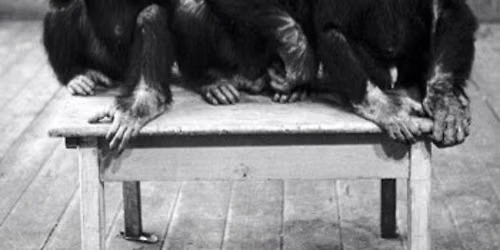
As a starting point of approaching this research I use the fact that we are a species of great ape to take a step back and view our needs through a more detached lens. By thinking about the environmental needs of human beings from a zoological point of view it lends an imaginative step to creating a list of aspects required for the health and wellbeing of people – you, me, everyone.
Thus my research started by looking at the advances in understandings necessary to keep various species alive and healthy in zoos. This is not about anthropomorphising other species but more, picking up on what Prof DeWaal highlights as a sort of denial of sentience in other species. Humans co-evolved with the living natural world for millions of years and in this presentation I will demonstrate how alienation from it produces stress and illness.
Developing holistic understandings of human development and wellbeing requires realising the importance of participation in meaningful activities, mutually recognitive relationships, opportunity to exercise choice and connection with varying communities of peers (amongst other things). Beyond the need for food, heat, shelter and rudimentary material needs lie many non material realities which are hard to measure but are noticeable in their absence through failures of mental and physical health.
I set this discussion inside the context of a natural habitat against the backdrop of political economies which are producing artificial scarcities in a range of contexts. I look at how finance and investment behaviours are producing a narrowing and homogenisation of many things including choice. This homogenisation is showing itself in forms of desertification of variety demonstrable by looking at dietary staples, biodiversity loss, erosion of culture and diminishing of wellbeing.
I illustrate this through the case study of Prof Jean Ziegler who through his work as the UN special rapporteur on the Human Right to Food illustrated how famine is structurally and deliberately brought about. My research is focused on what constitutes the differences between ‘environment’ and ‘habitat’ looking to auditing the habitat for any absences.
All this work looks towards not just the causes of disease but also what Harry Burns discusses as ‘salutogenesis’ – the study of the origins of health and focuses on factors that support human health and well-being.
For more information on the talk please visit:
https://raggeduniversity.co.uk/2026/06/15/21st-july-2026-exploring-education-as-human-development-reflections-of-our-environment-and-social-exclusion-by-alex-dunedin/
All are welcome; everyone is also welcome to do a talk, just get in touch and fill in a speakers information sheet and the rest can be organised. It is a chance to share and learn from the room.
Click here to Join Edinburgh Ragged University Meetup and receive advanced notifications on future events
Where is it happening?
Event Location & Nearby Stays:
USD 0.00