Resilient Roots: Boulder County’s Latine & Chicano History

About this Event
Boulder County Parks & Open Space is developing a historic context to document the histories, places, and experiences of Latine and Chicano communities across Boulder County. This presentation will share what we have learned through community engagement, oral histories, and archival research, highlight some of the stories and places emerging from the project, and discuss where the work is headed next. Attendees will also be invited to share feedback, stories, and connections that can help shape the final project.
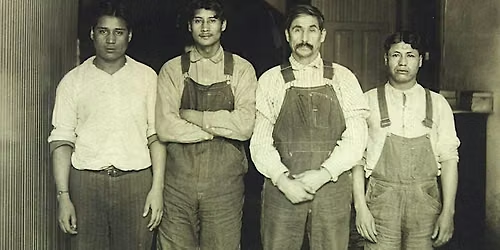
Photograph of Francisco Diaz and his three sons. Photo courtesy of the Carnegie Library for Local History, Boulder.
Photo, left to right: Jose, Juan, Francisco, and Manuel Diaz.
Photograph History: On 15 April 1911, Teddy J. Wycherley, a striking coal miner in Lafayette, Colorado, engaged in a fight with the Diaz men, non-union miners employed at the Capitol mine. During the fight, Wycherley was stabbed and died. Juan Diaz was shot in the stomach. The Diaz men were captured and held in the Lafayette J*il which was surrounded by "250 striking miners and a large number of women" when the Boulder County Sheriff Martin P. Capp arrived. A half hour later, the mob had increased to 500 people, and more than half of them were armed. Capp made an eloquent plea to the crowd, and was credited with preventing a lynching.
On 19 October 1911, the case was dismissed and all of the men were released. The Boulder Tribune wrote: "The action of the court and District Attorney meets with universal approval. As witness after witness testified for the state, it became clearer with each witness that the Mexicans had acted in self defense and that Juan Diaz, who was shot clean through his body by Wycherly, was fully justified in killing his assailant."
Where is it happening?
Event Location & Nearby Stays:
USD 0.00