Proportional to the Mischief | An Evening with Nicholas Rostow

About this Event
🎟 This event is FREE and open to the public and books will be available for purchase the night of the event! An RSVP grants general entry, but seating is not guaranteed, so please try and show up early. Please RSVP only if you intend to join us. Can't make the event? Buy your copy here.
About The Book
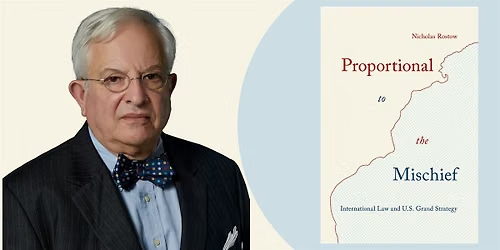
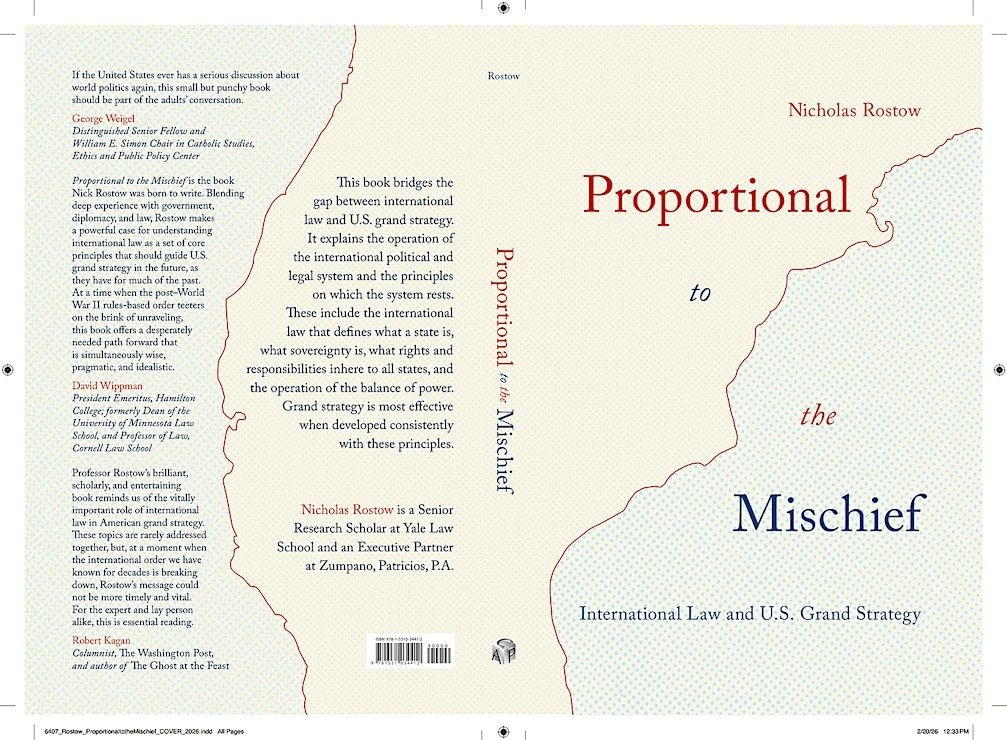
The book is an argument for considering international law and U.S. grand strategy together.
- Not usually done. Disciplines don’t talk to each other
- The book also is an argument for process—the Eisenhower example of the Solarium exercise in developing a grand strategy for dealing with the Soviet Union provides an example
- Despite the fact that the current administration seems oblivious to the book’s subject and analysis—and it is not the first such administration—the book may even be timely.
The book makes the following points in six chapters, an introduction and conclusion.
1. The international system of states is a system and includes the balance of power as a legal principle understood as the obligation to accept limits on state actions.
2. Over the course of World War I, Woodrow Wilson came to the conclusion that respect for international law was an American national interest. The bloodbaths of the two World Wars led first to the League of Nations and then to the United Nations as global organizations dedicated to the defense of public law: a standing committee of states to enforce the most fundamental rule of international politics without relying on the ad hoc reality of the balance of power and the nineteenth century Concert of Europe.
3. International law gave a great deal of coherence to U.S. grand strategy in the Cold War. In important respects, the ideological battle between the Communist/Socialist and western democratic worlds involved warring conceptions of international law.
4. The post-Cold War period has seen a U.S. grand strategy, if it existed, tethered only erratically to the legal core of the Cold War grand strategy.
5. The most important principles of international law are the prohibition on the international threat or use of force except in individual or collective self-defense. They are not recipes for perpetual war for perpetual peace. Rather they are the foundation of international law, order, and peace. They should form the large ends of U.S. grand strategy securing “the Blessings of Liberty to ourselves and our Posterity.” A world governed according to the Athenian view expressed in Thucydides’ Melian Dialogue—"the strong do what they have the power to do take what they want and the weak accept what they have to accept”—serves no people or country.
a. This part of Thucydides is often quoted without the damning riposte of the Melians to the Athenians:
. . . in our view (since you force us to leave justice out of account and to confine ourselves to self-interest)—in our view it is at any rate useful that you should not destroy a principle that is to the general good of all men—namely, that in the case of all who fall into danger there should be such a thing as fair play and just dealing, and that such people should be allowed to use and to profit by arguments that fall short of mathematical accuracy. And this is a principle that affects you as much as anybody, since your own fall would be visited by the most terrible vengeance and would be an example to the world.
6. 9/11 produced actions based on fear, not calculation or respect for law and sound decision-making processes. We still aren’t free of the shadow of that terrible day.
7. Minimum world public order: a goal based on the value of the independence of states and the advancement and protection as possible of human dignity. The requirement is constant effort and expense. Only way to maintain relative peace and advance human dignity.
8. Grotius: “All things are uncertain the moment men depart from law”
9. International law is not a panacea, but it can help the United States figure out what international interests are important and how to advance them. When it deviates from domestic and international law and ignores sound decision-making processes, it almost always gets into trouble and has to go back to the law the way a drowning person grabs a life-saver or a sailor looks for a compass.
Conclusion
The book concludes with some thoughts about what we might do now to build a consensus around our national grand strategy. To do that, requires disciplined thought and process according to law.
About The Author
Nicholas Rostow is Executive Partner with the firm of Zumpano, Patricios PLLC in Coral Gables, FL, and New York, NY. He also is a Senior Research Scholar at the Yale Law School and fellow of the Institute for Security, Technology, and Society at Dartmouth College.
Previously, Mr. Rostow served as: a visiting professor at the Cornell Law School, the Charles Evans Hughes Visiting Professor of Government and Jurisprudence at Colgate University, the Sol M. Linowitz Visiting Professor of International Relations at Hamilton College, University Professor and Senior Director, Center for Strategic Research, at the National Defense University, University Counsel and Vice Chancellor for Legal Affairs and professor at the State University of New York, General Counsel and Senior Policy Adviser to the U.S. Permanent Representative to the United Nations, Charles H. Stockton Chair in International Law at the U.S. Naval War College, Staff Director, Senate Select Committee on Intelligence, Counsel and Deputy Staff Director to the House Select Committee on Military/Commercial Concerns with the People’s Republic of China, Special Assistant to Presidents Reagan and George H.W. Bush for National Security Affairs and Legal Adviser to the National Security Council, and Special Assistant to the Legal Adviser, U.S. Department of State. He began his legal career at Shearman & Sterling in New Yok, New York. He earned his B.A. (1972), Ph.D. (history) (1979), and J.D. (1982) from Yale University. His publications are in the fields of international law, national security law, U.S. foreign policy and strategy, cybersecurity and cyberlaw, and diplomatic history.
Where is it happening?
Event Location & Nearby Stays:
USD 0.00