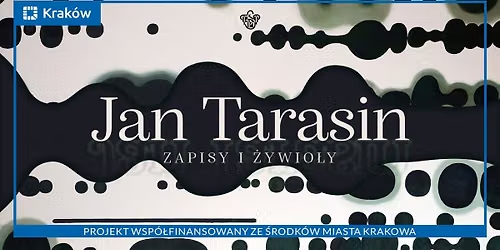
Jan Tarasin "Zapisy i żywioły" - wernisaż | opening

Advertisement
Jan Tarasin urodził się w 1926 roku. Malarstwem pasjonował się od dzieciństwa. Zbierał reprodukcje dawnych mistrzów i często oglądał dostępne mu prace w oryginale.
„...Rodzicom moim, nie mającym żadnych plastycznych zainteresowań, podobało się, że lubię rysować. Zwłaszcza mojemu ojcu, człowiekowi o bardzo otwartym sposobie myślenia i ogromnym poczuciu humoru musiało trochę imponować, że lubię robić rzeczy zupełnie niedostępne jego abstrakcyjno-spekulatywnej wyobraźni i minimalnej sprawności manualnej...” i dalej „...lubiłem oglądać malarstwo innych, zarówno to dostępne mi w oryginałach jak i reprodukcje, które namiętnie zbierałem. Miałem już chyba dziesięć lat, gdy znajomy malarz pożyczył mi książkę z jednobarwnymi reprodukcjami Cezanne’a i album ze stoma faksymilowymi szkicami i rysunkami Rembrandta. Chodziłem przez pewien czas zupełnie porażony ich niepojętą, niepowtarzalną ekspresją...”.
Okupację spędził Jan Tarasin w małej miejscowości Sarny na Polesiu, a obecnie znajdującej się w dzisiejszej zachodniej Ukrainie. Ojciec malarza zginął w czasie wojny podczas likwidacji obozu koncentracyjnego w Działdowie. Gdy wojna się skończyła Jan z matką i siostrą wyjechali do Olkusza. Tam zdał maturę.
Wierny pasji malarskiej studiował na krakowskiej ASP w latach 1946-1951. Uczyli go wybitni twórcy tacy jak Zbigniew Pronaszko, Zygmunt Radnicki czy Wacław Taranczewski.
Na uczelni zaprzyjaźnił się z Jerzym Tchórzewskim, Andrzejem Wajdą, Andrzejem Wróblewskim, Konradem Nałęckim i Jerzym Nowosielskim. Znaczącym krokiem artystycznym dla Jana Tarasina był udział w Ogólnopolskiej Wystawie Młodej Plastyki „Przeciw wojnie – przeciw faszyzmowi” powszechnie zwanej Arsenałem (od miejsca jej zorganizowania – warszawskiego Arsenału). W roku 1962 został członkiem Grupy Krakowskiej II, będącej kontynuatorką przedwojennej Grupy Krakowskiej.
W latach 1956-65 podróżował do Włoch, Moskwy, Chin, Wietnamu, Holandii, Paryża, Szwecji. Szczególnie azjatyckie podróże wywarły wpływ na późniejszą twórczość.
W latach 1963-1967 wykładał na Wydziale Architektury Wnętrz Akademii Sztuk Pięknych w Krakowie. W 1967 roku przeprowadził się do Warszawy by od 1974 roku prowadzić własną pracownię na tutejszej ASP. Od 1987 do 1990 roku pełnił funkcję rektora tej uczelni.
W swojej twórczości „badał” m.in. zależności zachodzące w przyrodzie. Fascynował go odwieczny dualizm chaosu i porządku. Komplikacji i prostoty. Pasjonowała go nauka, astronomia, fizyka.
„…Otaczający nas świat składa się z wielu nakładających się na siebie, przenikających się nawzajem, zwalczających się lub podporządkowanych sobie struktur. Ich wzajemne relacje, wypadkowe ich aktywności, splątane wątki ich powiązań, wielkość i rytm wprawiających je w ruch impulsów stanowią równie trudną do przeniknięcia, fascynującą i ograniczającą nas barierę jak otaczająca nas linia horyzontu. Wyrwanie się z jej zamkniętego kręgu odbiera nam definitywnie złudne poczucie centralnej pozycji w świecie…".
Zmarł 8 sierpnia 2009 roku w Warszawie.
"Zapisy i żywioły"
Twórczość Jana Tarasina to nieustanna próba odnalezienia granicy między porządkiem a chaosem, zapisem a gestem, kontrolą a przypadkiem. Artysta obserwował rzeczywistość nie jako zbiór gotowych przedmiotów, lecz jako dynamiczną sieć rytmów, powtórzeń, relacji i przemian. Z tych obserwacji tworzył własny język złożony ze znaków, punktów, linii i form, które układają się w pozornie uporządkowane, a jednocześnie pełne wewnętrznego ruchu kompozycje.
Wystawa „Zapisy i żywioły” zaprasza do spojrzenia na malarstwo Jana Tarasina poprzez dwa przenikające się sposoby myślenia o obrazie. „Zapisy” to świat struktur, rytmów i znaków, swoisty alfabet, za pomocą którego artysta próbował uchwycić ukryty porządek rzeczywistości. „Żywioły” to natomiast kolor, materia, energia i gest, które wprowadzają do tej struktury nieprzewidywalność i ruch.
Te dwa porządki nie są jednak przeciwieństwami, one nieustannie się dopełniają. Zapis potrzebuje żywiołu, a żywioł zostaje zatrzymany przez zapis. W obrazach Tarasina porządek nigdy nie jest ostateczny, a przypadek nie pozostaje całkowicie nieokiełznany.
Zapraszamy Państwa do wejścia w przestrzeń, w której świat zostaje zapisany, a zapis zaczyna żyć własnym rytmem! Do spotkania z malarstwem, które nie daje jednej odpowiedzi, lecz zachęca do własnego odczytywania znaków, relacji i ukrytych pomiędzy nimi napięć.
Między znakiem a gestem, między porządkiem a przypadkiem, tam rodzi się świat Jana Tarasina.
Wystawa zorganizowana w 100-lecie urodzin Jana Tarasina.
Współorganizator: Jakub Tarasin
[EN]
Jan Tarasin was born in 1926. He had been passionate about painting since childhood. He collected reproductions of the old masters and often viewed the original works available to him.
‘...My parents, who had no interest in the arts, were pleased that I enjoyed drawing. My father in particular – a man with a very open mind and a great sense of humour – must have been somewhat impressed that I enjoyed doing things that were completely beyond his abstract and speculative imagination and his minimal manual dexterity...’ ” and further on, “…I enjoyed looking at other people’s paintings, both the originals I had access to and the reproductions, which I collected passionately. I must have been about ten years old when a painter I knew lent me a book of monochrome reproductions of Cézanne’s works and an album containing a hundred facsimile sketches and drawings by Rembrandt. For a while, I walked about completely spellbound by their incomprehensible, unique expressiveness...”.
Jan Tarasin spent the Occupation in the small village of Sarny in Polesie, which is now located in western Ukraine. The painter’s father was killed during the war whilst the concentration camp in Działdowo was being liquidated. When the war ended, Jan, his mother and his sister moved to Olkusz. There, he passed his A-levels.
Remaining true to his passion for painting, he studied at the Academy of Fine Arts in Kraków from 1946 to 1951. He was taught by outstanding artists such as Zbigniew Pronaszko, Zygmunt Radnicki and Wacław Taranczewski.
At university, he became friends with Jerzy Tchórzewski, Andrzej Wajda, Andrzej Wróblewski, Konrad Nałęcki and Jerzy Nowosielski. A significant artistic milestone for Jan Tarasin was his participation in the National Exhibition of Young Artists ‘Against War – Against Fascism’, commonly known as the Arsenal (after the venue where it was held – the Warsaw Arsenal). In 1962, he became a member of the Kraków Group II, which was the successor to the pre-war Kraków Group.
Between 1956 and 1965, he travelled to Italy, Moscow, China, Vietnam, the Netherlands, Paris and Sweden. His travels in Asia, in particular, had a significant influence on his later work.
Between 1963 and 1967, he lectured at the Faculty of Interior Architecture at the Academy of Fine Arts in Kraków. In 1967, he moved to Warsaw, where, from 1974, he ran his own studio at the local Academy of Fine Arts. From 1987 to 1990, he served as rector of the academy.
In his work, he ‘explored’, amongst other things, the interrelationships found in nature. He was fascinated by the age-old dualism of chaos and order, and of complexity and simplicity. He was passionate about science, astronomy and physics.
“…The world around us consists of many structures that overlap, interpenetrate, conflict with one another or are subordinate to one another. Their mutual relationships, the resultant of their activities, the tangled threads of their connections, and the magnitude and rhythm of the impulses that set them in motion constitute a barrier that is as impenetrable, fascinating and limiting as the horizon line that surrounds us. Breaking free from its closed circle definitively robs us of the illusory sense of a central position in the world…”.
He died on 8 August 2009 in Warsaw.
"Records and Elements"
Jan Tarasin’s work is a constant attempt to find the boundary between order and chaos, record and gesture, control and chance. The artist observed reality not as a collection of ready-made objects, but as a dynamic network of rhythms, repetitions, relationships and transformations. From these observations, he created his own language composed of signs, dots, lines and forms, which arrange themselves into compositions that are seemingly orderly, yet full of internal movement.
The exhibition ‘Records and Elements’ invites visitors to view Jan Tarasin’s paintings through two intertwined ways of thinking about the image. ‘Records’ is a world of structures, rhythms and signs – a kind of alphabet through which the artist sought to capture the hidden order of reality. ‘Elements’, on the other hand, are colour, matter, energy and gesture, which introduce unpredictability and movement into this structure.
These two orders are not, however, opposites; they constantly complement one another. The ‘Record’ needs the ‘Elements’, whilst the ‘Elements’ are held in check by the ‘Record’. In Tarasin’s paintings, order is never definitive, and chance does not remain entirely unbridled.
We invite you to enter a space where the world is recorded, and where the record begins to live by its own rhythm! Come and encounter a form of painting that offers no single answer, but encourages you to interpret the signs, relationships and tensions hidden between them for yourself.
Between sign and gesture, between order and chance, this is where Jan Tarasin’s world is born.
An exhibition organised to mark the 100th anniversary of Jan Tarasin’s birth.
Co-organiser: Jakub Tarasin
„...Rodzicom moim, nie mającym żadnych plastycznych zainteresowań, podobało się, że lubię rysować. Zwłaszcza mojemu ojcu, człowiekowi o bardzo otwartym sposobie myślenia i ogromnym poczuciu humoru musiało trochę imponować, że lubię robić rzeczy zupełnie niedostępne jego abstrakcyjno-spekulatywnej wyobraźni i minimalnej sprawności manualnej...” i dalej „...lubiłem oglądać malarstwo innych, zarówno to dostępne mi w oryginałach jak i reprodukcje, które namiętnie zbierałem. Miałem już chyba dziesięć lat, gdy znajomy malarz pożyczył mi książkę z jednobarwnymi reprodukcjami Cezanne’a i album ze stoma faksymilowymi szkicami i rysunkami Rembrandta. Chodziłem przez pewien czas zupełnie porażony ich niepojętą, niepowtarzalną ekspresją...”.
Okupację spędził Jan Tarasin w małej miejscowości Sarny na Polesiu, a obecnie znajdującej się w dzisiejszej zachodniej Ukrainie. Ojciec malarza zginął w czasie wojny podczas likwidacji obozu koncentracyjnego w Działdowie. Gdy wojna się skończyła Jan z matką i siostrą wyjechali do Olkusza. Tam zdał maturę.
Wierny pasji malarskiej studiował na krakowskiej ASP w latach 1946-1951. Uczyli go wybitni twórcy tacy jak Zbigniew Pronaszko, Zygmunt Radnicki czy Wacław Taranczewski.
Na uczelni zaprzyjaźnił się z Jerzym Tchórzewskim, Andrzejem Wajdą, Andrzejem Wróblewskim, Konradem Nałęckim i Jerzym Nowosielskim. Znaczącym krokiem artystycznym dla Jana Tarasina był udział w Ogólnopolskiej Wystawie Młodej Plastyki „Przeciw wojnie – przeciw faszyzmowi” powszechnie zwanej Arsenałem (od miejsca jej zorganizowania – warszawskiego Arsenału). W roku 1962 został członkiem Grupy Krakowskiej II, będącej kontynuatorką przedwojennej Grupy Krakowskiej.
W latach 1956-65 podróżował do Włoch, Moskwy, Chin, Wietnamu, Holandii, Paryża, Szwecji. Szczególnie azjatyckie podróże wywarły wpływ na późniejszą twórczość.
W latach 1963-1967 wykładał na Wydziale Architektury Wnętrz Akademii Sztuk Pięknych w Krakowie. W 1967 roku przeprowadził się do Warszawy by od 1974 roku prowadzić własną pracownię na tutejszej ASP. Od 1987 do 1990 roku pełnił funkcję rektora tej uczelni.
W swojej twórczości „badał” m.in. zależności zachodzące w przyrodzie. Fascynował go odwieczny dualizm chaosu i porządku. Komplikacji i prostoty. Pasjonowała go nauka, astronomia, fizyka.
„…Otaczający nas świat składa się z wielu nakładających się na siebie, przenikających się nawzajem, zwalczających się lub podporządkowanych sobie struktur. Ich wzajemne relacje, wypadkowe ich aktywności, splątane wątki ich powiązań, wielkość i rytm wprawiających je w ruch impulsów stanowią równie trudną do przeniknięcia, fascynującą i ograniczającą nas barierę jak otaczająca nas linia horyzontu. Wyrwanie się z jej zamkniętego kręgu odbiera nam definitywnie złudne poczucie centralnej pozycji w świecie…".
Zmarł 8 sierpnia 2009 roku w Warszawie.
"Zapisy i żywioły"
Twórczość Jana Tarasina to nieustanna próba odnalezienia granicy między porządkiem a chaosem, zapisem a gestem, kontrolą a przypadkiem. Artysta obserwował rzeczywistość nie jako zbiór gotowych przedmiotów, lecz jako dynamiczną sieć rytmów, powtórzeń, relacji i przemian. Z tych obserwacji tworzył własny język złożony ze znaków, punktów, linii i form, które układają się w pozornie uporządkowane, a jednocześnie pełne wewnętrznego ruchu kompozycje.
Wystawa „Zapisy i żywioły” zaprasza do spojrzenia na malarstwo Jana Tarasina poprzez dwa przenikające się sposoby myślenia o obrazie. „Zapisy” to świat struktur, rytmów i znaków, swoisty alfabet, za pomocą którego artysta próbował uchwycić ukryty porządek rzeczywistości. „Żywioły” to natomiast kolor, materia, energia i gest, które wprowadzają do tej struktury nieprzewidywalność i ruch.
Te dwa porządki nie są jednak przeciwieństwami, one nieustannie się dopełniają. Zapis potrzebuje żywiołu, a żywioł zostaje zatrzymany przez zapis. W obrazach Tarasina porządek nigdy nie jest ostateczny, a przypadek nie pozostaje całkowicie nieokiełznany.
Zapraszamy Państwa do wejścia w przestrzeń, w której świat zostaje zapisany, a zapis zaczyna żyć własnym rytmem! Do spotkania z malarstwem, które nie daje jednej odpowiedzi, lecz zachęca do własnego odczytywania znaków, relacji i ukrytych pomiędzy nimi napięć.
Między znakiem a gestem, między porządkiem a przypadkiem, tam rodzi się świat Jana Tarasina.
Wystawa zorganizowana w 100-lecie urodzin Jana Tarasina.
Współorganizator: Jakub Tarasin
[EN]
Jan Tarasin was born in 1926. He had been passionate about painting since childhood. He collected reproductions of the old masters and often viewed the original works available to him.
‘...My parents, who had no interest in the arts, were pleased that I enjoyed drawing. My father in particular – a man with a very open mind and a great sense of humour – must have been somewhat impressed that I enjoyed doing things that were completely beyond his abstract and speculative imagination and his minimal manual dexterity...’ ” and further on, “…I enjoyed looking at other people’s paintings, both the originals I had access to and the reproductions, which I collected passionately. I must have been about ten years old when a painter I knew lent me a book of monochrome reproductions of Cézanne’s works and an album containing a hundred facsimile sketches and drawings by Rembrandt. For a while, I walked about completely spellbound by their incomprehensible, unique expressiveness...”.
Jan Tarasin spent the Occupation in the small village of Sarny in Polesie, which is now located in western Ukraine. The painter’s father was killed during the war whilst the concentration camp in Działdowo was being liquidated. When the war ended, Jan, his mother and his sister moved to Olkusz. There, he passed his A-levels.
Remaining true to his passion for painting, he studied at the Academy of Fine Arts in Kraków from 1946 to 1951. He was taught by outstanding artists such as Zbigniew Pronaszko, Zygmunt Radnicki and Wacław Taranczewski.
At university, he became friends with Jerzy Tchórzewski, Andrzej Wajda, Andrzej Wróblewski, Konrad Nałęcki and Jerzy Nowosielski. A significant artistic milestone for Jan Tarasin was his participation in the National Exhibition of Young Artists ‘Against War – Against Fascism’, commonly known as the Arsenal (after the venue where it was held – the Warsaw Arsenal). In 1962, he became a member of the Kraków Group II, which was the successor to the pre-war Kraków Group.
Between 1956 and 1965, he travelled to Italy, Moscow, China, Vietnam, the Netherlands, Paris and Sweden. His travels in Asia, in particular, had a significant influence on his later work.
Between 1963 and 1967, he lectured at the Faculty of Interior Architecture at the Academy of Fine Arts in Kraków. In 1967, he moved to Warsaw, where, from 1974, he ran his own studio at the local Academy of Fine Arts. From 1987 to 1990, he served as rector of the academy.
In his work, he ‘explored’, amongst other things, the interrelationships found in nature. He was fascinated by the age-old dualism of chaos and order, and of complexity and simplicity. He was passionate about science, astronomy and physics.
“…The world around us consists of many structures that overlap, interpenetrate, conflict with one another or are subordinate to one another. Their mutual relationships, the resultant of their activities, the tangled threads of their connections, and the magnitude and rhythm of the impulses that set them in motion constitute a barrier that is as impenetrable, fascinating and limiting as the horizon line that surrounds us. Breaking free from its closed circle definitively robs us of the illusory sense of a central position in the world…”.
He died on 8 August 2009 in Warsaw.
"Records and Elements"
Jan Tarasin’s work is a constant attempt to find the boundary between order and chaos, record and gesture, control and chance. The artist observed reality not as a collection of ready-made objects, but as a dynamic network of rhythms, repetitions, relationships and transformations. From these observations, he created his own language composed of signs, dots, lines and forms, which arrange themselves into compositions that are seemingly orderly, yet full of internal movement.
The exhibition ‘Records and Elements’ invites visitors to view Jan Tarasin’s paintings through two intertwined ways of thinking about the image. ‘Records’ is a world of structures, rhythms and signs – a kind of alphabet through which the artist sought to capture the hidden order of reality. ‘Elements’, on the other hand, are colour, matter, energy and gesture, which introduce unpredictability and movement into this structure.
These two orders are not, however, opposites; they constantly complement one another. The ‘Record’ needs the ‘Elements’, whilst the ‘Elements’ are held in check by the ‘Record’. In Tarasin’s paintings, order is never definitive, and chance does not remain entirely unbridled.
We invite you to enter a space where the world is recorded, and where the record begins to live by its own rhythm! Come and encounter a form of painting that offers no single answer, but encourages you to interpret the signs, relationships and tensions hidden between them for yourself.
Between sign and gesture, between order and chance, this is where Jan Tarasin’s world is born.
An exhibition organised to mark the 100th anniversary of Jan Tarasin’s birth.
Co-organiser: Jakub Tarasin
Advertisement
Where is it happening?
Plac Szczepański 4, 31-011 Kraków, Poland, plac Szczepański 4, 31-011 Kraków, Polska, Krakow, Poland
Event Location & Nearby Stays:
Know what’s Happening Next — before everyone else does.
Host or PublisherPałac Sztuki w Krakowie / The Palace of Fine Arts in Kraków







![BEAST WITHOUT BEAUTY\/spektakl taneczny\/program prezentacji ta\u0144ca ROLLERCOASTER [ENG\ud83d\udc47]](https://cdn-ip.allevents.in/s/rs:fill:500:250/g:sm/sh:100/aHR0cHM6Ly9jZG4tYXouYWxsZXZlbnRzLmluL2V2ZW50czEvYmFubmVycy9kMGQwMWJjMzczYTAyZjIzYjQ1ZTU5OTdmNTZjNWJiYmFmZDJjNjFhZjY3ZTA5ODAyYmRlOTAyYjZlMDk3Nzg3LXJpbWctdzEyMDAtaDYyOC1kYzA4MDgwOC1nbWlyP3Y9MTc4ODQ4NjYyMQ.avif)