Global Health Governance Across Scales: From State to Individual

About this Event
The panel will bring together three presentations that examine health governance across historical, political, and lived-experience dimensions. Moving from the transformation of infectious disease hospitals in mid-twentieth-century Beijing and London, to China’s contemporary engagement in global health governance, and finally to the racialised experiences and resistance of Chinese and ESEA communities in the UK during COVID-19, this panel explores how health governance operates across multiple scales.
Qiman Liu— Infrastructure, Epidemiology, and Political Regimes: Infectious Disease Hospitals Transformation in Beijing and London, 1940s–1960s
Jinxuan Wu — China’s Engagement in Global Health Governance: A Neo-Gramscian Analysis of World Order, State Transformation, and Social Forces
Shengjun Zhang — Chineseness as a Racialised Signifier: COVID-19, Anti-Asian Racism, and ESEA Resistance in the UK
ABOUT THE SPEAKERS
Qiman Liu is a visiting PhD student at the University of Manchester’s Centre for the History of Science, Technology and Medicine, and a PhD candidate in medical history at Peking University. His research centres on the history of Chinese infectious disease hospitals, especially their evolution and operation in Beijing. He also conducts comparative studies on Sino-British hospital development across the 20th century. His broader interests cover modern medical history and urban environmental history.
Jinxuan Wu is a PhD candidate in Politics at the University of Manchester. Drawing on neo-Gramscian theory, his current project examines how China’s participation in global health governance has been shaped by interactions between global governance structures, state transformation, and social forces. His research interests include global governance, international political economy, and public health.
Shengjun Zhang is a second year PhD student in Sociology at the University of Manchester. Her work examines grassroots activism within the Stop Asian Hate movement in the UK during and after the Covid 19 pandemic. In particular, she focuses on the emergence of ESEA (East and Southeast Asian) identity as a form of panethnic mobilisation and intergroup alliance shaped by the specific racial positioning of Asianness in the UK. Methodologically, she employs mixed method social network analysis to trace the formation and expansion of ESEA community networks and collective identity. Beyond academia, she curates film events with ESEA communities to foster dialogue, build connections, and challenge racial inequality and representation
ABOUT THE PGR WORKSHOPS
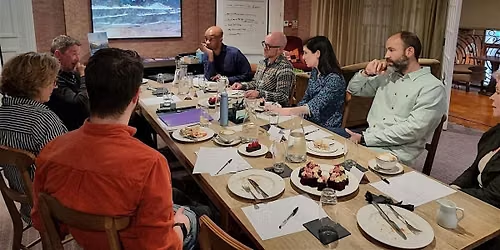
MCI’s PGR workshops are lunchtime seminars held in person at the Manchester China Institute. They seek to bring together students, faculty and staff who can best provide feedback as postgraduate researchers develop their ideas. Free lunch will be provided.
Accessibility
The MCI is a listed building and therefore does not have any lifts. Please note that you must use the stairs in order to access the venue and the toilets.
Photography
The organisers will be taking photos during this event. If you prefer not to be included in any photos, kindly inform the organisers before the event starts.
Where is it happening?
Event Location & Nearby Stays:
GBP 0.00