Galaxies, black holes and the birth of the Universe

About this Event
Black holes are among the most mysterious objects in the Universe. They emit no light of their own, yet the matter falling into them can outshine entire galaxies. How do we study something that cannot be seen? The answer lies in learning to "see" the invisible.
In this lecture, we will journey from the hearts of nearby galaxies to the dawn of the Universe. Along the way, we will discover how astronomers use the full spectrum of light—from radio waves to X-rays—to reveal the hidden workings of black holes. We will see how these cosmic giants launch powerful jets that can extend far beyond their host galaxies, shaping the galaxies they inhabit and influencing their evolution over billions of years. Together, these discoveries tell a remarkable story: by learning to see the invisible, we are uncovering how the Universe itself came to be.
This presentation will be in the Hansen Dome Theatre.
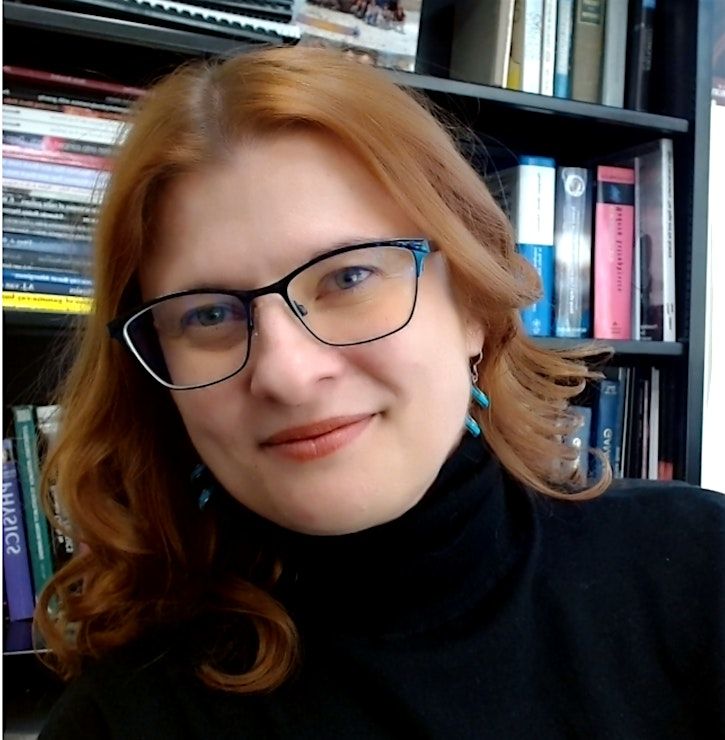
Dr Anna D. Kapinska is an Astronomer and Staff Scientist at the National Science Foundation's (NSF) National Radio Astronomy Observatory (NRAO). Her research focusses on understanding the evolution of super-massive black holes in the centres of galaxies, how their powerful activity can be measured and how it changes their host galaxies and the Universe as a whole.
Dr Kapinska received PhD in Physics(Astrophysics) from the University of Southampton in the UK in 2012. She then worked with international research teams across the UK, Europe and Australia on launching new-generation radio telescopes before she joined the National Radio Astronomy Observatory in 2018. She is highly regarded for her work in mapping the cosmos in radio waves to uncover how black hole environments grow and evolve over time. She is credited for the serendipitous co-discovery of Odd Radio Circles - mysterious, ghostly cosmic rings that have sparked entirely new questions in modern astrophysics. A prominent figure in the international radio astronomy community, Dr Kapinska was recently honored as a 2026 American Astronomical Society (AAS) Harlow Shapley Lecturer to share her passion for scientific discovery and the unseen, invisible wonders of the Universe with public audiences
Would you like to have more opportunities to hear from Dr. Kapinska? Join her and Clark Planetarium on the following dates for these free events:
- Fun Science Friday -- Learn about Black Holes -- August 7, 2:30-6:30 at the Clark Planetarium Learning Space (130 S 400 W Salt Lake City, UT)
- Star Party -- August 8, 9:00pm -12:00 am at Silver Lake in Big Cottonwood Canyon, with Salt Lake Astronomical Society & Clark Planetarium (free Eventbrite registration: https://milkywaysummerstarparty.eventbrite.com/?aff=IG)
Where is it happening?
Event Location & Nearby Stays:
USD 0.00