FDA and Regulation of Generative AI-Enabled Medical Devices

About this Event
co-sponsored by Normandale Community College and the North Star Chapter of INCOSE
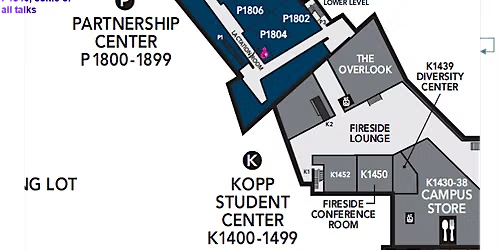
9547 Collegeview Road is not a mailing address but makes a good navigational reference; or “Continuing Education and Customized Training at Normandale Partnership Center,” near the Japanese Garden;
between Lot 5 and the south lot off 98th, though not well accessible by either.
“Reserve a Spot” here before Dec. 7 for the catering order. Pizza tentative; let us know your preferences from the menu, noting the minimum orders of 10.
ABSTRACT
Utilization of AI/ML technology has become widespread in the medical device industry. A recent review of AI devices cleared by FDA shows a total of 1,524 devices, the majority of which are utilized as diagnostic tools, particularly in radiology.
A common characteristic of the current generation of AI-enabled medical devices is that algorithms utilized by the devices are “locked”. Algorithms are trained, deployed and maintained in a static state while in use, with subsequent changes deployed as new versions or entirely new devices.
Medical device companies are seeking to deploy medical devices incorporating Generative AI technology. Generative AI is different from traditional AI in that it can utilize incoming information to further refine analyses and responses, including creating new information. Said another way, it continues to learn after deployment.
Generative AI creates unique regulatory challenges for FDA. In response, FDA recently published a discussion paper proposing strategies for regulating Generative AI in medical devices. A key element of the proposed strategy is characterizing device risk based on the activities or functions being performed by Generative AI tools. The proposed function-based approach places this squarely in the purview of systems engineers, who often play a key role in defining functions and associated requirements.
The presenter will review the proposed function-based methodology as well as other key aspects of the discussion paper.
PRESENTER
Paul Wisnewski
Founder and Principal Consultant, MedQual Advisors LLC
Paul Wisnewski is a medical device professional with 35+ years experience in the industry. An engineer by training, Paul has held roles in both R&D and Quality at such companies as Smith+Nephew, Medtronic and Digital Diagnostics (now a part of OKU). Paul’s past experience includes supporting the quality aspects of a medical device utilizing AI/ML technology. Paul is the founder of and a principal consultant with MedQual Advisors LLC, which provides quality consulting services to the medical device industry.
Paul holds a BS in Mechanical Engineering and MS in Bioengineering, both from Clemson University. He is a senior member of ASQ and holds ASQ certifications in Reliability Engineering (CRE) and Medical Device Quality Audit (CMDA).
Click for Microsoft Teams meeting.
Meeting ID: 290 561 832 063 94
Passcode: qJ7dC6L5
Agenda
🕑: 06:00 PM
Network and socialize over food (provided)
🕑: 06:30 PM - 06:45 PM
Welcome & INCOSE North Star Chapter information
Host: Warren Porter, ASEP, Chapter President
🕑: 06:45 PM - 08:00 PM
Presentation, FDA and Regulation of Generative AI-Enabled Medical Devices
Host: Paul Wisnewski
Info: Things Systems Engineers Should Know
🕑: 08:00 PM - 08:30 PM
Q & A
Where is it happening?
Event Location & Nearby Stays:
USD 0.00