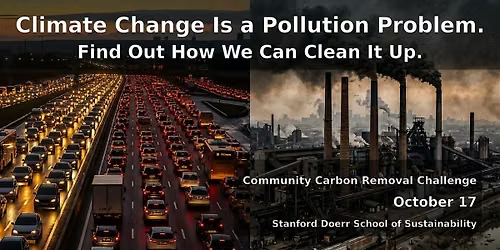
Community Carbon Removal Challenge

About this Event
Human activity has left a legacy of roughly 1.8 trillion tons of excess CO₂ in the atmosphere and ocean— more than 40 times the amount the world emits in a single year. Nature will not clean up that legacy climate pollution on a human timescale. Much of it will remain in the atmosphere–ocean system for thousands of years unless we deliberately remove it. Removing legacy CO2 emissions is essential to restoring climate stability and safeguarding our future. Catalyzing that removal is why we are here today.
The Climate Center, 4Corners Climate Coalition, and the Stanford Sustainability Accelerator, based in the Stanford Doerr School of Sustainability have organized the Carbon Removal Challenge. This community event aims to educate, stimulate discussion, and allocate pre-raised funds for carbon dioxide removal.
At this lively interactive event, participants will explore the major pathways for removing carbon using biology, rocks and minerals, oceans, and the atmosphere. They’ll examine real-world projects, consider potential community benefits, and hear from climate leaders working to advance effective policy and responsible deployment.
The Community Carbon Removal Challenge is unique because it culminates in caucusing and community action. After a thorough introduction to carbon dioxide removal, participants will act as an informed public caucus — deliberating together and deciding how pre-raised funds will be used to purchase real carbon removal from actual projects.
At a Glance
- Keynote presentation by California Senator Josh Becker
- What is responsible Carbon Dioxide Removal and why do we need it?
- What are the benefits and goals of CDR
- How do we remove CO2 and what do we do with it?
- Presentations and discussions with companies doing CDR now
- Caucus-style voting conducted among participants to decide how pre-raised funds will be allocated
- Identify opportunities for continued local engagement and building informed public support for effective carbon-removal policy and action
Through presentations, questions, discussion, and collaborative exercises, participants will learn how to evaluate carbon-removal approaches: How much carbon will they remove? How securely and durably will it be stored? What are the costs, risks, tradeoffs, and potential benefits? Which projects deserve support?
Details on caucusing
As participants, you will be asked to collectively determine how available funds should be allocated. To do that, you will be prepared to ask tough questions. For example: How much carbon can each pathway remove? How securely will the removed carbon be stored? What are the costs, risks, tradeoffs, and potential benefits? Through caucusing, you will convert that knowledge into decisions that will allocate pre-raised funds to purchase real carbon removal.
Join us October 17 at the Stanford Sustainability Accelerator for this interactive 5+hour event comprising presentations, questions, discussion, and collaborative exercises.
Lunch is included.
Supporting Partners include: City CDR Initiative, Open Air Collective, Terraset
Agenda
🕑: 10:00 AM - 10:30 AM
Welcome and keynote
Info: A look at climate pollution efforts on local, state, national, and global stages
🕑: 10:30 AM - 11:00 AM
What is Carbon Dioxide Removal and why do we need it?
Info: To restore balance to Earth’s climate system we must clean up legacy CO₂ pollution. You'll come to understand why cutting emissions remains indispensable but is no longer sufficient, We provide simple definitions of what Carbon Dioxide Removal (CDR) is, what it isn't, and why it is an essential high priority part of the climate action toolkit
🕑: 11:00 AM - 11:15 AM
Criteria for Responsible CDR Deployment
Info: CO₂ is literally everywhere in our biosphere. But in terms of removing climate pollution, what is beneficial removal, what is not, and once removed, where will all that carbon go?
🕑: 11:15 AM - 01:00 PM
From concept to reality— a CDR portfolio
Info: One way to get your head around the rich diversity of ways to clean up climate pollution is to think of CDR happening via four major spheres, or pathways: through biology, through chemistry, in the ocean, and in the atmosphere. Here you'll meet people working in each of these pathways and examine projects and companies in California and around the world. For each pathway we cover the same set of 4 basic questions: How does removal work in this pathway? What does it look like in the real world? How is the carbon stored and for how long? What must be considered when evaluating CDR choices in this pathway?
🕑: 01:00 PM - 01:30 PM
Lunch and networking
Info: Continue the conversation while enjoying a catered lunch.
🕑: 01:30 PM - 02:30 PM
Discussion and review— what are the choices and how do we evaluate them?
Info: As a group we'll discuss today's CDR choices and review how to compare and evaluate them.
🕑: 02:30 PM - 03:30 PM
Community action
Info: We will separate our space into four areas, one for a CDR choice from each major pathway. You'll choose which areas to visit, and in each space discuss and consider allocating funding to the choice represented there. Then we come together as a group and discuss the choices made. Finally, we'll discuss ways you engage in CDR advocacy after the day's Challenge.
9
Info: 9
Where is it happening?
Event Location & Nearby Stays:
USD 0.00