CAA Fall Symposium 2026 Toronto: Environmental Noise & Building Acoustics

About this Event
About the symposium
The Canadian Acoustical Association's 2026 Fall Symposium is a two-day working event, run identically in Ontario and Vancouver so you can attend whichever is closer. Day one covers environmental noise, day two covers residential building acoustics. Each day is sold as its own ticket, so you can come for one day or both.
The agendas for each day are displayed at the bottom of this page, scroll down to see what's in store.
This is not a lecture series. Each day builds toward practical CAA guidance: two good practice documents on environmental noise modelling and assessment, and a guidance document on residential building acoustics that will make the case for raising minimum standards in the National Building Code. The morning presents the evidence and the state of practice across Canada and internationally; the afternoon puts it to work in workshops where attendees help shape the documents directly. Working groups carry them forward afterwards, and everyone who takes part is invited to stay involved.
Where national guidance does not yet exist, the CAA intends to build it, and these two days are where that starts.
Day 1: Environmental noise in Canada, towards consistent practice and national guidance
Environmental noise is regulated differently in almost every province, with little shared ground on method or compliance. The day opens with a substantial session on ISO 9613-2 (2024), what changed from the 1996 version, the consequences seen in modelling comparisons, and the amendment now being planned, followed by guided discussion where your experience and data help shape Canada's input. The morning continues with short framings of practice in Ontario, Alberta and BC, Health Canada and Quebec (including the LDBE change), and good practice from the UK and Europe, plus a short update on traffic noise modelling. The afternoon is two workshops working from draft CAA documents: a modelling approach document (reflections, ground factor, methodology and uncertainty) and an assessment approach document (baseline and ambient comparison, magnitude of effect, corrections and the absolute limit question), closing with a plenary on how the documents move forward.
Day 2: Residential building acoustics, raising the bar for the National Building Code
Current code minimums are failing occupants, and Canada lags peer nations. The morning sets out the evidence: the human cost of minimum compliance and the metrics that actually predict occupant satisfaction; what is really being built across Canada, drawn from aggregate consultancy project data; how Canadian requirements compare with ISO 19488 and the European experience; and a panel with an architect, developer and property manager on the business case for building beyond code. After lunch, an NRC technical session covers apparent sound transmission class and impact noise calculation, software tools and facade insulation research. The afternoon roundtables ask each table to agree its top three deficiencies in the current code and top three recommended solutions, feeding directly into a CAA guidance document on residential building acoustics.
Format and what is included
Each day runs 08:00 to 17:00 and includes registration and morning coffee, lunch, morning and afternoon breaks, and a dedicated one-hour exhibitor session in the afternoon. Attendees are assumed to have a working grounding in acoustics. Presenter names will be confirmed closer to the date; the topics and structure above are fixed.
An optional evening social is held on the first night at each location. It is ticketed separately and is not included in a day ticket.
Venue
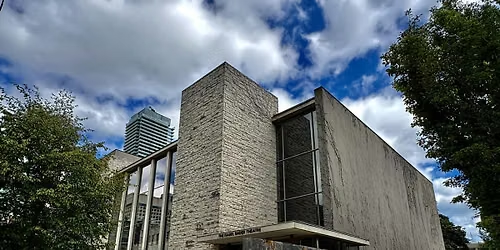
Weston Golf Club, 50 St. Phillips Road, Etobicoke, Ontario. Both days run in the main room with exhibitor tables in the same space. Parking is available on site. The optional evening social on 2 November is being arranged nearby in conjunction with the CAA Southern Ontario Chapter (GTA & Southwestern ON) Regional Chapter, more details to come.
Tickets and pricing
Tickets are per day. Choose the day or days you want to attend and the price that applies to you.
CAA member pricing is available to anyone who is a current member of the Canadian Acoustical Association at the time of the event. No promo code is needed: select the member ticket and we will check membership at registration on the day. If you are not a member and would like to be, see the membership note below. Non-member tickets are available to everyone.
Ticket prices are in Canadian dollars.
A note on CAA membership and our website
The CAA is building a new website, launching in the coming weeks. In the meantime, our current site is only partly working, but you can still log in and access your account, and take payments or send emails. The site was not working for a period, and so we temporarily had membership available as an add-on here. But we have closed that now.
Exhibitors
Exhibitor spaces are available at both locations, with a dedicated exhibition session on each day. If your organization would like to exhibit, email [email protected].
Questions
Email [email protected] for anything else about the symposium.
Day 1 | Environmental Ac.
🕑: 08:00 AM - 08:30 AM
Registration, coffee and networking
🕑: 08:30 AM - 08:45 AM
Welcome and opening remarks
Host: Dan Clayton (CAA President | SLR Consulting)
Info: The problem of inconsistency across Canada in environmental noise and vibration assessment, the clean slate and long term ambition, and the two documents the day works towards.
🕑: 08:45 AM - 09:15 AM
ISO 9613-2 (2024): what changed and the amendment plan
Host: Scott Penton (SLR Consulting)
Info: What changed from the 1996 version and why, and the apparent consequences, including increases of up to 10 dB shown through modelling comparisons and example graphs. The plan to amend the standard, with Abar and Cmet proposed to return to the 1996 basis, which does affect Canadian standards, while other changes such as reflections from cylinders remain. What comments and data are needed to support the amendment, and what the future ISO committee process looks like, with the next versions likely four to ten years away.
🕑: 09:15 AM - 09:55 AM
ISO 9613-2: guided discussion
Host: Presenter to be confirmed
Info: Open discussion captured on the whiteboard, with handouts to complete and return by the end of the day and an MS Forms survey shared through Teams. Focus 1, the effects of the 2024 changes on industry and compliance, with real examples where available, including previously accepted abatement plans and new permitting. Focus 2, uncertainty in modelling beyond 1 km, how to acknowledge and address it, whether other models serve better, and the regulatory and met dataset issues that raises.
🕑: 09:55 AM - 10:15 AM
Canadian practice, part 1
Host: Presenter to be confirmed
Info: Short framings of Ontario, then Alberta and BC, drawing on the pre-reads rather than walking through the regulations.
🕑: 10:30 AM - 11:00 AM
Canadian practice, part 2
Host: Presenter to be confirmed
Info: Short framings of Health Canada and Quebec, including the LDBE change.
🕑: 10:15 AM - 10:30 AM
Morning coffee
Info: Exhibitor booths open.
🕑: 11:00 AM - 11:25 AM
Good practice and policy from elsewhere
Host: Presenter to be confirmed
Info: British, Australian and others, including ProPG, the BS 4142 corrections and the Environment Agency permit guidance, and what is adoptable here.
🕑: 11:25 AM - 11:35 AM
Traffic noise, a ten-minute update
Host: Scott Penton (SLR Consulting)
Info: A short update on the new TNM version and the FHWA issues, with FTA and FRA inputs, and notice that a working group is being formed.
🕑: 11:35 AM - 12:00 PM
Panel discussion: the case for consistent practice
Info: A regulator, a planner and a proponent on what inconsistent practice costs them: the approvals that stall, the models that get re-run to a different method for each province, the conditions that are impossible to enforce, and what they would need from national guidance to make decisions faster and defend them with confidence. The panel closes by framing the two draft documents and how the afternoon tables will run. Moderator to be confirmed, sourcing panelists locally in each city.
🕑: 12:00 PM - 01:00 PM
Lunch and networking
Info: Exhibitor booths open.
🕑: 01:00 PM - 02:00 PM
Roundtable Workshop 1: modelling approach document
Info: Discussing content for guidelines on modelling approach document/documents for industrial/stationary types of sources
🕑: 02:00 PM - 03:00 PM
Vendor exhibition and afternoon coffee
Info: A dedicated hour with exhibitors
🕑: 03:00 PM - 04:15 PM
Roundtable Workshop 2: assessment approach document
Info: Baseline and ambient comparison, magnitude of effect, corrections, and the absolute limit question
🕑: 04:15 PM - 04:50 PM
Plenary: gathering the feedback
Info: Table captains report the strongest arguments and data points from their groups, and the Chair sets out how the feedback will shape the structure of the White Paper.
🕑: 04:50 PM - 05:00 PM
Closing remarks and call to action
Host: Dan Clayton (CAA President | SLR Consulting)
Info: The timeline for the White Paper or guidance document, how attendees can input and review future drafts through the Environmental Noise Special Interest Group, and how to get involved.
🕑: 06:30 PM - 09:30 PM
Evening Event - Southern Ontario Chapter (GTA & Southwestern ON)
Info: Exact time and details TBC.
Day 2 | Building Acoustic
🕑: 08:00 AM - 08:30 AM
Registration, coffee and networking
🕑: 08:30 AM - 08:45 AM
Welcome and opening remarks
Host: Dan Clayton (CAA President | SLR Consulting)
Info: The goal of the day, to gather evidence, identify industry pain points and build consensus toward a CAA White Paper or guidance document on evidence-based best practice in residential building acoustics, and where appropriate to make the case for raising minimum acoustic standards in the National Building Code.
🕑: 08:45 AM - 09:30 AM
Session 1: the human cost of minimum compliance
Host: Roderick Mackenzie (CAA Director | Soft dB)
Info: A data-driven look at why current code minimums fail occupants, covering the health, sleep and physiological impacts of noise in multi-residential spaces, both interior and exterior, and establishing what acoustic metrics and target values are needed for occupant satisfaction. Drawing on existing evidence-based indoor environmental quality work.
🕑: 09:30 AM - 10:15 AM
Session 2: the reality on the ground, what we are actually building
Host: Eric Salt (Aercoustics)
Info: A collaborative look at aggregate consultancy project data showing what is being constructed across Canada, the interior and facade partitions, flanking assemblies and building services noise control measures in real use, and where the gaps remain.
🕑: 10:15 AM - 10:30 AM
Morning coffee
Info: Exhibitor booths open.
🕑: 10:30 AM - 11:15 AM
Session 3: looking abroad, ISO 19488 and the European experience
Host: Presenter to be confirmed
Info: A brief history of the acoustic mandates in the Canadian building code, why the standards sit where they do and why Canada lags peer nations, followed by a comparison against global benchmarks such as ISO 19488 and the proven models for higher standards.
🕑: 11:15 AM - 12:00 PM
Panel discussion: the business case for better standards
Host: Presenters to be confirmed
Info: An architect, developer and property manager on the economic and practical realities of building beyond code, weighing the cost of design, retrofit and tenant turnover against the value of early acoustic integration. Moderator to be confirmed, sourcing panelists locally in each city.
🕑: 12:00 PM - 01:00 PM
Lunch and networking
Info: Exhibitor booths open.
🕑: 01:00 PM - 02:00 PM
Technical session: quantifying performance, NRC updates
Host: Presenters to be confirmed
Info: NRC updates on Apparent Sound Transmission Class calculations, impact noise calculation, software tools and facade insulation research, showing how the industry is already equipped to handle more rigorous code requirements.
🕑: 02:00 PM - 03:00 PM
Vendor exhibition and afternoon coffee
Info: A dedicated hour with exhibitors
🕑: 03:00 PM - 04:00 PM
Roundtable workshops: strategizing the White Paper
Info: Attendees synthesize the day and identify the most critical deficiencies in the current code, such as low frequency impact noise, weak facade insulation mandates and the gap on building services noise, along with the advocacy hurdles to fixing them. Each table agrees its top three barriers and top three recommended solutions and submits a short structured brief. Table captains to be confirmed.
🕑: 04:15 PM - 04:45 PM
Plenary: gathering the feedback
Info: Table captains report the strongest arguments and data points from their groups, and the Chair sets out how the feedback will shape the structure of the White Paper.
🕑: 04:50 PM - 05:00 PM
Closing remarks and call to action
Info: The timeline for the White Paper or guidance document, how attendees can input and review future drafts through the Building Acoustics Special Interest Group, and how to get involved.
🕑: 06:30 PM - 09:30 PM
Evening Event
Info: Exact time and details TBC.
Where is it happening?
Event Location & Nearby Stays:
CAD 120.00 to CAD 241.43