Brent Martin & John Lane

Advertisement
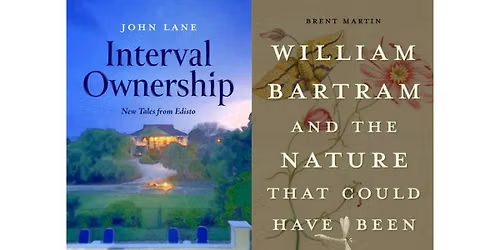
Brent Martin & John Lane will visit City Lights on Saturday, October 10th to share their new books, "William Bartram and the Nature that Could Have Been" and "Interval Ownership: New Tales from Edisto".
Two hundred fifty years ago, on the eve of the American Revolution, William Bartram, the young naturalist, illustrator, and observer of indigenous customs traveled the Southern backcountry in search of species new to science. His journey was a rich and rhapsodic description of nature and of landscapes largely undisturbed by colonial settlers, though on the eve of great change and upheaval. The result of his journey, the 1791 publication TRAVELS, is a beautiful rendering of the plant and animal world, and a vivid account of native American villages and people, providing us with a baseline of ecological conditions at that time. WILLIAM BARTRAM AND THE NATURE THAT COULD HAVE BEEN is a look back at the nature described by Bartram, as well as the vast changes and seemingly irreversible damage inflicted upon the American landscape since that time. It is a reflection upon the choices made by a new country that diverted from Bartram's view of nature and the holiness that was imbued within it, and that instead chose a more utilitarian, extractive, and exploitative path that inflicted irreversible damage to many species and landscapes visible to this day. At its core, it is lamentation, but not without hope. Art and efforts to conserve and restore are alive within these Bartram landscapes today, and Martin offers readers a glimpse into these efforts, as well as some insight on how we might move forward towards recreating landscapes and places that still inspire and offer hope for the nature that remains and that can be.
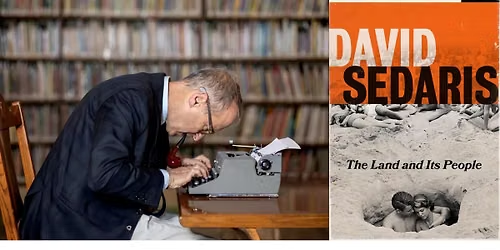
Thirteen owners rotate through a beach house on Edisto Island, South Carolina, four weeks a year, one week each season. They share a kitchen, a pool, a view of the ocean, and a set of storage lockers that nobody can agree on. John Lane's INTERVAL OWNERSHIP gives each owner a story. A singer-songwriter buries his mother and loses his father's approval in the same afternoon. A therapist buys back his favorite chair from a thrift shop and gives away the replacements to a passing kid on a bicycle. An old man appears at a hedge and asks, again and again, if the pool is public. A couple races back to the island to find a missing ring. Two college friends hunt fossils on a winter beach and meet a fisherman who turns out to be Jasper Johns. These are comic and melancholy stories about what happens when people pour their lives into a place they only partly own. Lane writes about marriage and money, fathers and sons, faith and skepticism, race and belonging, memory and erosion. The island endures. The owners come and go, and somebody always leaves the Old Bay seasoning open.
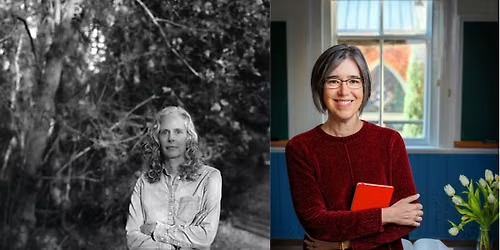
Brent Martin lives in the western North Carolina mountains where he recently served as director of the Blue Ridge Bartram Trail Conservancy. He is the author of GEORGE MASA'S WILD VISION, winner of the Thomas Wolfe Memorial Literary Award, and has served as the Gilbert-Chappell Distinguished Poet for the West.
John Lane is the author of two novels, FATE MORELAND'S WIDOW and WHOSE WOODS THESE ARE. He has also published several dozen books of poetry and nonfiction. A cofounder of the Hub City Writers Project, he lives in Spartanburg, South Carolina.
Two hundred fifty years ago, on the eve of the American Revolution, William Bartram, the young naturalist, illustrator, and observer of indigenous customs traveled the Southern backcountry in search of species new to science. His journey was a rich and rhapsodic description of nature and of landscapes largely undisturbed by colonial settlers, though on the eve of great change and upheaval. The result of his journey, the 1791 publication TRAVELS, is a beautiful rendering of the plant and animal world, and a vivid account of native American villages and people, providing us with a baseline of ecological conditions at that time. WILLIAM BARTRAM AND THE NATURE THAT COULD HAVE BEEN is a look back at the nature described by Bartram, as well as the vast changes and seemingly irreversible damage inflicted upon the American landscape since that time. It is a reflection upon the choices made by a new country that diverted from Bartram's view of nature and the holiness that was imbued within it, and that instead chose a more utilitarian, extractive, and exploitative path that inflicted irreversible damage to many species and landscapes visible to this day. At its core, it is lamentation, but not without hope. Art and efforts to conserve and restore are alive within these Bartram landscapes today, and Martin offers readers a glimpse into these efforts, as well as some insight on how we might move forward towards recreating landscapes and places that still inspire and offer hope for the nature that remains and that can be.
Thirteen owners rotate through a beach house on Edisto Island, South Carolina, four weeks a year, one week each season. They share a kitchen, a pool, a view of the ocean, and a set of storage lockers that nobody can agree on. John Lane's INTERVAL OWNERSHIP gives each owner a story. A singer-songwriter buries his mother and loses his father's approval in the same afternoon. A therapist buys back his favorite chair from a thrift shop and gives away the replacements to a passing kid on a bicycle. An old man appears at a hedge and asks, again and again, if the pool is public. A couple races back to the island to find a missing ring. Two college friends hunt fossils on a winter beach and meet a fisherman who turns out to be Jasper Johns. These are comic and melancholy stories about what happens when people pour their lives into a place they only partly own. Lane writes about marriage and money, fathers and sons, faith and skepticism, race and belonging, memory and erosion. The island endures. The owners come and go, and somebody always leaves the Old Bay seasoning open.
Brent Martin lives in the western North Carolina mountains where he recently served as director of the Blue Ridge Bartram Trail Conservancy. He is the author of GEORGE MASA'S WILD VISION, winner of the Thomas Wolfe Memorial Literary Award, and has served as the Gilbert-Chappell Distinguished Poet for the West.
John Lane is the author of two novels, FATE MORELAND'S WIDOW and WHOSE WOODS THESE ARE. He has also published several dozen books of poetry and nonfiction. A cofounder of the Hub City Writers Project, he lives in Spartanburg, South Carolina.
Advertisement
Where is it happening?
3 East Jackson Street, Sylva, NC, United States, North Carolina 28779
Event Location & Nearby Stays:
Know what’s Happening Next — before everyone else does.
Host or PublisherCity Lights Bookstore