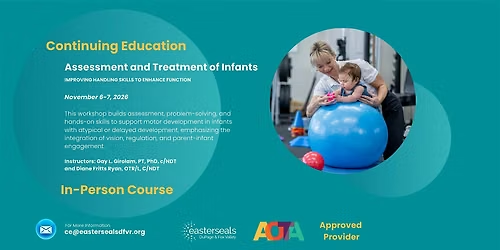
Assessment and Treatment of Infants

About this Event
Improving Handling Skills to Enhance Function
This workshop will focus on assessment and problem-solving skills to support your work with young infants, birth through transitions to standing, who have atypical or delayed development.
This course will include lecture, case studies and participant labs to practice handling strategies. Integration of vision, regulation and parent-infant engagement will be integrated as it relates to supporting motor function.
Full Course Details To Download & Print
To sign up and receive all course information and future courses from Easterseals, please click here to sign-up.
Target Audience
This course is appropriate for PTs/PTAs and OTs/COTAs who have experience treating infants with atypical motor development and/or conditions that interfere with typical development and the acquisition of functional skills.
Course Objectives
Following this course, participants will be able to:
1. Identify key developmental changes in infants from birth to 10 months.
2. Implement a movement system assessment and plan treatment goals for infants from birth to 10 months.
3. Explain the key components of postural control to support development of functional skills in infants.
4. Describe treatment strategies that can be used to enhance gross and fine motor function in infants.
5. Integrate principles of vision, regulation and engagement into infant motor assessment and treatment to support participation, organization, and motor function.
About the Instructors
Gay L. Girolami, PT, PhD, c/NDT
Gay L. Girolami holds the rank of Clinical Professor and serves as the Director of DPT Professional Education in the Doctor of Physical Therapy Program (DPT) at the University of Illinois Chicago (UIC). She holds a Bachelor of Science in Physical Therapy from Marquette University, a Master of Science in Pediatric Physical Therapy with a minor in curriculum design from the University of North Carolina at Chapel Hill and a doctoral degree in Movement Science from the Department of Kinesiology and Nutrition at the University of Illinois Chicago.
She is a certified NDT coordinator instructor for the basic NDT and the NDT Advanced Handling Baby Course. Gay serves on the Program and Research committees of Academy for Pediatric Physical Therapy and is the co-chair of the Academy of Pediatric Physical Therapy Movement System Committee.
Dr. Girolami’s research interests include the study of posture, balance and motor control in infants and children with typical and atypical motor development, and the assessment and treatment of infants and children with neuromotor disorders. Gay is co-developer of the Test of Infant Motor Performance (TIMP), a measurement tool to assess functional motor behavior and postural and selective control of movement in infants between 34 weeks gestational age and 4 months adjusted age.
Diane Fritts Ryan, OTR/L, C/NDT
Diane F Ryan is an occupational therapist at ESD, receiving her occupational therapy degree from the University of Illinois/Champaign. Her work experience includes assessment and treatment of infants, children and young adults with neurological disorders as well as developmental delays.
Diane works in an outpatient clinic which offers a multidisciplinary approach to pediatric treatment NB-18yo, including: OT, PT, ST, DT, Technology, Nutrition, and Mental Health services. Diane also works independently in Illinois Early Intervention assessment and treatment for infants and toddlers NB-3yo in Chicago (home therapy).
Diane teaches the OT portion of the basic pediatric certificate course, the advanced baby course and advanced UE course as well as other short courses related to UE and hand treatment, infant assessment and treatment, infant regulation, and vision. She currently is candidate review and mentoring committee for upcoming NDT instructors. Diane has publications in the NDTA newsletter as well as coauthored book chapters on assessment and treatment of infants with neurological conditions and in the updated NDT Theory and Guide to Clinical Practice.
Agenda
November 6, 2026
8:00 - 8:30am: Registration
8:30-9:30am: Foundations of Normal Development - Use of lecture, photos video and discussion to present the key foundational components of normal development.
9:30-10:30am: Regulation - Use of lecture, photos, video and discussion to present how infant regulation, behavior organization, and engagement influence participation and motor function.
10:30-10:45am: Break
10:45-11:30am: Vision - Use of lecture, photos, video and discussion to present the role of vision and visual attention in behavior organization, engagement, and motor function.
11:30am-12:30pm: Normal & Atypical Development: Birth to 5 months - Use of lecture, photos video and discussion to present the key components of development for infants from birth to 5 months and discussion of how atypical patterns interfere with typical development.
12:30-1:30pm: Lunch
1:30-2:30pm: Treatment Strategies for Infants Birth to 5 Months - Use of movement labs, videos, discussion and movement practicums to practice and discuss treatment strategies for infants.
2:30-2:45pm: Break
2:45-5:00pm: Treatment Strategies for Infants Birth to 5 Months - Use of movement labs, videos, discussion and movement practicums to practice and discuss treatment strategies for infants.
November 7, 2026
8:30-10:00am: Systems-based Assessment - Use of lecture, photos video and discussion to present the key components of a systems-based assessment for infants from 4 - 5 month.
10:00-10:45am: Treatment Planning - Use of lecture, discussion case study to plan treatment for the infant assessed in the previous section.
10:45-11:00am: Break
10:45am-12:00pm: Key developmental changes in infants from 6-10 months - Use of lecture, photos video and discussion to present the key components of development for infants from 6-10 months and discussion of how atypical patterns interfere with typical development.
12:30-1:30pm: Lunch
1:30-2:45pm: Treatment Strategies for Infants 6-10 months - Use of movement labs, videos, discussion and movement practicums to practice and discuss treatment strategies for infants.
2:45-3:00pm: Break
3:00-4:30pm: Treatment Strategies for Infants 6-10 months - Use of movement labs, videos, discussion and movement practicums to practice and discuss treatment strategies for infants.
4:30-5:00pm: Questions
Continuing Education
Continuing Education credits for P.T./O.T. will be offered through the Illinois Department of Professional Regulation. Early Intervention and AOTA credits have been requested for 14 contact hours or 1.4 CEUs.
All participants will receive a course completion certificate upon successful completion of the conference. No certificates will be awarded until course completion is verified on the final date of the conference. This course can be used towards NDTA recertification credits when self-reported by attendees.
Where is it happening?
Event Location & Nearby Stays:
USD 472.78 to USD 498.97