Aquatic Macroinvertebrates in Habitat Assessment

About this Event
Aquatic Macroinvertebrates in Habitat Assessment 2-Day Course
When:
Wednesday, Aug. 26, 2026 and Thursday, Aug. 27, 2026*
Lecture/Field Practicum 8:30 a.m. – 5: 00 p.m., 30 min lunch
Please bring a sack lunch.
*Rain Date: Aug. 31, 2026 (Mon.) In the event of adverse weather, the Field Practicum portion of class on both Aug 26th and 27th will need to be rescheduled. Please block off all day Monday, Aug. 31st in your calendar in case rescheduling is necessary.
Locations:
- Lecture: Environmental Learning Center at Clackamas Community College, Oregon City Campus: 19600 Molalla Ave., Oregon City, OR 97045
- Field Practicum: Day 1 at Hopkins Demonstration Forest, Day 2 at Metzler Park
Note: If we are unable to secure transportation to and from the sites, participants are encouraged to carpool to the site from campus. Hopkins Demonstration Forest is approximately 7 miles from campus and offers free parking. Metzler Park is approximately 22 miles from the campus. There is an $8.00 per car entry fee for the park.
Ticketss: Standard $375
Professional Credit: Clackamas Community College, 16 hours or 1.6 CEU. Award of Completion will be provided.
Workshop Description:
This hands-on course for natural resources professionals who will be provided an overview of aquatic macroinvertebrate sampling in the Willamette Valley, and guidelines for using the resulting data for assessment of habitat condition and responses to restoration.
Participants will learn:
- To identify different families of aquatic invertebrates which are commonly encountered in our water bodies.
- To know which species are characteristic of running versus still waters
- The basics of designing and implementing aquatic invertebrate-based biomonitoring methodologies, including multiple sampling techniques.
- The variety of data analysis options, and how to choose one based on the research goals.
- Use these techniques and equipment in the field, and perform basic data analysis on the information collected.
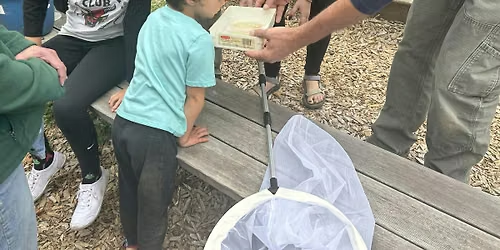
Field Practicum: Each day will have a field component, providing hands-on experience in slow and fast water sites. Students will then use the data gathered in the field to practice developing a conceptual plan.
Instructor:
Zee Searles Mazzacano, Ph.D., is the Owner and Principal Scientist at CASM Environmental LLC, where their work focuses on insects, freshwater mussels, and other invertebrates. Zee has a B.S. in Genetics & Cell Biology and a Ph.D. in Entomology from the University of Minnesota. Their research and teaching has taken them from river bottoms to tree canopies and from universities to fish & wildlife agencies, non-profits, and independent consulting as they work to investigate and preserve insect species, characterize their impacts on habitats, and develop management plans that protect the overall ecosystem. Zee's field research includes species surveys, habitat delineation, population status and distribution assessment, and macroinvertebrate-based aquatic bioassessment. As an educator, Zee strives to impart excessive enthusiasm about insects to others and engender a greater awareness and appreciation of their important ecological functions.
Learning Outcomes:
Upon completion of this workshop, students should be able to:
- Upon completion of this workshop, students should be able to:
- Explain the importance of knowing why one would want to assess macroinvertebrate populations, and how the goal might influence the approach.
- Accurately identify aquatic macroinvertebrate specimens to family, using morphological characteristics and dichotomous keys.
- Describe macroinvertebrate ecosystem services.
- Distinguish between different functional feeding groups & habit types.
- Recognize the value of indicator species.
- Use and identify a variety of sampling gear available to properly collect specimens.
- Properly preserve specimens.
- Determine appropriate types of data analysis for a given situation (EPT Index, taxa richness, functional feeding groups, percent dominance, temperature associations, Indices of Biotic Integrity, predictive models, Biological Condition Gradients
Major Topics:
- Macroinvertebrate identification
- Recognize macroinvertebrate ecosystems
- Functional feeding groups and habit types
- Indicator species
- Specimen preservation
- EPT Index, Richness, Trophic groups, Percent dominance, IBI, Predictive models, Biological condition gradients, and Functional Feeding Groups
- Sampling gear to collect and ID specimens
- Field Practicum
Note about Field work:
Dress appropriately for field work. Come prepared for a day in and around the water, so boots or waders if you have them, or shoes that you don't mind getting wet and have good traction. No felt-bottom wader boots which have been shown to transmit invasive algae. Also bring a water bottle, sun protection, maybe a trek pole that may help with good footing in the water.
Refund Policy:
Cancellations are allowed up to 1-day prior to the start of class, however, refund amounts vary based on when you notify us of your cancellation.
- >14 days prior to event: Full refund, excluding Eventbrite fees
- 1-14 days prior to event: 50% refund, excluding Eventbrite fees
Please contact [email protected] if the cancellation is due to illness or family emergency. We will work with you on a case by case basis, and may be able to apply your registration fee toward a future workshop.
Thank you to our sponsor:
Where is it happening?
Event Location & Nearby Stays:
USD 300.00 to USD 375.00