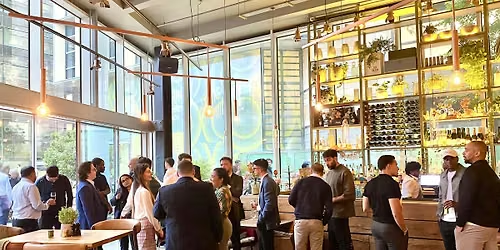
AI Trust Forum - London

About this Event
London - AI Trust Forum
The AI Trust Forum is special.
It brings together brilliant thinkers, innovators, policymakers, and practitioners to learn, build relationships, and work together personally solving AI engineering, business, legal and ethical challenges at retreats held in cities around the world. That’s why we call it a “Forum”, not a “Conference”.
What happens at the Forum?
Keynotes
Visionary sessions from global leaders framing the most pressing engineering, business, legal, and ethic issues in AI to spark strategic insight and set the agenda.
Open Working Sessions
Small group collaboration tackling specific challenges in AI alongside leaders in the space. Participants ideate, whiteboard, and contribute to publicly shareable work.
Town Halls
Expert-led open discussion where attendees interrogate pressing topics, exchange diverse perspectives, and brainstorm possible courses of action.
Symposium Sessions
Presentation showcasing original research, innovative practice, or notable case studies that attendees can use in their work building Trustworthy AI back home.
See our website for more information about this event: london.trustforum.ai
Click to register your interest, and secure your place at this unmissable forum.
Agenda is subject to change
Agenda
🕑: 09:00 AM - 10:30 AM
Opening Keynote
Host: Mike Bugembe
Info: The day opens on a shared stage, not a single keynote: several leaders seed the ideas the rest of the programme returns to.
First, the question the Forum exists to ask. Trustworthy AI is an engineering problem, a regulatory problem, and an ethical one. Most of the day covers the first two. Everyone building AI asks whether to build it, exploit it, or control it; far fewer ask what kind of organisation they intend to build with it. An organisation that cannot answer that has no way to judge which AI is worth the money.
Then the morning turns practical: AI strategy and architecture shown working as an instrument rather than a document; a keynote from the Chief of Information Management, UN Political and Peacebuilding Affairs; and an introduction to AI diligence, a discipline most leaders already undergo without knowing its name.
Leave with a shared vocabulary for the day, a higher bar for what counts as hard, and a question about your own organisation you did not arrive with.
🕑: 10:40 AM - 11:40 AM
The AI Partner of the Future
Host: Lucy Bourne
Info: To be announced
🕑: 11:50 AM - 12:50 AM
Strangers at the Gate: AI Diligence and the Organizations That Survive It
Host: Andrew Welch
Info: Sooner or later, someone who does not know your organization and is under no obligation to be fair will ask it to prove how its AI works. AI-specific diligence frameworks are published and in active use. The question is no longer what will be asked, but whether the answer exists before the question arrives.
The technologist's companion to the legal framework from Danny Tobey and colleagues at DLA Piper, drawn from original work published by the Center for Trustworthy AI. Everything counsel asks for is either an artifact a well-run AI program already produces, or evidence that no such program exists. Diligence is a maturity assessment performed by strangers, under time pressure, with valuation at stake. And it is no longer confined to M&A. Customers, insurers, auditors, and boards ask the same questions on different letterhead.
Attendees leave with a way to tell which of those questions they could answer today with evidence rather than assertion.
🕑: 12:50 AM - 01:50 PM
Lunch and Networking
🕑: 01:50 PM - 02:50 PM
Navigating AI's Choppy Regulatory Seas
Host: To be announced
Info: To be announced
🕑: 03:00 PM - 04:00 PM
Symposium Session
Host: Karim Galzahr
Info: To be announced
🕑: 04:15 PM - 05:00 PM
Closing Keynote
Host: Dona Sarkar
Info: Microsoft's Director of Enterprise AI Advocacy closes the day on what she sees inside organisations: the ones that make the leap, the ones that stall, and the difference between them, which is rarely what leadership believes it is.
The second half is ask and answer. Put your real problem to the room, whatever the day has surfaced or failed to resolve. Often the answer turns out to be someone three seats away who solved it eighteen months ago, and those introductions are made deliberately and followed up after the event rather than left to the coffee queue. It is the part of the day the Forum takes most seriously. Published knowledge is durable, but a peer who will take your call next year is worth more.
What attendees leave with: a straight answer from someone who sees hundreds of these programmes, at least one introduction worth having, and a next step that fits their organisation.
Working Sessions
🕑: 10:40 AM - 01:05 PM
Working Session A - Getting and Keeping Agents in Production (at Scale)
Host: Chris Huntingford
Info: Building an agent is no longer the hard part. Keeping a population of them running inside a real organisation is. This session takes on the machinery that decides whether agents survive contact with the organisation's real work, and it stays deliberately platform-neutral: identity and permissions, ownership and who gets called at night, cost and consumption, observability, versioning and change control, retirement, and the problem of the agents nobody registered.
It is work rather than talk. Attendees put their own blockers on the table at the start, the group sorts them into the patterns that keep recurring, and the remainder of the time is spent building shared answers to the ones most of the room holds in common. The conversation stays at the level where it transfers, so that a bank or a public sector agency can use a version of the same answer, with each participant's specifics as the worked examples.
🕑: 12:50 PM - 01:50 PM
Lunch and Networking
🕑: 01:35 PM - 04:00 PM
Working Session B - Human Context Protocol and the AI Workforce of the Future
Host: Ana Welch
Info: Every organisation runs on context its people hold implicitly. Who decides what. What gets escalated, to whom, and how fast. What good work looks like. What is never done regardless of who asks. Almost none of it is written down, and agents inherit none of it. The Human Context Protocol is an open line of work on making that context explicit enough that mixed teams of people and agents can operate against it: leadership capabilities, decision rights, and the operating norms of teams whose members are not all human.
This is a drafting session. What is a role when part of it is performed by an agent? Where does accountability sit when the work was assembled by software and approved by a person? What must digital fluency mean now? What do regulators already expect an organisation to demonstrate about the competence of its people? The work stays at the level of the protocol rather than any one sector, with participants' own situations as the test cases.
Where is it happening?
Event Location & Nearby Stays:
GBP 0.00