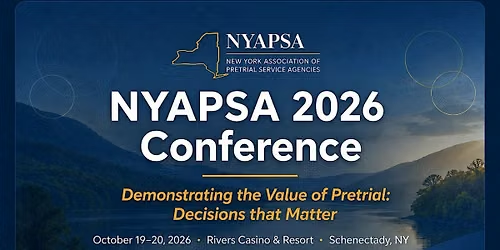
2026 NYAPSA Annual Conference: Built on 50 Years of Pretrial Practice

About this Event
The New York Association of Pretrial Service Agencies invites you to the 2026 NYAPSA Annual Conference, taking place October 19–20, 2026 at Rivers Casino & Resort in Schenectady, New York.
This year’s conference recognizes NYAPSA’s long history of bringing pretrial professionals together while focusing directly on the challenges and opportunities facing the field today. Over two days, attendees will participate in workshops, plenary sessions, simulations, and practical discussions designed to strengthen pretrial services across New York State.
Conference topics will focus on areas such as pretrial practice, court appearance support, supervision strategies, behavioral health and treatment access, data and decision-making, communication, leadership, reentry, statewide collaboration, and emerging tools that can support stronger outcomes.
The 2026 conference is designed for professionals working in or alongside pretrial services, including pretrial agency staff, directors and supervisors, probation departments, nonprofit providers, court partners, treatment and service providers, policy professionals, and others committed to improving pretrial practice.
Registration includes access to conference sessions, materials, networking opportunities, vendor/sponsor exhibits, and meals/breaks as provided during the conference schedule.
Additional conference details, hotel information, and schedule updates will be shared as they become available.
Agenda
Engagement over Enforcement
Host: Todd Monahan, M.S., CASAC-M
Info: This presentation is designed to help pretrial professionals better understand and effectively work with individuals experiencing substance use challenges while under pretrial supervision. The training emphasizes practical, evidence-informed approaches that improve engagement, strengthen connections to treatment and recovery supports, and reduce unnecessary compliance failures tied to the realities of recovery.
Engagement Over Enforcement: Effective Pretrial Responses for Individuals with Substance Use Needs. The presentation will focus on balancing accountability with individualized, trauma-informed, and behaviorally informed supervision practices that recognize relapse, ambivalence, and fluctuating treatment readiness as common features of substance use disorders rather than automatic indicators of noncompliance or unwillingness to change.
Enhancing Pretrial Services Through Effective Use of Technology
Host: Gary Govel
Info: Pretrial service agencies face increasing demands: ensuring court appearance, supporting public safety, promoting fairness, and managing high caseloads with limited resources. Technology — when implemented thoughtfully — can strengthen decision‑making, streamline operations, and improve outcomes for both clients and the justice system. This workshop provides a practical, evidence‑informed exploration of how modern technologies can support pretrial functions, reduce administrative burden, improve pretrial outcomes, and enhance equity. Through facilitated audience participation and polling, this workshop will explore technologies currently utilized by pretrial service agencies across the state, identify technology related needs and gaps, and examine how technology supports the goals of NYAPSA and individual agencies, and national standards.
Pretrial and Probation: Compare and Contrast
Host: Tanya Anderson
Info: As pretrial systems continue to evolve, the risk of drifting from core principles increases. This session brings participants back to the foundations of pretrial practice, grounded in the presumption of innocence, the necessity of individualized decision-making, and the legal requirement that any conditions imposed must be necessary to reasonably assure a person's return to court. Drawing on national research, New York’s evolving bail statute, and real-world examples, this interactive workshop will challenge participants to assess whether their current practices truly reflect pretrial fundamentals. Participants will examine how well-intentioned policies and practices can inadvertently undermine outcomes and learn practical strategies to realign their systems with evidence-based, principle-driven, and legally grounded approaches.
Gender-Based Violence Intervention: Supervision Best Practices
Host: Meghan Malone, M.S.
Info: Gender-Based Violence continues to be a prevalent issue facing those who work supervising individuals pre-trial. This presentation by the NYS Office for the Prevention of Domestic Violence will offer a refresher of GBV tactics of abuse with a focus on awareness of stalking, technology-facilitated gender-based violence, and strangulation. This presentation will also share best practices for those who supervise individuals who may commit or be victims of gender-based violence and how to use OPDV’s three pillar approach. We will also discuss Domestic Incident Reports and Danger Assessments, as well as how to utilize a Community Coordinated Response when working on these cases.
Peer Power in Pretrial
Host: Doug Bisher
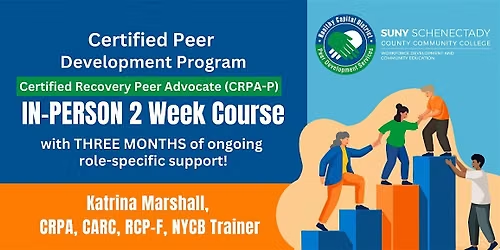
Info: This workshop will provide a practical, real-world look at how peer professionals can be effectively integrated into pretrial systems to improve engagement, strengthen service connections, and support better outcomes for justice-involved individuals. Drawing from my experience as a Certified Recovery Peer Advocate working within treatment courts, pretrial settings, and community-based recovery systems in Niagara County, I will highlight how lived experience can be used as a tool to build trust and reduce barriers at one of the most critical points in the justice process.
Systemic Equity & Justice: Using Defense Based Mitigation
Host: Angeeluz Cortorreal, M.A.
Info: Defense-based mitigation allows organizations like ours to present the Court with valuable client
information that may not otherwise have been considered at critical decision-making points,
including the fashioning of plea agreements and sentencing. We operate as non-attorney agents
of the Defense, practicing under a confidential parallel-services model. We provide a perspective
of our clients that includes: trauma exposure, socioeconomic status, childhood, mental &
physical health, and substance use. Our investigative process is trauma-informed and designed to be collaborative with assigned attorneys. Following our interview process and record review, we
submit comprehensive psychosocial reports, which provide the Court with an evaluation and
recommendation. These recommendations align with the attorney's advocacy goals while also
considering the best interests of our clients and public safety.
Trauma-Informed Court Advocacy/Addressing Technical Violations w/o Remand
Host: Imairis Reynoso
Info: This interactive presentation uses a real-world scenario to strengthen empathetic advocacy and communication in high-stakes settings between program and courts. Participants examine a case involving a client with a significant trauma history who appears non-compliant, highlighted by missed appointments, a failed drug screen, and curfew violations while required to provide context in a courtroom setting.
The training focuses on helping staff translate trauma-related behaviors into clear, courtroom-appropriate language, avoid clinical jargon, and balance confidentiality with effective advocacy. Through guided simulation, participants practice presenting a corrective, supportive plan rather than a punitive response, advocating for graduated interventions, and demonstrating both accountability and client engagement.
It's Not About Me: Eff. Use of Self Disclosure in Trauma Informed Pretrial
Host: Carrie Miceli, LMSW
Info: his interactive workshop explores how staff can integrate their lived experience
into effective self-disclosure techniques to improve pretrial services through a relational,
trauma-informed lens in the service of improving the pretrial supervision experience.
Pretrial professionals bring a wide range of personal and professional experiences to their
work along with individual resilience and relatability. Sharing these
experiences appropriately in professional settings requires intention, strong boundaries,
and awareness of purpose. Attendees will examine the differences between relationshipbuilding and relationship-diminishing self-disclosure, reflect on how their experiences
influence interactions with participants, and develop strategies for using authenticity to
build trust, foster engagement, and strengthen credibility. The session will offer practical
tools to address common communication pitfalls of such as oversharing, reactive sharing,
and boundary drift.
The Power of Pretrial Data
Host: Alexandra Ackles
Info: Pretrial agencies are tasked with collecting, reporting, and navigating data across a variety of
formats and contexts. This session explores the importance of high quality, standardized data in
supporting effective, evidence-based pretrial practice. From operational insights and
evidence-based decisionmaking to cross-jurisdictional comparisons and informing public
perception, we illustrate what is possible when agencies adopt strong data collection practices.
We will address common challenges, from technology limitations to definitional inconsistencies,
and provide a set of recommendations for how to begin addressing these hurdles in your
organization. Throughout this session, attendees will have the opportunity to share challenges and
solutions from their own perspective, workshop solutions to common issues, and will leave with an
understanding of where to begin, or how to strengthen what they already have, along with a
renewed understanding of the power of reliable pretrial data.
Staying True to Pretrial Fundamentals: Aligning Practice with Core Principles
Host: Tanya Anderson
Info: This session brings participants back to the foundations of pretrial practice, grounded in the presumption of innocence, the necessity of individualized decision-making, and the legal requirement that any conditions imposed must be necessary to reasonably assure a person's return to court.
In New York, this legal framework is clearly defined. Under CPL § 510.10, courts must make an individualized determination of flight risk, and pretrial decisions are—by law—focused exclusively on ensuring court appearance, not on managing perceived dangerousness. Yet as political pressure, agency culture, and post-conviction habits shape daily practice, even well-intentioned practitioners can drift from these foundations. Drawing on national research, N.Y’s evolving bail statute, and real-world examples, this interactive workshop will challenge participants to assess whether their current practices truly reflect pretrial fundamentals.
More Coming Soon!
Keynotes, Simulations and Additional Workshops will be updated soon
Where is it happening?
USD 150.00 to USD 295.29