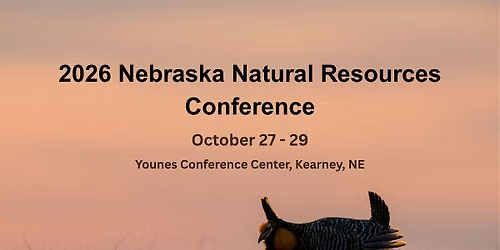
2026 Nebraska Natural Resources Conference

About this Event
Conference website
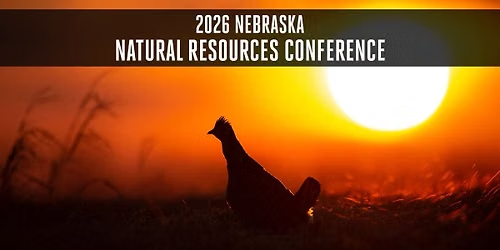
Welcome to the 2026 Nebraska Natural Resources Conference.
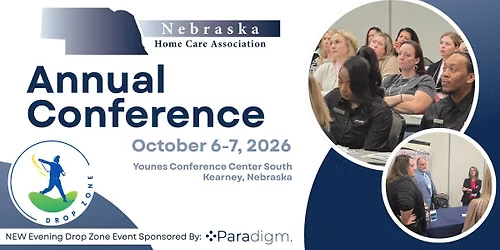
This year, we're gathering in person at the Younes Center South in Kearney, NE for several days of networking, learning, and fun. Join us for engaging presentations, interactive workshops, and insightful discussions with fellow range/wildlife professionals. Don't miss this opportunity to connect with like-minded individuals and stay up-to-date on the latest trends in natural resource management. Mark your calendars and get ready for an unforgettable experience at this event.
Early registration ends October 12, prices go up by $20/ticket on October 13.
Hotel Room Block
Comfort Inn - Kearney, NE
Reserve your room by September 27 using one of the following methods:
Book online using this conference room block link
Or all the hotel (308)251-2822 and mention you are with "TWS/SRM/NNLP Conference 2026".
A credit card is required to guarantee your reservation.
Reservations made after September 27 are subject to availability. If rooms remain available, the hotel will continue to honor the conference rate for reservations made by phone.
Please note: If your room is being direct billed to your organization, you must call the hotel to make your reservation. Direct-billed reservations cannot be made using the online booking link.
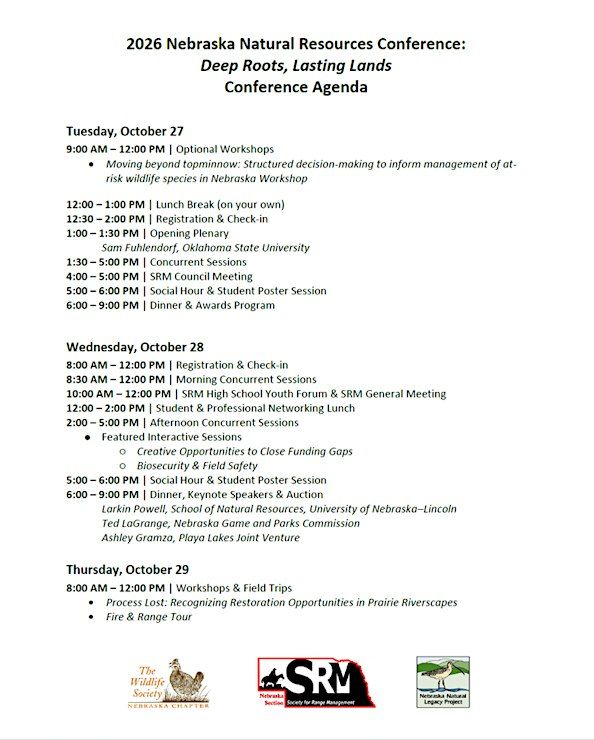
Workshop & Interactive Session Descriptions:
Tuesday Workshop | 9:30 AM - 12:00 PM
Moving beyond topminnow: Structured decision-making to inform management of at-risk wildlife species in Nebraska
Facilitator: Dr. David Schumann, Associate Professor, University of Wisconsin-La Crosse, Department of Biology and River Studies Center
Background: Decision-making in conservation planning requires recognition of ecological, social, and political perspectives and the economics of diverse management strategies. Through the process of structured decision-making, valuable stakeholder expertise can be used for deliberation of important ecological and population processes and uncertainties to identify management strategies most likely to achieve conservation objectives. The Nebraska Games and Parks Commission (NGPC) implemented a structured decision-making effort for Plains Topminnow (Fundulus sciadicus, PTM), a prioritized species for management lacking an organized management plan in Nebraska. In collaboration with NGPC, we designed decision analysis tools to inform the statewide management of PTM. We developed a Bayesian belief network to target management efforts and a Bayesian decision network to rank management actions at stream sites identified for management. Through this approach, a standardized, non-regulatory management plan was developed for use in the conservation of PTM in Nebraska through defensible management decisions.
Workshop Description: Building off of the Plains Topminnow (PTM) research, this workshop will explore its applicability to other wildlife species of conservation concern in Nebraska. Participants will be introduced to structured decision-making and then work through the initial framework for applying a similar process to Greater Prairie-Chicken (Tympanuchus cupido) conservation as a case study. Along the way, we'll discuss objectives, spatial scales, stakeholder input, and other key considerations that shape decision models. Participants will leave with a practical understanding of structured decision-making and ideas for adapting the framework to their own conservation challenges.
Wednesday Interactive Sessions | 2:00 - 5:00 PM
Creative Opportunities to Close Funding Gaps
Facilitators: Amelia Baker and Jessi Tapp
Description: Funding can be a limiting factor for implementing conservation. In this workshop, we’ll hear from conservation grant writing professionals in Nebraska about how to leverage partnerships to be competitive in the grant writing process and hear lessons learned during a career in grant writing. We’ll also have small group discussions to inspire partner collaboration, identify where funding needs overlap, and discuss ways to improve grant writing across the state. Whether you’ve written grants before, are interested in pursuing funding, or are someone in need of funding for your organization, all are welcome to participate.
Biosecurity and Field Safety
Facilitators: Colleen Rothe-Groleau and Andrea Malek
Description: The Biosecurity and Field Safety Session is meant to encourage students and professionals to make safety and biosecurity an automatic part of their field work rather than an afterthought. We’ll hear from experts on preventing the spread of aquatic and terrestrial invasive species, wildlife health, safe handling of animals, and general safety before, during, and after working in the field. We will demonstrate easy preventative maintenance that everyone should be doing as part of the day-to-day work we do. The takeaways from this session should be that these are things we should automatically be doing, rather than an afterthought. Complacency and distraction result in accidents and injuries. An ounce of prevention today avoids a ton of work trying to catch up to the problem once it’s had a chance to run away.
Thursday Morning Workshop & Tour Options
Process Lost: Recognizing Restoration Opportunities in Prairie Riverscapes
Facilitators: Cassidy Wessel and Kyle Schumacher
Estimated Duration: 8:00 AM – 12:30 PM
*Note: The Thursday field tour builds on the concepts introduced during the Wednesday morning discussion session. While attendees are welcome to participate in the field tour only, attending both sessions will provide the full workshop experience.
Description: Low-Tech, Process Based Restoration (LTPBR) Strategies have been gaining popularity for the last two decades as resource practitioners seek to better match the scale of stream restoration implementation to the scale of need. Nebraska ranks as one of the top states in the nation for miles of rivers and streams found within its borders, yet consideration of aquatic and riverine resources are often overlooked in larger grassland restoration projects because of the perceived cost and complexity, or lack of regional training to diagnose problems and craft solutions. This workshop is intended to help resource professionals learn to recognize when prairie streams are not functioning naturally, to identify where LTPBR solutions can benefit grassland systems, and to introduce participants to the planning and permitting steps for initiating process-based stream projects. The discussion topics on Wednesday morning will include defining and understanding riverscapes, understanding the role of beavers on the Great Plains, lessons learned from beaver dam analog projects in the Great Plains, and rules and expectations around the most recent Nationwide 27 permit guidance. The field tour on Thursday will focus on recognizing active vs. past incision, beneficial vs. non-beneficial erosion for sediment balance and supply, and floodplain function.
Fire and Range Tour
Facilitator: Jacob Harvey
Estimated Duration: 8:00 AM – 1:30 PM
Seating is limited. Please reserve your spot during conference registration. Tour enrollment is first come, first served.
Description: Details to come. If you are interested in learning more or assisting with the field tour please reach out to Jacob Harvey at [email protected]
Where is it happening?
Event Location & Nearby Stays:
USD 0.00 to USD 161.90