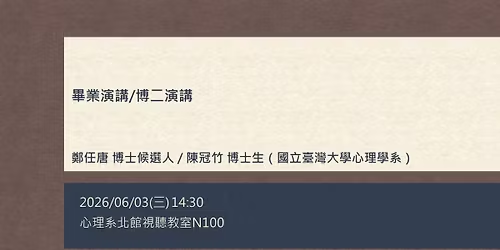
演講訊息 6/3 鄭任唐 博士候選人/陳冠竹博士生 (國立臺灣大學心理系)
Schedule
Wed, 03 Jun, 2026 at 02:30 pm
UTC+08:00Location
台北市大安區羅斯福路四段1號、 10617 | Taipei, TP

Advertisement
日期:2026/06/03(三)地點:北館視聽教室N100
場次一 【畢業演講】14:30-15:30
講者:鄭任唐 博士候選人 (國立臺灣大學心理系)
講題:Individual Differences and Neural Bases of Technology-Mediated Verbal and Nonverbal Communication
摘要:
Technology-mediated communication has become increasingly central to everyday social interaction, yet its psychological and neural consequences remain incompletely understood. When people communicate through video conferencing systems or interact with AI agents, the social conditions of communication are altered: the interlocutor may be nonhuman, nonverbal cues may be reduced, and the emotional context may become ambiguous. This study examined how such technological mediation influences communicative experience, cognitive performance, and neural processing, with particular attention to individual differences.
Two complementary experiments were conducted. The first used an fMRI agent-interaction task to compare brain responses during interactions with human partners and chatbots, and examined whether subjective ratings of fluency, sociality, and human-likeness were associated with distinct neural activation patterns. The second investigated video conferencing, testing how camera use, emotional climate, and personality traits jointly predicted memory retention and attentional performance.
Results suggested that chatbots interaction elicited stronger engagement of attention and cognitive control networks, indicating that communicating with AI may require greater cognitive resources than human interaction. In video meetings, camera use itself did not significantly affect memory performance. Instead, personality-related factors were more predictive: higher agreeableness was associated with poorer memory, and extraverts showed reduced recall in emotionally neutral contexts. Overall, the findings suggest that the effects of technology-mediated communication depend more on individual characteristics and socio-emotional context than on technological format alone.
場次二 【博二演講】15:30-16:00
講者:陳冠竹 博士生 (國立臺灣大學心理系)
講題:少年矯正學校適應議題:評估工具的建構與心理結構探索
摘要:
本研究旨在建構一套適用於臺灣少年矯正學校之適應議題評估工具,以作為三級輔導與個案評估之參考。本研究透過文獻整理、焦點團體訪談及實務工作者討論形成初始題庫,並赴少年矯正學校對學生進行預試與正式施測,正式施測樣本涵蓋全臺四所少年矯正學校,其中男性451人、女性42人。經題目修訂、因素分析及信效度檢驗後,最終量表包含負向自我概念、情緒困擾、情緒調適、自傷殺議題、家庭議題、人際議題、創傷經驗、創傷反應及問題急迫性等九個構面。
研究結果顯示,少年矯正學校學生之適應議題具有多面向且高度交互影響之特性,驗證性因素分析支持九因素結構。各構面間呈現具有理論意義之高度關聯,反映少年矯正學校學生心理困擾之複雜性與系統性。人口變項分析結果顯示,女性學生於多數構面之得分皆顯著高於男性;年齡與多數適應議題呈現低度負相關;在校時間長度則與多數適應議題呈現無線性相關,反映適應議題可能隨著學生年齡變化,但不因在少年矯正學校之收容時間長短影響。
本研究除提供矯正學校學生適應困難之心理結構觀點外,亦期待此評估工具未來可應用於少年矯正學校之輔導實務中,協助輔導人員辨識學生適應議題,並作為轉介與成效評估之參考依據。
Advertisement
Where is it happening?
台北市大安區羅斯福路四段1號、 10617, 台灣106216台北市大安區羅斯福路四段1號,Taipei, TaiwanEvent Location & Nearby Stays:

Know what’s Happening Next — before everyone else does.