‘Pakadarpan’ (The Culinary Mirror): get a taste of ‘hitahara,’ menu curated from ‘Pakadarpanam’

Advertisement
Paushtik Life opens its table to a small group of guests for an extraordinary twelve-course lunch drawn entirely from the Pakadarpan — one of the oldest surviving books on culinary art in human history, authored by Raja Nala, the legendary king of Nishadha. A master chef of antiquity, endowed with eight divine boons from Indra, Agni, Varuna, and Yama, Raja Nala was considered peerless in two arts: cooking and chariot driving. His recipes have waited centuries to be tasted again. They are ready now.
This is not a heritage food festival or a cooking demonstration. It is a seated supper club — an intimate, curated dining experience in which every dish has been researched, tested, and faithfully recreated from the Pakadarpan and other classical Sanskrit culinary texts, including the Manasollasa of King Someswara III of the Chalukya dynasty. The menu changes with the season and the occasion. Every ingredient is chosen for its provenance, its role in Vedic dietary wisdom, and its flavour. Every dish arrives with its story.
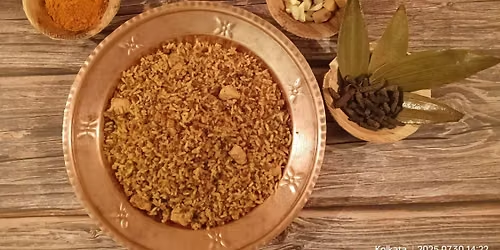
Twelve courses. No ultra-processing. No industrial shortcuts. No ingredients that would have been unrecognisable to the ancient Indian kitchen. Ancient Indian culinary science understood something that modern nutritional science is only now rediscovering: that food is not fuel — it is medicine, ceremony, and philosophy. The Vedic tradition distinguished between Hitāhāra, food that nourishes the body and sustains life, and Ahitāhāra — also called Viruddhāhāra — food that interferes with normal body function and, over time, causes disease. Every dish at the Raja Nala table is Hitāhāra, by design and by tradition. The grains trace their lineage to the Kashyap Samhita and the Brihadaranyaka Samhita — barley, rice, sesame, masha, millet, wheat, lentils, and horsegram. The condiments find their ancestry in the Arthashastra — mustard, linseed, safflower, and sugarcane. The spices are not seasoning. They are healing.
We live in an age of abundance and illness simultaneously. Lifestyle diseases — obesity, hypertension, cardiac conditions, certain cancers — are rising at a rate that cannot be explained by genetics alone. The explanation, in large part, is on our plates. The ancient masters who wrote these texts were not romantics; they were precise observers of the relationship between food and the human body, and they documented what they found with extraordinary rigour. Paushtik Life believes the most powerful response to the crisis of modern eating is not to lecture about it, but to serve an alternative — course by course, conversation by conversation, table by table.
Each course is accompanied by a short narrative: its ingredient, its Vedic significance, and its place in the ancient science of eating well. Seating is strictly limited to preserve the intimacy of the experience. This is part of Paushtik Life's broader mission to create a living, tasted, shared practice of Vedic cuisine — and an open conversation about what it means, in 2025, to eat with intention.
Let's bring ancient flavours to modern plates — authentically, responsibly, and deliciously.
Experience curated by Paushtik Life
This is not a heritage food festival or a cooking demonstration. It is a seated supper club — an intimate, curated dining experience in which every dish has been researched, tested, and faithfully recreated from the Pakadarpan and other classical Sanskrit culinary texts, including the Manasollasa of King Someswara III of the Chalukya dynasty. The menu changes with the season and the occasion. Every ingredient is chosen for its provenance, its role in Vedic dietary wisdom, and its flavour. Every dish arrives with its story.
Twelve courses. No ultra-processing. No industrial shortcuts. No ingredients that would have been unrecognisable to the ancient Indian kitchen. Ancient Indian culinary science understood something that modern nutritional science is only now rediscovering: that food is not fuel — it is medicine, ceremony, and philosophy. The Vedic tradition distinguished between Hitāhāra, food that nourishes the body and sustains life, and Ahitāhāra — also called Viruddhāhāra — food that interferes with normal body function and, over time, causes disease. Every dish at the Raja Nala table is Hitāhāra, by design and by tradition. The grains trace their lineage to the Kashyap Samhita and the Brihadaranyaka Samhita — barley, rice, sesame, masha, millet, wheat, lentils, and horsegram. The condiments find their ancestry in the Arthashastra — mustard, linseed, safflower, and sugarcane. The spices are not seasoning. They are healing.
We live in an age of abundance and illness simultaneously. Lifestyle diseases — obesity, hypertension, cardiac conditions, certain cancers — are rising at a rate that cannot be explained by genetics alone. The explanation, in large part, is on our plates. The ancient masters who wrote these texts were not romantics; they were precise observers of the relationship between food and the human body, and they documented what they found with extraordinary rigour. Paushtik Life believes the most powerful response to the crisis of modern eating is not to lecture about it, but to serve an alternative — course by course, conversation by conversation, table by table.
Each course is accompanied by a short narrative: its ingredient, its Vedic significance, and its place in the ancient science of eating well. Seating is strictly limited to preserve the intimacy of the experience. This is part of Paushtik Life's broader mission to create a living, tasted, shared practice of Vedic cuisine — and an open conversation about what it means, in 2025, to eat with intention.
Let's bring ancient flavours to modern plates — authentically, responsibly, and deliciously.
Experience curated by Paushtik Life
Advertisement
Where is it happening?
Paushtik Life, Palki Apartment, P-11, Bansdroni, Kolkata 700070, India, Kolkata
Event Location & Nearby Stays:
Know what’s Happening Next — before everyone else does.
Host or PublisherImmersive Trails-Global