Threads, Echoes, and Ink
Schedule
Thu May 14 2026 at 05:00 pm to 06:30 pm
UTC+01:00Location
Woolf Institute | Cambridge, EN
About this Event
Usually, when thinking about medieval Spain, one thinks of castles, kings and knights. Spain is understood as an extension of Christian Europe. Its cultural diversity – when considered – is framed as a sort of European version of the Crusades.
This event aims to look at medieval Spain under a different light: one in which the ‘otherness’ of those of different faiths is not seen as alien but understood as part of a rich cultural heritage; and one that is not focussed on the history of power, men and warfare but rather on the histories of poets, philosophers, women and everyday people. All these voices, intertwined, form the choir – sometimes harmonious, sometimes dissonant – that was the culture of medieval Spain.
This event will consist of three 15-minute talks, each of which will look at Spain and medieval Mediterranean culture from a different perspective. The event will conclude with a discussion between the speakers and questions from the audience.
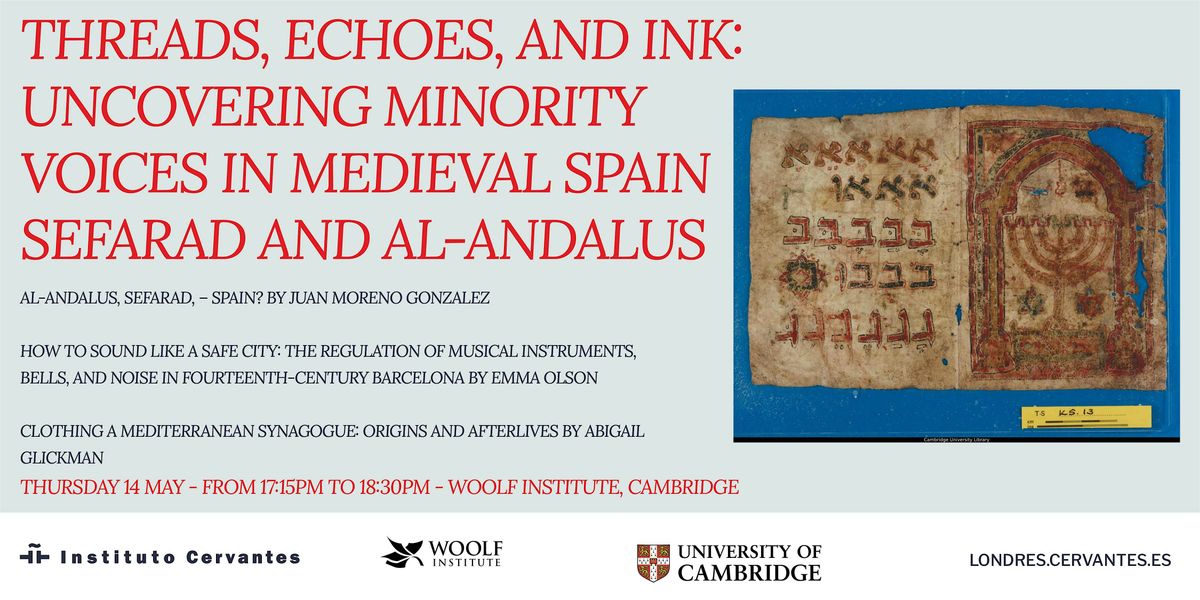
Al-Andalus, Sefarad, – Spain?
Juan Moreno Gonzalez
This talk aims to explore the Jewish and Muslim cultural heritage of Spain, providing a brief summary of its most important exponents and achievements. It will also discuss some of the surviving manuscripts that were produced by this culture and are preserved at the library in Cambridge. Finally, it will conclude with a reflection on how this heritage is perceived in modern-day Spain.
How to Sound Like a Safe City: The Regulation of Musical Instruments, Bells, and Noise in Fourteenth-Century Barcelona
Emma Olson
What did medieval Barcelona sound like? How, if at all, did civic authorities, like the famous Consell de Cent, attempt to regulate noise? This presentation will reveal the results of an extensive investigation into the sonic worlds of fourteenth-century Barcelona via the abundant medieval archives of Catalonia. Most notable is a surprising ban on musical instruments and what it might tell us about medieval understandings of sound, violence, and the daily governance of an urban environment.
Clothing a Mediterranean Synagogue: Origins and Afterlives
Abigail Glickman
In the late seventeenth century, Jewish travellers seeking hidden scrolls visited the Ben Ezra synagogue in Fustat – old Cairo – and commented on the graffiti covering its walls. To the historian Joseph Hacker, these inscriptions were a “barbaric practice of defacing the structure”, an indication that the synagogue had become “more a tourist site” and “less a sacred place”. Challenging Hacker’s distinction between the secular and the sacred, and how we see and remember across histories and narratives, this talk will look at an eleventh-century transfer of textile to a woman via her dowry, and the textile’s subsequent reuse as covering for a synagogue’s walls, reading the seventeenth-century inscriptions as an afterlife of the eleventh-century textile. The intention is to map the movement of textile from a woman’s body to the body of the synagogue, analysing it, alongside the later graffiti text, as a social fabric(ation) that provides a critical point of entry into collective memory and cultural identity.
Where is it happening?
Woolf Institute, Madingley Road, Cambridge, United KingdomEvent Location & Nearby Stays:
GBP 0.00