THE FLYING ACE w/ Pipe Organ Score by Jeff Rapsis!
Schedule
Fri, 10 Apr, 2026 at 06:30 pm
UTC-04:00Location
Epsilon Spires | Brattleboro, VT

Advertisement
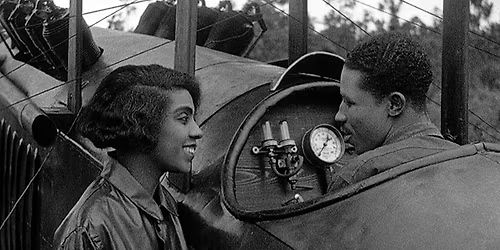
Celebrate Black History with the 100th Anniversary of THE FLYING ACE with a dynamic live soundtrack performed on our Estey pipe organ! A rare surviving example of silent films produced early in the 20th century intended for Black audiences in segregated cinemas, featuring an All-Black cast.Can discrimination exist in an America where everyone is Black? That's among the questions posted by THE FLYING ACE (Dir. Richard E. Norman, 60 mins, 1926). A former railway detective turned decorated fighter pilot comes home from the Great War just in time to foil nefarious local ne’er-do-wells and save the girl. The only "Race Film" production by Jacksonville’s Norman Studios to survive in its entirety features an all-Black cast led by Laurence Criner and Kathryn Boyd and inspired a generation of real-life heroes and first Black pilots to fly with the U.S. Air Force, the Tuskegee Airmen.
The Flying Ace was inspired by Bessie Coleman, America’s first black female licensed pilot, with whom filmmaker Richard Norman had discussed making an aviation movie. Unfortunately, Coleman was killed in an April 1926 plane crash while practicing for an air show at Jacksonville’s Paxon Airfield, now the Paxon School for Advanced Studies. Norman based the character of Ruth Sawtelle on Coleman, produced and released the film later that year. According to World War II historians, many of the young boys who would grow up to become the Tuskegee Airmen were inspired to fly by seeing The Flying Ace.
The Performance:
Jeff Rapsis lives in Bedford, New Hampshire, and accompanies silent film programs in venues throughout New England. A lifelong silent film fan, he began creating original musical scores and staging silent film programs in 2007 as a way to keep the form vibrant before the public. His technique is rooted in a traditional approach and texture, while applying imporovisation using contemporary scoring methods when appropriate to connect with today's audiences. Outside New England, he has accompanied films at the New York Public Library’s “Meet the Musicmakers” series and the Kansas Silent Film Festival. Rapsis has also provided original music for several silent film DVD releases by Looser Than Loose Vintage Entertainment of Manchester, N.H., and scored the independent feature film Dangerous Crosswinds (2005). His recorded scores also include piano music for Kino Lorber's reissue of Gloria Swanson's 'Zaza' (1923) and music for Reel Classic DVD's reissue of 'The Bells' (1926) starring Lionel Barrymore and Boris Karloff. As a composer, his 'Kilimanjaro Suite' for large orchestra was premiered in 2017 by the N.H. Philharmonic. A journalist by profession, Rapsis is co-founder and associate publisher of HippoPress, a weekly newspaper based in Manchester, N.H. He also serves as executive director of the Aviation Museum of N.H., a non-profit educational center based at Manchester-Boston Regional Airport. Jeff has previously performed live soundtracks on the historic Estey organ at Epsilon Spires for silent films: The Phantom Carriage, and The Last Command, Buster Keaton's THE GENERAL and Our Hospitality, and Clara Bow's romantic comedy "It".
HISTORICAL BACKGROUND FOR THE FLYING ACE:
“Unlike the stereotypical roles that Black actors usually played in silent-era studio films, Norman’s characters in The Flying Ace were dignified and dutiful examples of racial achievement. They included a Black stationmaster, a Black dentist, a Black deputy, and a daring heroine Ruth (played by distinguished Black actress Kathryn Boyd). But the most impressive of all was war hero Captain Stokes (played by J. Laurence Criner, Boyd’s real-life husband). Notably, Stokes—whom Norman depicts wearing his military uniform throughout the film—was a hero more aspirational than actual. Black men, after all, had been denied opportunities to serve as pilots in World War One and were restricted in their service in other military branches. By giving his audience the prominent and accomplished characters they wanted to see on screen, however, Norman lauded Black ambition, encouraged race uplift, and celebrated race pride.” -Barbara Tepa Lupack, Author & Historian
"Unlike his 1923 film REGENERATION, Richard Norman’s THE FLYING ACE exists in its entirety, and the image quality is stunning. A rural crime drama revolving around a pair of rival aviators, THE FLYING ACE illuminates the fact that many films made for African American audiences were less concerned with race than with making popular entertainment in the traditional Hollywood style. Filmed in the Arlington area of Jacksonville, Florida, THE FLYING ACE is a unique aviation melodrama in that no airplanes actually leave the ground (the spectacular flight scenes being performed on terra firma, in front of neutral backdrops). Norman divided the film into four chapters, so that exhibitors could show the film as a feature or as a four-episode serial. The film is buoyed by the presence of Norman Studios regular Steve “Peg” Reynolds as the hero’s one-legged sidekick, who in tne memorable scene rides a bicycle while firing a rifle built into the shaft of his crutch."
-Criterion
Advertisement
Where is it happening?
Epsilon Spires, 190 Main St, Brattleboro, VT 05301-2837, United StatesEvent Location & Nearby Stays:

Know what’s Happening Next — before everyone else does.