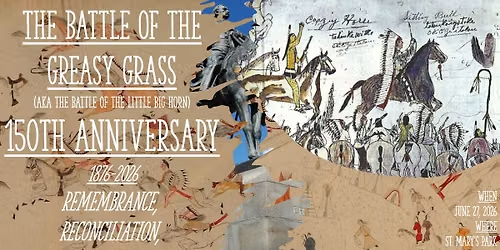
The Battle of the Greasy Grass 150th Anniversary: Remembrance, Reconciliation, Decolonization

Advertisement
This June marks the 150th anniversary of what is commonly known as ‘The Battle of the Little Bighorn’ but is better known as “The Battle of the Greasy Grass” by many Indigenous Americans. With this anniversary, we seek to address the legacy of this battle, as it represents one of the greatest examples of Indigenous resistance against imperialism.
We intend to mark this anniversary at the site of the “George Armstrong Custer Equestrian Monument” that was dedicated to the man famous for starting the battle in question, and which led to one of the greatest defeats in U.S. military history. The monument is ostensibly dedicated to Custer’s service during the American Civil War, and many today note how his acts on the Union side helped to end slavery as it existed in the U.S. However, the records of the ceremony dedicated to its unveiling paint a different picture. Many of the people involved in the ceremony continually praised Custer’s service after that war in the subjugation of Indigenous people, with no reference to slavery or the freedom of African Americans. This shows the intention for the monument to stand as a form of propaganda and highlights the racism implicit in its construction.
Poet Will Carleton helped dedicate the statue with a poem that included lines such as “The wrath of our ancient Indian foes”, “The days of treaties and truce were past”, and “foemen savage, numberless, fierce” (1,2). Then Monroe City Mayor Jacob Martin marked his speech accepting the statue with reference to “thousands of painted and hideous savages” (3). What’s more, then U.S. President William Howard Taft stated to the crowd in front of the statue how “driving out the bloody Indians” made “settlement” and the “building of railroads” possible. He even ended his speech testifying to the “effectiveness and heroism" of George A. Custer in “that great war for civilization, of which he was the most conspicuous and shining sacrifice.” (4)
In addressing the history of this monument, we seek to address the legacy of colonialism and imperialism as a whole. We seek to remember the lives of all those impacted by imperialism, in all its forms, over the generations. We seek to reconcile relations between all people alive today living with the impact of that legacy in order to end the cycles of trauma it has perpetuated. Moreover, we seek to foster a new legacy of decolonization: to repair the harms done, let go of harmful beliefs that set people against each other, and foster a healing bond between the people of all nations.
https://linktr.ee/MonroeGreasyGrass
1. https://archive.org/details/ceremoniesattend00mich/page/51/mode/1up
2. https://archive.org/details/ceremoniesattend00mich/page/52/mode/1up
3. https://archive.org/details/ceremoniesattend00mich/page/58/mode/1up
4. https://archive.org/details/ceremoniesattend00mich/page/41/mode/1up
We intend to mark this anniversary at the site of the “George Armstrong Custer Equestrian Monument” that was dedicated to the man famous for starting the battle in question, and which led to one of the greatest defeats in U.S. military history. The monument is ostensibly dedicated to Custer’s service during the American Civil War, and many today note how his acts on the Union side helped to end slavery as it existed in the U.S. However, the records of the ceremony dedicated to its unveiling paint a different picture. Many of the people involved in the ceremony continually praised Custer’s service after that war in the subjugation of Indigenous people, with no reference to slavery or the freedom of African Americans. This shows the intention for the monument to stand as a form of propaganda and highlights the racism implicit in its construction.
Poet Will Carleton helped dedicate the statue with a poem that included lines such as “The wrath of our ancient Indian foes”, “The days of treaties and truce were past”, and “foemen savage, numberless, fierce” (1,2). Then Monroe City Mayor Jacob Martin marked his speech accepting the statue with reference to “thousands of painted and hideous savages” (3). What’s more, then U.S. President William Howard Taft stated to the crowd in front of the statue how “driving out the bloody Indians” made “settlement” and the “building of railroads” possible. He even ended his speech testifying to the “effectiveness and heroism" of George A. Custer in “that great war for civilization, of which he was the most conspicuous and shining sacrifice.” (4)
In addressing the history of this monument, we seek to address the legacy of colonialism and imperialism as a whole. We seek to remember the lives of all those impacted by imperialism, in all its forms, over the generations. We seek to reconcile relations between all people alive today living with the impact of that legacy in order to end the cycles of trauma it has perpetuated. Moreover, we seek to foster a new legacy of decolonization: to repair the harms done, let go of harmful beliefs that set people against each other, and foster a healing bond between the people of all nations.
https://linktr.ee/MonroeGreasyGrass
1. https://archive.org/details/ceremoniesattend00mich/page/51/mode/1up
2. https://archive.org/details/ceremoniesattend00mich/page/52/mode/1up
3. https://archive.org/details/ceremoniesattend00mich/page/58/mode/1up
4. https://archive.org/details/ceremoniesattend00mich/page/41/mode/1up
Advertisement
Where is it happening?
St Marys Park Monroe Mi, Monroe, United States
Event Location & Nearby Stays:
Know what’s Happening Next — before everyone else does.
Host or PublisherCody Crutchfield