Stavros Niarchos Foundation Brain Insight Lecture

About this Event
Memory is fundamental for our ability to learn, make decisions, and guide future behaviors. Of course, we don’t remember just any random assortment of past events; what the brain latches onto are the significant ones, which can update with time and experience. What determines such significance? And how does the brain flexibly assign meaning to memories, both old and new? In this lecture, three experts bridge computational and experimental neuroscience approaches across species to examine the role memory plays in our lives.
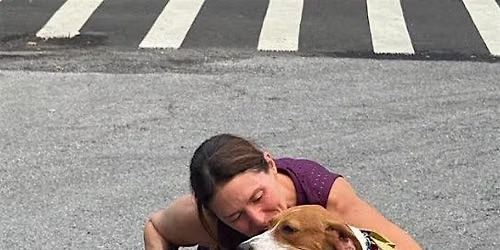
Daphna Shohamy, PhD, Director of the Mortimer B. Zuckerman Mind Brain Behavior Institute, Kavli Professor of Brain Science at Columbia University, and Co-Director of the Kavli Center for Neural Sciences, will open our event by sharing her research on how memory shapes who we are. Because we can’t remember every experience we’ve had, the brain must preserve the meaningful ones while the rest fade. One way to do this is to prioritize memories linked to rewards, a process involving the neurotransmitter dopamine. For example, discovering a surprising reward during spatial navigation ultimately leads to better memory for events that came right before the reward. Through experiments that explore how this happens, Dr. Shohamy shows us how the flexibility of memory allows us to make decisions adaptively and dynamically.
Ashok Litwin-Kumar, PhD, Associate Professor in Columbia's Department of Neuroscience and a member of the Center for Theoretical Neuroscience and the Zuckerman Institute, will then take us deeper into the details of how our experience affects what we remember. The philosopher and psychologist William James proposed that, “...whatever moods, affections, and passions I have, are in very truth constituted by, and made up of, those bodily changes we ordinarily call their expression or consequence.” Consistent with this idea that the body informs our emotional state, researchers have found that making fruit flies walk backwards when they smell an odor prompts the flies to learn to avoid that odor, as if it predicted a punishment. This process in flies also involves dopamine. By leveraging powerful computational tools and datasets, including a complete map of the fly brain and its connections, Dr. Litwin-Kumar explores how the body influences what we learn and which memories we keep.
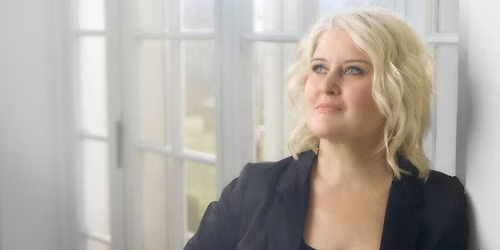
Following the two talks, Isabel Low, PhD, Postdoctoral Research Scientist at Columbia’s Zuckerman Institute, will moderate a discussion and Q&A with the speakers. Audience questions are welcome, either submitted during registration or live at the event.
About the experts
Daphna Shohamy, PhD, is the Director of the Mortimer B. Zuckerman Mind Brain Behavior Institute, and the Kavli Professor of Brain Science at Columbia University, where she co-directs the Kavli Center for Neural Sciences. Research in Dr. Shohamy's lab focuses on the link between memory and decision-making. Combining brain imaging in healthy humans with studies of patients with neurological and psychiatric disorders, Dr. Shohamy seeks to understand how the brain transforms experiences into memories, how memories shape decisions and actions, and how motivation and exploration affect human behavior.
Ashok Litwin-Kumar, PhD, is an Associate Professor in Columbia's Department of Neuroscience and a member of the Center for Theoretical Neuroscience and the Zuckerman Institute. He received a BS in Physics from Caltech and a PhD in Neural Computation from Carnegie Mellon University. His group builds theoretical models of how the activity of neural circuits gives rise to behavior. Of particular interest are models constrained by large-scale datasets, such as anatomical connectivity maps generated by electron microscopy and physiological recordings of populations of neurons. This work is done across species and systems, often in close collaboration with experimental colleagues.
Isabel Low, PhD, is a neuroscientist in the Aronov Lab at Columbia University’s Zuckerman Institute, where she researches how the brain uses memories to make decisions in dynamic environments. To study this question, she works with black-capped chickadees, small songbirds that flexibly leverage their powerful memories to make life-or-death decisions about whether to eat or save their caches of hidden seeds. She was awarded a Simons Society of Fellows Junior Fellowship to pursue this work. Dr. Low completed her graduate work with Dr. Lisa Giocomo at Stanford University, where she received the Sammy Kuo Award for Meritorious Neuroscience Research for her work studying flexible coding in the brain's navigation center. Outside of the lab, Dr. Low works to promote equity and job security in academic research and conducts informal studies of her infant twin daughters.
This talk is part of the Stavros Niarchos Foundation Brain Insight Lecture series, offered free to the public to enhance understanding of the neuroscience of the mind and the complexity of human behavior. The lectures are hosted by Columbia’s Mortimer B. Zuckerman Mind Brain Behavior Institute and supported by the Stavros Niarchos Foundation. When registering, please indicate whether you wish to attend in person or watch the livestream virtually. All registrants will receive a Zoom link for the livestream and a recording of the lecture afterwards.
Where is it happening?
Event Location & Nearby Stays:
USD 0.00