Scale Up Conference 2026
Schedule
Thu Jun 11 2026 at 09:30 am to 07:30 pm
UTC+01:00Location
Jesus College Cheng Kar Shun Digital Hub | Oxford, EN
About this Event
Scaling up represents a crucial, yet often neglected, aspect of scientific innovation. Many researchers discover the limitations of “It worked in the lab” only years after leaving academia. Embedding scale-up considerations into early-stage research can greatly enhance the societal (sustainability, world health, etc.) and industrial impact of academic discoveries.
The in-person Scale Up Conference 2026 at the University of Oxford will explore the scientific and technical challenges of translating laboratory-scale discoveries in chemistry, biology, materials science, and pharmaceuticals, in to viable industrial-scale processes.
Join us to hear about “AI for Scale-up Challenges” from our keynote speaker Antonio Del Rio Chanona (Imperial College London) as well as a fireside chat on “How to scale-up the manufacturing of the University of Oxford COVID-19 vaccine" with Sandy Douglas, (University of Oxford). This will complement two parallel speaker tracks throughout the day on scale-up challenges in Biology and Chemistry. More speaker details can be found below.
The conference will be followed by a Laboratory Automation Showcase and networking reception in the evening.
Tickets include lunch, tea breaks and a wine reception. The event is part of the Cheng Kar Shun Digital Hub Programme at Jesus College Oxford.
Speakers (more to be announced soon):
- AI for Scale-Up with Antonio del Rio Chanona (Imperial College London) Developing high-performing bioprocesses is costly and complex, requiring iterative, multi-scale experimentation from microtiter plates to pilot reactors. We propose a multi-fidelity batch Bayesian optimization framework to accelerate bioprocess development and reduce experimental costs. Multiple case studies show how the proposed workflow can achieve a reduction in experimental costs and increased yield.
- Fireside Chat with Sandy Douglas (University of Oxford) Sandy led the manufacturing scale-up of the University of Oxford COVID-19 vaccine up to the point of transfer to AstraZeneca. This included the development of the novel low-cost large-scale manufacturing process, and initiating the formation of the UK & international 'distributed manufacturing site' consortium which has produced over a billion doses. Following this fireside chat, Sandy will be joined by other speakers for a panel discussing process scale-up across both biology and chemistry. Moderated by Jonathan Cook (Jenner Institute Oxford)
- Emma Brass (University of Liverpool) Process chemistry creates scalable routes for new lead molecules and is a crucial but laborious stage in pharmaceutical and agrochemical development cycles. We have built an automated process chemistry platform that tackles late-stage process development. Timings for round-the-clock, back-to-back experiments suggest that the weekly reaction output of the robot operating multiple reactors could exceed that of a human process chemist by a factor of 12 in an industrial setting. In this talk, I will discuss our work building this platform and the challenges that we faced.
- Matthew Bone (Principal Computational Scientist, SOLVE Chemistry) Computational chemistry for automated virtual pre-screening of various tasks like solubility at SOLVE Chemistry.
- Dania Awad (Werner-Siemens Chair of Synthetic Biology, TU Munich) The SUSPENSE project develops bio-based wood adhesives from wheat bran milling waste, a readily available, non-food biomass. SUSPENSE links biorefinery processing with circular material design, with process validation progressing from laboratory scale (100 mL) to demonstrator scale (50–200 L), the project provides a clear pathway toward sustainable, industrially viable adhesive systems.
- Laura Helleckes (Eric and Wendy Schmidt AI in Science Postdoctoral Fellow, Imperial College London) Self-driving labs for scale-up with data-driven optimisation: Bioprocess experimentation is disconnected across scales - from microtitre plates to pilot reactors - making high-performing process development costly and complex. Conventional Design of Experiments (DoE) methods often struggle to address scale-up. Laura’s talk will highlight data-driven solutions, including multi-fidelity batch Bayesian optimisation.
- Suzanne Robb (CPI) Scaling a bioprocess is often framed as a problem of volume, but in reality it is a problem of understanding. As processes move from lab to pilot to production, hidden constraints emerge; biological, operational, financial, and regulatory, that cannot be solved by bigger vessels alone. This talk explores scale‑up as a systems challenge: one that demands deep process insight, access to the right scale‑up infrastructure and investment, and smarter approaches to managing risk. Drawing on real‑world examples and over 16 years of industry experience, it will examine how these challenges are being addressed in practice, and how advances in data integration, AI‑enabled modelling, and digital experimentation can be used to accelerate scale‑up decisions. By reducing timelines and costs while increasing confidence at every stage, this approach enables a more resilient, capital‑efficient path to manufacturing at scale, one in which technology and biology evolve together.
- Joe Taylor (Head of Innovation, Hoxton Farms) Scaling a bioprocess from R&D to manufacturing is a persistent challenge with high costs, long timelines and technical risk. We experienced this first-hand at Hoxton Farms, scaling mammalian cell culture from flasks to 500L. Solving this guided our development of Lattice, our modular, AI-native bioreactor platform. This talk will explore how AI-driven process development, automation and a scalable hardware platform can streamline bioprocess scale-up to cut costs and timelines and deliver biomanufacturing at scale.
- Jasper Schuurmans (University of Amsterdam) Jasper is a chemical engineer perusing his PhD in the Noël Research Group in Amsterdam. He will discuss scaling up synthetic organic photochemistry, with a focus on multiphasic systems. While new photochemical methods are typically developed at milligram scale, intensification and process design can enable production at gram and kilogram scale. Jasper will also emphasise the additional challenges associated with photochemical scale-up compared to conventional thermal chemistry.
- Hessam Mehr (Lecturer in AI for Science and Chemistry, King’s College London) Does scaling up discovery simply mean going from one to an army of robots searching for a hit? In this talk, I will showcase ongoing work in my research group to scale up the discovery of new molecules, reactions and materials, by re-imagining the search process without the constraints of manual laboratory chemistry.
FIND US
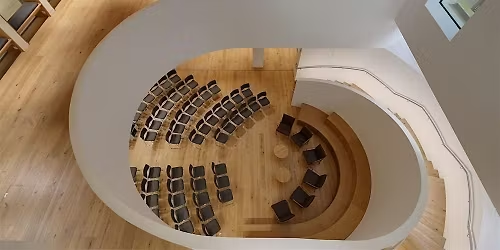
This event will take place in the Cheng Kar Shun Digital Hub at Jesus College, Oxford. The Hub entrance is on Market Street (opposite Wagamama). The Hub is accessible, with automatic double doors at the entrance and lifts to and from the main lower ground floor event space.
If you have any accessibility requirements, please do contact [email protected] and we are happy to help.
*Filming and photography will be taking place during the event. If you do not wish to be photographed or filmed, please notify a member of the Hub team on arrival.

Where is it happening?
Jesus College Cheng Kar Shun Digital Hub, Market Street, Oxford, United KingdomEvent Location & Nearby Stays:
GBP 45.00 to GBP 95.00