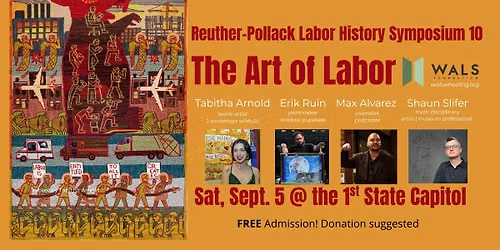
Reuther-Pollack Labor History Sympsium 10, The Art of Labor

Advertisement
The 10th Symposium is themed, The Art of Labor
The event is free, though to keep it accessible, admission is offered on a sliding scale of suggested donations.
Payment receivable any time WALSWheeling.org or at the door.
Suggested Donations:
Labor Leader: $60
Pay Your Way $30
Workers Appreciation: $5
Optional Lunch (Catered through Midges Kitchen): $15
Note: All donations go to: speakers & symposium expenses, further WALS initiatives. (All WALS personnel volunteer).
FULL SCHEDULE
(Note: Times are subject to change. Details will be added as known.)
9 am: Doors Open (Continental Breakfast)
10 am: Erik Ruin, printmaker; puppeteer
"Illustrating Legacies of Resistance"
Abstract: Paper-cut artist, puppeteer and printmaker Erik Ruin will discuss his work illustrating legacies of resistance- including his series of hand-printed artist’s books based on the personal correspondence of legendary agitator/organizers like Emma Goldman and Rosa Luxemburg, the joys and challenges of collaborating with social movements, and his two decades of experience as a founding member of the worker-owned Justseeds Artists Cooperative.
Bio: Erik is a Michigan-raised, Philadelphia-based printmaker, shadow puppeteer, paper-cut artist, etc., who has been lauded by the New York Times for his "spell-binding cut-paper animations." His work oscillates between the poles of apocalyptic anxieties and utopian yearnings, with an emphasis on empathy, transcendence and obsessive detail. He frequently works collaboratively with musicians, theater performers, other artists and activist campaigns. He is a founding member of the international Justseeds Artists' Cooperative, and co-author of the book Paths Toward Utopia: Graphic Explorations of Everyday Anarchism (w/ Cindy Milstein, PM Press, 2012). Current projects include the Ominous Cloud Ensemble, an ever-evolving, collectively-improvising large ensemble for projections and music.
11 am: Tabitha Arnold, textile artist
Art as the Language of Labor
Abstract: Art is one of many languages that working-class people use when they come together in a workplace struggle. Just as the way people speak is diverse and unique in every part of the world, so are the art forms that emerge from labor movements to tell their stories. In the Appalachian South, it comes in the form of craft mediums like quilting and folk music. What was the role of imagery and verse in our labor ancestors’ struggles, and why do so many of these traditions still appear on the picket line today? How can artists serve the contemporary labor movement, and how can workers embrace this language of expression to dream, fight and win bigger?
Bio: Born and deeply rooted in Chattanooga, Tennessee, Arnold tried to study painting in Philadelphia, until an Ann Hamilton exhibit freed her to abandon the medium and teach herself tapestry weaving. In 2019, she began organizing a union at her workplace: a profound experience that called for making tapestries about labor. Using a rug-punching tool as a makeshift embroidery needle, Arnold borrows images from Bible Belt spirituality, social realism, and pre-modern art to create monuments for the working class. Her practice comes out of a generational revival of union organizing in the United States, and the tapestries tie this moment into a long lineage of historical class struggle, especially in the Appalachian South. Arnold is the winner of the 2025 Southern Prize for Visual Art. She exhibits her tapestries at union halls and labor conventions, along with traditional venues like Field Projects (Chelsea, NY), The Worker's Art and Heritage Center (Hamilton, ON), and Institute 193 (Lexington, KY). You can read about her work in the New York Times, Interview Magazine, Jacobin, and The Guardian, and see it on covers for Dissent Magazine since 2021. Her pieces are in museum collections and on the walls of union-loving homes, but her biggest flex is a solidarity tapestry at the Cuban Institute for Friendship with the Peoples (ICAP) in Havana.
NOON: Lunch (details TBA)
Walking tour to Reuther and Pollack monuments at Heritage Port led by Dr. Hal Gorby.
Happy Birthday Walter Reuther
1:30 Patrick Cassidy (Co-Founder of WALS) “Witness to the Backlash: More than half a century practicing Civil Rights Law in the Ohio Valley.”
2 pm: Maximillian Alvarez, journalist; podcaster
Working-class literature: Why the stories we tell to ourselves about ourselves matter
Abstract: From Robin Hood to Tracy Chapman, from Hollywood films to campfire tales, from pop music to podcasts, the stories working people tell about ourselves shape how we live, what we remember, and what we see when we look in the mirror. In this session, Maximillian Alvarez, literature scholar and historian turned grassroots journalist, will lead a discussion about the importance of stories in the history and present of working-class life.
Bio: Maximillian Alvarez is an Izzy-Award-winning journalist and the Editor-in-Chief and Co-Executive Director of The Real News Network (TRNN) in Baltimore. He is the founder and host of Working People, "a podcast about the lives, jobs, dreams, and struggles of the working class today," and he is the author of The Work of Living, a collection of interviews with US workers recorded during Year One of COVID-19. Prior to joining TRNN, he was an Associate Editor at the Chronicle Review, and he formerly hosted "The Art of Class War" series on Breaking Points. His writing has been featured in outlets like The Nation, Poynter, In These Times, Boston Review, The Baffler, Current Affairs, and The Chronicle of Higher Education, and as an analyst and commentator, he has appeared on programs like PBS NewsHour, Breaking Points, Democracy Now!, The New Republic, NPR’s 1A, The Hill’s Rising, and more.
3 pm: Shaun Slifer, multi-disciplinary artist; museum professional
Building a People's Museum from Below
Abstract: This program will explore the last 11+ years of Shaun’s role as the aesthetic lead for a rural people's history museum (the West Virginia Mine Wars Museum) originally built from scratch. Coming from punk and DIY roots, Slifer's work designing and building the Museum's exhibits and other public design remains consistently grounded in the collective vision of a Museum team that includes union coal miners, educators, community activists, and other Appalachian story-holders and -tellers.
Bio: Shaun Slifer (b.1979) is a multi-disciplinary artist, nonfiction author, and museum professional based in Pittsburgh. His creative practice fundamentally investigates memory, directly challenging the oppression of currently-dominant historical narratives, both social and ecological. Shaun regularly works in collaboration with artists and other specialists, and in collectively-structured groups. He has worked as the Creative Director at the West Virginia Mine Wars Museum since 2015, where he also serves as the lead designer with the Museum's community-based public history project, “Courage in the Hollers.” Shaun is a founding member of the Justseeds Artists’ Cooperative, and an original member of the now-disbanded Howling Mob Society. His investigative people’s history book, So Much To Be Angry About: Appalachian Movement Press 1969-79, was released by West Virginia University Press in March, 2021.
RSVP: https://www.ohiocountylibrary.org/programs/rplhsx-rsvp-form/8283
More info or questions, email: spd[at]walswheeling.org
The event is free, though to keep it accessible, admission is offered on a sliding scale of suggested donations.
Payment receivable any time WALSWheeling.org or at the door.
Suggested Donations:
Labor Leader: $60
Pay Your Way $30
Workers Appreciation: $5
Optional Lunch (Catered through Midges Kitchen): $15
Note: All donations go to: speakers & symposium expenses, further WALS initiatives. (All WALS personnel volunteer).
FULL SCHEDULE
(Note: Times are subject to change. Details will be added as known.)
9 am: Doors Open (Continental Breakfast)
10 am: Erik Ruin, printmaker; puppeteer
"Illustrating Legacies of Resistance"
Abstract: Paper-cut artist, puppeteer and printmaker Erik Ruin will discuss his work illustrating legacies of resistance- including his series of hand-printed artist’s books based on the personal correspondence of legendary agitator/organizers like Emma Goldman and Rosa Luxemburg, the joys and challenges of collaborating with social movements, and his two decades of experience as a founding member of the worker-owned Justseeds Artists Cooperative.
Bio: Erik is a Michigan-raised, Philadelphia-based printmaker, shadow puppeteer, paper-cut artist, etc., who has been lauded by the New York Times for his "spell-binding cut-paper animations." His work oscillates between the poles of apocalyptic anxieties and utopian yearnings, with an emphasis on empathy, transcendence and obsessive detail. He frequently works collaboratively with musicians, theater performers, other artists and activist campaigns. He is a founding member of the international Justseeds Artists' Cooperative, and co-author of the book Paths Toward Utopia: Graphic Explorations of Everyday Anarchism (w/ Cindy Milstein, PM Press, 2012). Current projects include the Ominous Cloud Ensemble, an ever-evolving, collectively-improvising large ensemble for projections and music.
11 am: Tabitha Arnold, textile artist
Art as the Language of Labor
Abstract: Art is one of many languages that working-class people use when they come together in a workplace struggle. Just as the way people speak is diverse and unique in every part of the world, so are the art forms that emerge from labor movements to tell their stories. In the Appalachian South, it comes in the form of craft mediums like quilting and folk music. What was the role of imagery and verse in our labor ancestors’ struggles, and why do so many of these traditions still appear on the picket line today? How can artists serve the contemporary labor movement, and how can workers embrace this language of expression to dream, fight and win bigger?
Bio: Born and deeply rooted in Chattanooga, Tennessee, Arnold tried to study painting in Philadelphia, until an Ann Hamilton exhibit freed her to abandon the medium and teach herself tapestry weaving. In 2019, she began organizing a union at her workplace: a profound experience that called for making tapestries about labor. Using a rug-punching tool as a makeshift embroidery needle, Arnold borrows images from Bible Belt spirituality, social realism, and pre-modern art to create monuments for the working class. Her practice comes out of a generational revival of union organizing in the United States, and the tapestries tie this moment into a long lineage of historical class struggle, especially in the Appalachian South. Arnold is the winner of the 2025 Southern Prize for Visual Art. She exhibits her tapestries at union halls and labor conventions, along with traditional venues like Field Projects (Chelsea, NY), The Worker's Art and Heritage Center (Hamilton, ON), and Institute 193 (Lexington, KY). You can read about her work in the New York Times, Interview Magazine, Jacobin, and The Guardian, and see it on covers for Dissent Magazine since 2021. Her pieces are in museum collections and on the walls of union-loving homes, but her biggest flex is a solidarity tapestry at the Cuban Institute for Friendship with the Peoples (ICAP) in Havana.
NOON: Lunch (details TBA)
Walking tour to Reuther and Pollack monuments at Heritage Port led by Dr. Hal Gorby.
Happy Birthday Walter Reuther
1:30 Patrick Cassidy (Co-Founder of WALS) “Witness to the Backlash: More than half a century practicing Civil Rights Law in the Ohio Valley.”
2 pm: Maximillian Alvarez, journalist; podcaster
Working-class literature: Why the stories we tell to ourselves about ourselves matter
Abstract: From Robin Hood to Tracy Chapman, from Hollywood films to campfire tales, from pop music to podcasts, the stories working people tell about ourselves shape how we live, what we remember, and what we see when we look in the mirror. In this session, Maximillian Alvarez, literature scholar and historian turned grassroots journalist, will lead a discussion about the importance of stories in the history and present of working-class life.
Bio: Maximillian Alvarez is an Izzy-Award-winning journalist and the Editor-in-Chief and Co-Executive Director of The Real News Network (TRNN) in Baltimore. He is the founder and host of Working People, "a podcast about the lives, jobs, dreams, and struggles of the working class today," and he is the author of The Work of Living, a collection of interviews with US workers recorded during Year One of COVID-19. Prior to joining TRNN, he was an Associate Editor at the Chronicle Review, and he formerly hosted "The Art of Class War" series on Breaking Points. His writing has been featured in outlets like The Nation, Poynter, In These Times, Boston Review, The Baffler, Current Affairs, and The Chronicle of Higher Education, and as an analyst and commentator, he has appeared on programs like PBS NewsHour, Breaking Points, Democracy Now!, The New Republic, NPR’s 1A, The Hill’s Rising, and more.
3 pm: Shaun Slifer, multi-disciplinary artist; museum professional
Building a People's Museum from Below
Abstract: This program will explore the last 11+ years of Shaun’s role as the aesthetic lead for a rural people's history museum (the West Virginia Mine Wars Museum) originally built from scratch. Coming from punk and DIY roots, Slifer's work designing and building the Museum's exhibits and other public design remains consistently grounded in the collective vision of a Museum team that includes union coal miners, educators, community activists, and other Appalachian story-holders and -tellers.
Bio: Shaun Slifer (b.1979) is a multi-disciplinary artist, nonfiction author, and museum professional based in Pittsburgh. His creative practice fundamentally investigates memory, directly challenging the oppression of currently-dominant historical narratives, both social and ecological. Shaun regularly works in collaboration with artists and other specialists, and in collectively-structured groups. He has worked as the Creative Director at the West Virginia Mine Wars Museum since 2015, where he also serves as the lead designer with the Museum's community-based public history project, “Courage in the Hollers.” Shaun is a founding member of the Justseeds Artists’ Cooperative, and an original member of the now-disbanded Howling Mob Society. His investigative people’s history book, So Much To Be Angry About: Appalachian Movement Press 1969-79, was released by West Virginia University Press in March, 2021.
RSVP: https://www.ohiocountylibrary.org/programs/rplhsx-rsvp-form/8283
More info or questions, email: spd[at]walswheeling.org
Advertisement
Where is it happening?
The First State Capitol Building, 1413 Eoff St, Wheeling, WV 26003-3554, United States
Event Location & Nearby Stays:
Know what’s Happening Next — before everyone else does.
Host or PublisherWALS Foundation