Pedro Ribeiro in an Amazing Cello Concert
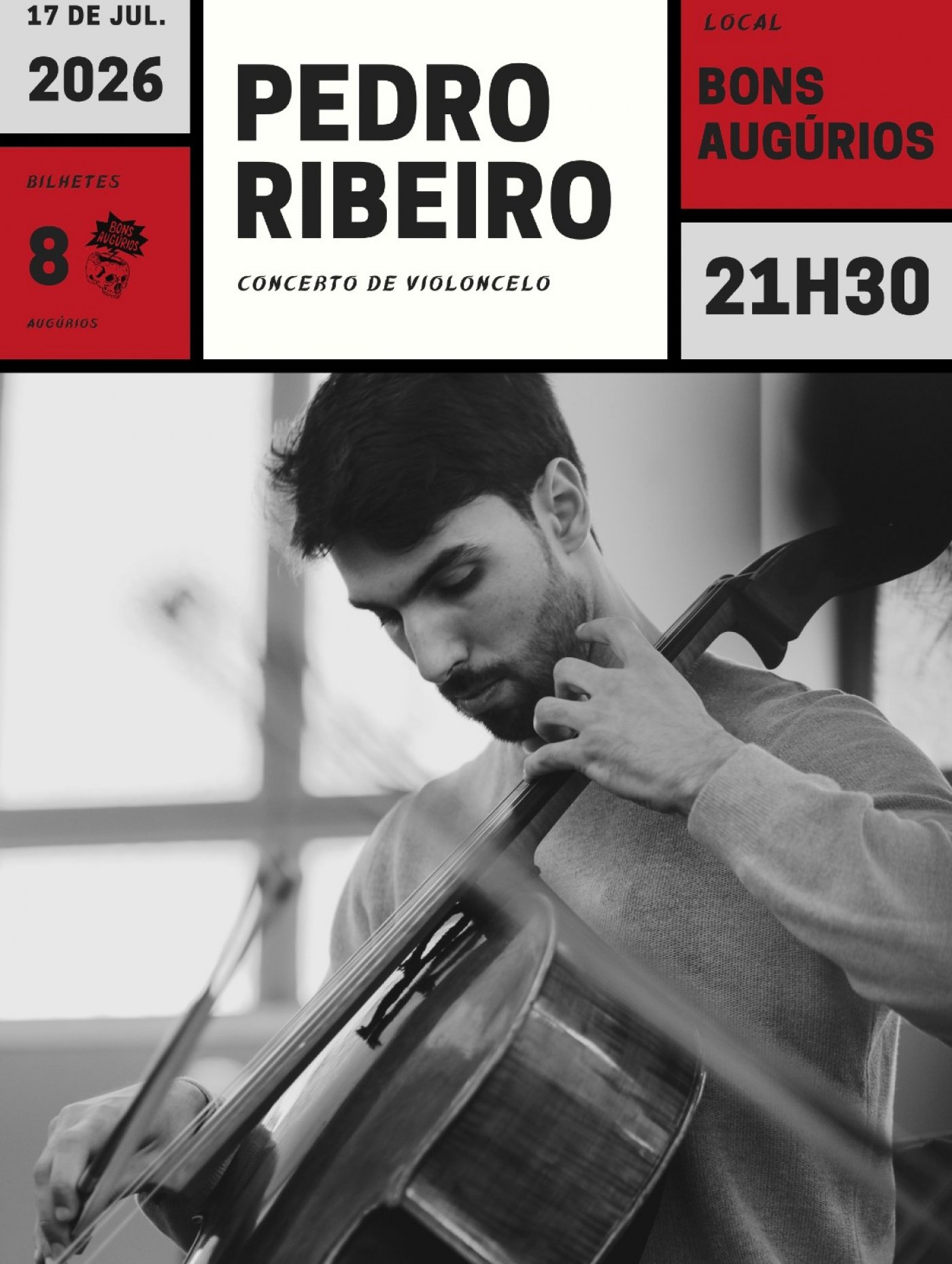
Pedro Ribeiro has built his professional career around music, drawing on extensive experience in the field of classical music. In recent years, he has performed in various European countries and the United States, playing classical cello repertoire as well as original and improvised music. A native of Aveiro, he began his studies at the Calouste Gulbenkian Conservatory.
He lived in Lisbon for six years, where he had the opportunity to immerse himself in the Portuguese capital's vibrant musical culture. Highlights of his training include studies with prominent cellists such as Paulo Gaio Lima, Levon Mouradian, and Pavel Gomziakov. He completed his studies in San Sebastián at the prestigious Musikene school. He has collaborated with various orchestras, including the Gulbenkian Orchestra, Orquestra XXI, and the Bilbao Symphony Orchestra.
Programme:
Johann Sebastian Bach
- Cello Suite No. 1 in G Major, BWV 1007
Prelude
Allemande
Courante
Sarabande
Menuet I & II
Gigue
- Cello Suite No. 2 in D minor, BWV 1008
Prelude
Allemande
Courante
Sarabande
Menuet I & II
Gigue
Pedro Ribeiro
- Suite MESA
Notes of the Programme:
At a time when the cello was primarily used as an orchestral instrument, Johann Sebastian Bach composed some of the most important works for the instrument: the six Suites for Solo Cello, BWV 1007–1012. These works were created during the years the composer served as *Kapellmeister* (music director) at the court of Köthen—between 1717 and 1723—in the service of Leopold, Prince of Anhalt-Köthen.
These suites comprise a set of dance pieces that, while not intended for actual dancing, preserve the character, rhythm, and expressiveness of the dance forms from which they take their names. In each suite, Bach maintains the same key throughout the various movements, with the exception of the second *galanterie*, which appears in the parallel major or minor key relative to the key established in the rest of the work. The arrangement of the movements creates contrasts in character, tempo, and expression, contributing to the balance and richness of each work.
All the suites follow a similar structure:
They open with a Prelude—a movement with a freer form, often characterized by an improvisational style.
This is followed by an Allemande, a dance of German origin with a moderate tempo.
Next comes a Courante, which is faster and lighter than the preceding dance.
Then follows the Sarabande, a slow, expressive dance with origins tracing back to Spain, Latin America, and North Africa.
They are followed by the so-called *galanteries*—dances that were fashionable at the time. These are lighter in character, and their inclusion is optional. In the suites to be performed in this concert, Bach employs two Minuets—elegant dances of French origin that were highly popular in the 17th and 18th centuries.
Finally, they conclude with the Gigue, a lively, energetic dance of English folk origin.
The *MESA* Suite is a concert adaptation of music composed in 2022 for a theater production by the Bestiário company, from which it takes its name.
Where is it happening?
EUR 8.00