Music Transmission and the Modern Encounter in the Late Ottoman Era
Schedule
Fri Jan 30 2026 at 02:30 pm to 10:00 pm
UTC+00:00Location
St Antony's College | Oxford, EN

About this Event
Panel of Talks (2.30-5pm) followed by a Concert (8-9.30pm) at St Anthony’s College, University of Oxford
The Panel is free, the Concert has a fee that can be bought through the present page
Friday 30 January 2026
The second half of the 19th century witnessed a series of cultural transformations in the Ottoman region and beyond, shaped by colonial encounters, political and legal transformations, and the rise of new elites and dominant classes in various domains of social life. The stories that music as a trace of forms of knowledge tells has points of similarities and differences from the usual narratives that came down to us through the literary works of what has been dubbed as the Nahda period in the Arab world. During this period different parts of the world, notwithstanding Ottoman Egypt and the Levant, ushered in a process of standardizing and classicizing “traditions of doing” in musical practices, involving establishing repertoires, performing, grappling with new technologies such as recording, developing and innovating that became a hallmark of the modernization process, and inviting a rethinking of the boundaries and fluidity of identity (Arabic, Islamic, Traditional, Modern, Turkish, Ottoman, etc). The three interventions (see program below) will explore how various aspects of music and sound as a field tell new stories about those broader social and cultural transformations. This will be followed by a musical performance with members of the Oxford Maqam Ensemble who, through years of training and performing around the world, will demonstrate late 19th century music as inspired by a multitude of early Egyptian recordings.
Panel of Talks (2.30-5pm), Investcorp Auditorium (ILT) - Free Attendance:
Coffee reception at 2.30pm, Panel starts at 3pm
Arabs, Turks, or Orientals? Late Ottoman Views of Arab Music and Musicians
Jacob Olley (Career Development Fellow, Durham University)
The 1932 Mevlevi Ayin Recording: Notes and Queries
Martin Stokes (Professor of Music, Kings College London)
When the Ney was not sad: Tradition and idiosyncrasy in Amin Buzari’s virtuoso (1855-1928) in Ottoman Egypt
Bashir Saade (Lecturer in Religion and Politics, University of Stirling)
Discussant
Sophie Frankford (Postdoctoral Research Associate, Department of Music, King’s College London)
Musical Performance (8-9.30pm), Nissan Theatre - book your spot (£10-7 concessions):
A musical performance with Oxford Maqam, with an instrumental part inspired by the early recording performances of prominent musicians of the late Ottoman period based in Egypt, such as Amin Buzari (Ney), Mohammad al-Aqqad (Qanun), Sami Shawwa (Violin), Mansur Awad (Oud), and others. The second part will explore a Wasla in the late 19th century Egypt genre (which includes instrumentals such as Bashraf and Semai, and singing through Muwashshahat, Adwar, and Qasidas).
Tarik Beshir – Oud, Lead Vocals
Sophie Frankford – Violin
Malachy O’Neill – Double Bass
Bashir Saade – Ney, Vocals
Yara Salahideen – Lead Vocals
Eric Samothrakis – percussions
Martin Stokes – Qanun, Vocals
Walid Zeido – Riq
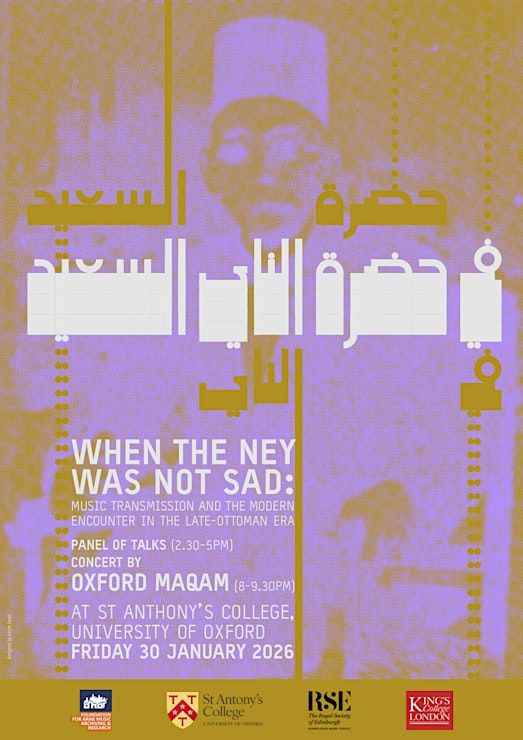
This event is based on research that was not possible without the generous support of AMAR foundation (Lebanon) in precious recordings, and a Royal Society of Edinburgh (RSE) Research Grant.
Where is it happening?
St Antony's College, 62 Woodstock Road, Oxford, United KingdomEvent Location & Nearby Stays:
GBP 8.30 to GBP 11.55