Joint CAS Denver/AIA Denver Symposium
Schedule
Sat Mar 14 2026 at 01:00 pm to 03:00 pm
UTC-06:00Location
Englewood Public Library | Englewood, CO
 New Perspectives on Northern Gallinazo Identity, Mortuary Practice, and Bioarchaeological Methods in Northern Peru
About this Event
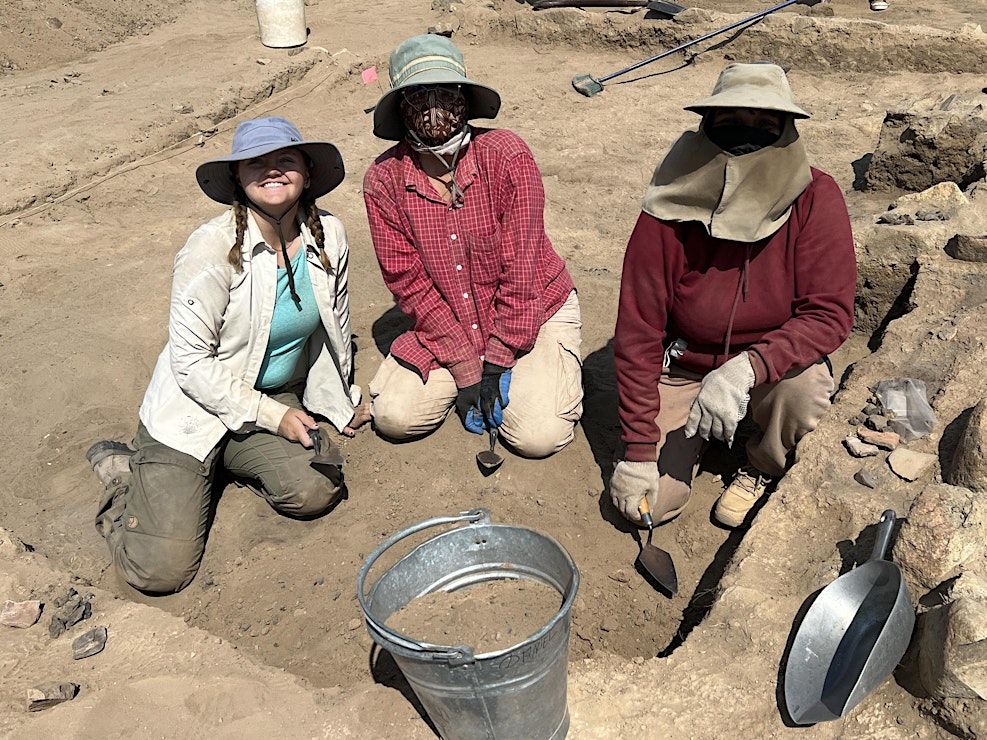
We are excited to announce a Joint Meeting of CAS Denver and the AIA Denver Society! Many thanks to our friends at the Colorado Archaeological Society for reaching out to us to partner on this! Please note that this will have a symposium structure with the presentation of four papers, rather than a singular lecture!
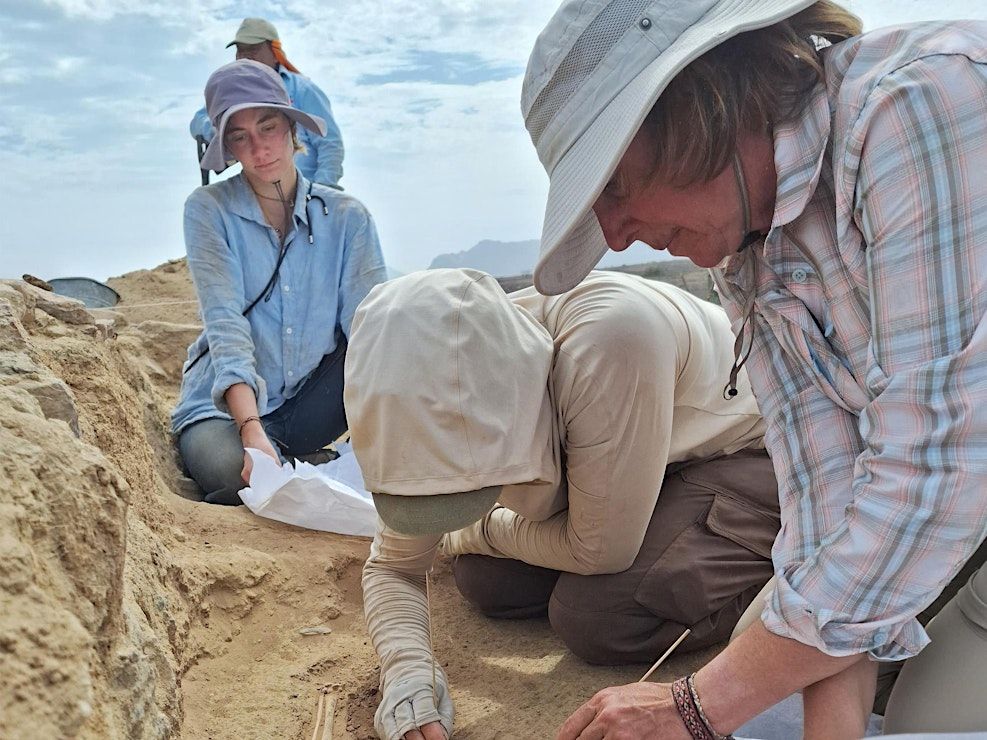
Recent fieldwork in Peru's Lambayeque Region is transforming our understanding of Northern Gallinazo (NG) society during the first millennium CE. Papers in this symposium address NG as a distinct ethnic polity engaged in copper production and mutualistic exchange with Mochica groups, while bioarchaeological analysis of a juvenile burial at Huaca Letrada illuminates childhood experience and mortuary tradition. Complementary research at Huaca Las Ventanas integrates photogrammetry, pXRF, and pigment analysis to explore intersecting social identities through funerary use of cinnabar and other red pigment. The fourth paper introduces a deep learning approach to augment traditional osteological methods, helping to reduce barriers of cost and specialized training in northern Peru and other world regions.
Eowyn Ann Stojanowski, Northern Arizona University
Title:A Comparative Case Study of the First Official Burial at Huaca Letrada (North Coast of Peru, 220-420 AD)
Abstract:In the Summer of 2025, the first systematic excavation of a burial at the site of Huaca Letrada, La Leche valley was completed. The following summer’s analysis revealed significant details about the demographics and life history of this ceremonially interred juvenile individual. Bioarchaeological analysis indicates this individual was 2 years old (+/-6 months), and the pathology and trauma present shows that there are a multitude of biological and social factors affecting the life this child once had. By cross-referencing mortuary tradition displayed at different archaeological sites in the region, we were able to identify whether or not this burial was an isolated case or a part of a broader trend. In doing so, we uncovered additional insights into Northern Gallinazo life and structure at H. Letrada.
Bio:Eowyn Stojanowski is a senior undergraduate anthropology major at Northern Arizona University. Her focus lies in bioarchaeology including dentition, pathology, and juvenile osteology. In the summer of 2025, she was a project member for the PIAGN field school in the Lambayeque region of Peru. During this experience, she documented a burial excavated in the previous field season. This burial forms the basis of her senior year’s research, which involves the bioarchaeological analysis done on this individual.
Maegan Jankowski, George Mason University
Title:Personified Pigment: Cinnabar Paint, Mortuary Patterns, and Bioarchaeology at Huaca Las Ventanas
Abstract:The combination of mortuary archaeology and bioarcheology creates a cohesive approach in understanding complex social identities; however, adding additional approaches from other archaeological subdisciplines could bring about new insights for understanding of group social identity dynamics. This research examines individuals from funerary contexts at the Middle Sicán site of Huaca Las Ventanas. Photogrammetry, pXRF, digital image enhancement, and soil color analysis were used to understand intersecting identities embodied through cinnabar and hematite paint found on skeletal remains, grave goods, and back dirt. Combining archaeological science methods with bioarchaeological and mortuary analyses revealed a mix of both social identities emulated through skeletal remains, grave goods, and red pigment of the burials. We recommend that archaeology employ methods from multiple archaeological subdisciplines to examine identity in complex societies.
Bio:Maegan Jankowski is currently a master's student studying anthropology at George Mason University. Her research focuses on bioarchaeology, mortuary archaeology, and cinnabar analyses on the north coast of Peru, specially the Middle Sicán Culture. Her thesis research focuses on the site of Huaca Las Ventanas, one of the six main huacas of the Middle Sicán capital. This red pigment study is a continuation of her thesis research, analyzing red pigment excavated at Huaca Las Ventanas through photogrammetry, pXRF, digital image enhancement, and soil color analysis.
Kate Collette, Northern Arizona University
Title:Applying Convolutional Neural Networks to Archaeological Skeletal Analysis: Toward Open-Access Bioarchaeological Methods
Abstract:Traditional biological profile estimation methods are labor-intensive, expertise-dependent, and inaccessible for under-resourced projects. This research develops a deep learning approach to age and sex estimation from archaeological skeletal remains in Northern Peru, applying convolutional neural networks to images of prehistoric and colonial-era individuals across eight coastal sites. To navigate the constraints of a limited archaeological dataset, the project employs transfer learning, k-fold cross-validation, and an ensemble framework of anatomically-specialized "expert" models, mirroring the region-by-region reasoning of a human expert. This work demonstrates deep learning's potential to augment traditional osteological methods, showing that a trained model can democratize expert-level biological profile estimation, thereby reducing barriers of cost and specialized training.
Bio:Kate Collette is a master’s student in the Anthropology program at NAU. Her current research at NAU has taken her to the north coast of Peru, where she works with her advisor and head of the digital archaeology lab at NAU, Dr. Kayeleigh Sharp, studying the pre-Inca Moche and Gallinazo cultures. Her master’s project involves the application of deep learning for the estimation of age and sex of human remains from archaeological contexts. This project has allowed Kate to lean on her strengths as a cross-disciplinary scientist to find unique solutions that redefine the boundary of archaeological methods.
Dr. Kayeleigh Sharp([email protected]), Northern Arizona University
Title:Copper, Clay, and Community: Redefining Northern Gallinazo in the Lambayeque Region
Abstract:Recent fieldwork (2024/2025) in Peru's Lambayeque Region identified Northern Gallinazo (NG) as a distinct ethnic polity controlling crucial copper resources during the first millennium CE. Excavations at Huaca Letrada (ca. 250-420 CE), Songoy-Cojal (ca. 530-880 CE), and other sites reveal that NG were engaged in both mining and copper metallurgical activities. Combined with distinctive regional pottery styles and distinctive monumental construction techniques, excavation in workshop areas reveal characteristic firing and smelting techniques. These findings transform understanding of Gallinazo-Mochica interactions, suggesting mutualistic relationships remained in place between NG and others throughout much of the first millennium.
Bio:Kayeleigh Sharp is a computational archaeologist with a long-standing interest in ancient Andean civilizations. In 2010, she launched a long-term research project on the first millennium in Lambayeque Region, Peru, one of the two primary centers of cultural development in the Central Andes. Her research on the first millennium focuses on the socio-economic phenomenon she calls “economic complementarity”, a term that refers to the mutually interdependent production, distribution, consumption of goods, and the complementary social relationships that support them.
Where is it happening?
Englewood Public Library, 1000 Englewood Parkway, Englewood, United StatesUSD 0.00