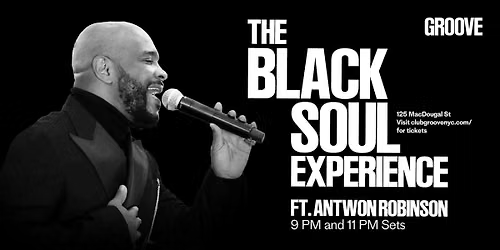
Jazz Memorial for James Blood Ulmer

About this Event
James “Blood” Ulmer stands as one of the most distinctive and influential figures in American music of the past half‑century. For more than fifty years, he has forged a fiercely individualistic sound that defies genre boundaries, drawing from gospel, blues, jazz, funk, rock, and the avant‑garde. Critics have long struggled to categorize him, often resorting to hybrid metaphors: Down Beat’s Larry Birnbaum once described him as “a cross between Jimi Hendrix, Bob Dylan and Mike Bloomfield,” while Greg Tate famously called him “the missing link between Jimi Hendrix and Wes Montgomery on one hand, between P‑Funk and Mississippi Fred McDowell on the other.” These comparisons hint at Ulmer’s breadth, but the truth is simpler: there is only one James Blood Ulmer.
Born in 1940 in rural St. Matthews, South Carolina, Ulmer grew up in a strict Baptist household where music was inseparable from faith. His father, a preacher, placed a guitar in his hands at the age of four, guiding his fingers as he strummed. Gospel shaped his earliest musical world, and by elementary school he was singing with The Southern Sons, a quartet modeled after the touring gospel groups he admired. For seven years he traveled the South performing church music, absorbing the emotional intensity and spiritual urgency that would remain central to his artistic Identity. As a teenager, Ulmer’s musical curiosity expanded beyond the church. Early rock & roll, country, and rhythm & blues filled the radio, and he listened with fascination — even when the blues, considered “devil’s music” in his household, had to be heard in secret. At eighteen he left South Carolina for Pittsburgh, where he quickly became a working musician on the chitlin’ circuit, backing doo‑wop groups such as The Savoys and touring with Dick Clark’s “Caravan of the Stars.” Pittsburgh also introduced him to the city’s vibrant organ‑tenor club scene, where he sat in with Richard “Groove” Holmes and Jimmy Smith, sharpening the jazz instincts that would soon define his path.
By the mid‑1960s, Ulmer was determined to pursue jazz more seriously. A pivotal opportunity arrived when he joined organist Hank Marr’s group, touring internationally and making his first recordings. Around this time he experienced a formative encounter with his idol, Wes Montgomery. Ulmer hoped for validation, but Montgomery’s silence pushed him toward a deeper artistic transformation. He began dismantling conventional guitar approaches, searching for a new musical language that rejected scales, sequences, and standard chord structures. This search intensified when Ulmer moved to Detroit in 1967, immersing himself in the city’s progressive jazz community. He experimented with new concepts, played with the cooperative group Focus Novii, and worked at the legendary 20 Grand Club — sharing the stage with musicians who would become Funkadelic. Detroit’s jazz elders encouraged him to seek out Miles Davis in New York. Ulmer never found Miles, but instead encountered someone even more pivotal: Ornette Coleman. Arriving in New York in 1971, Ulmer entered the world of harmolodics, Coleman’s radical musical philosophy. Working closely with Coleman in the downtown loft jazz scene, Ulmer developed the idiosyncratic guitar style that would define his career. He absorbed Coleman’s teachings, endured months of rigorous harmolodic drills, and eventually experienced a breakthrough: a dream that led him to tune all six guitar strings to the same pitch. Coleman recognized the innovation immediately, telling him he had “moved the tone center,” and encouraging him to pursue this new sonic territory.
Ulmer’s early recordings reflected this bold direction. His debut, Tales of Captain Black (1978), produced by Coleman, announced a new voice in American music — raw, free, and electrifying. A series of acclaimed albums followed, including Are You Glad to Be in America?, Free Lancing, Black Rock, and Odyssey. These works fused harmolodic principles with funk, rock, and blues, earning Ulmer comparisons to Hendrix and opening doors to rock audiences. He performed at venues previously closed to jazz musicians and collaborated with artists such as Public Image Ltd. and Captain Beefheart.
Despite critical acclaim, Ulmer’s uncompromising style challenged the commercial expectations of major labels. After CBS released Odyssey in 1983 — now considered a landmark of American experimental music — the label dropped him. Ulmer spent the late 1980s and 1990s recording for smaller European labels, touring extensively, and continuing to refine his voice. His reputation grew steadily among musicians, even as mainstream audiences struggled to categorize him. A major turning point came in the early 2000s, when guitarist Vernon Reid encouraged Ulmer to revisit the blues — the music he had once been forbidden to play. The resulting albums, Memphis Blood: The Sun Sessions (2001) and No Escape from the Blues: The Electric Lady Sessions (2003), reintroduced Ulmer to a wide audience and earned him a Grammy nomination. In 2005 he released Birthright, his first solo album, a stark and deeply personal work that critics hailed as a masterpiece.
Today, James “Blood” Ulmer is recognized as an elder statesman of American music — a guitarist, composer, and vocalist whose innovations have shaped generations. His journey from gospel quartet singer to harmolodic pioneer to blues icon reflects a lifetime of reinvention, resilience, and uncompromising artistic truth. At the core remains the unmistakable voice of Blood: raw, visionary, and forever searching.
Photo Credit: Daniel Kurganov
Where is it happening?
Event Location & Nearby Stays:
USD 0.00