Into the Color World
The greatest challenge of contemporary art has never been the search for a new medium, but rather the ability to redefine the relationship between human beings and the world.
Today we live in an age shaped by information, images, and algorithms, where art appears to possess an unlimited range of expressive tools. Yet the works that truly resonate with us are rarely those distinguished by technical complexity alone. Rather, they are those that succeed in asking new questions. Ye Xiaozhou is precisely this kind of artist—one who continuously interrogates reality through artistic practice.
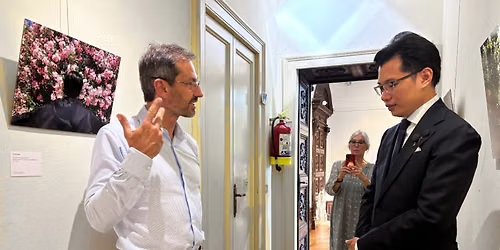
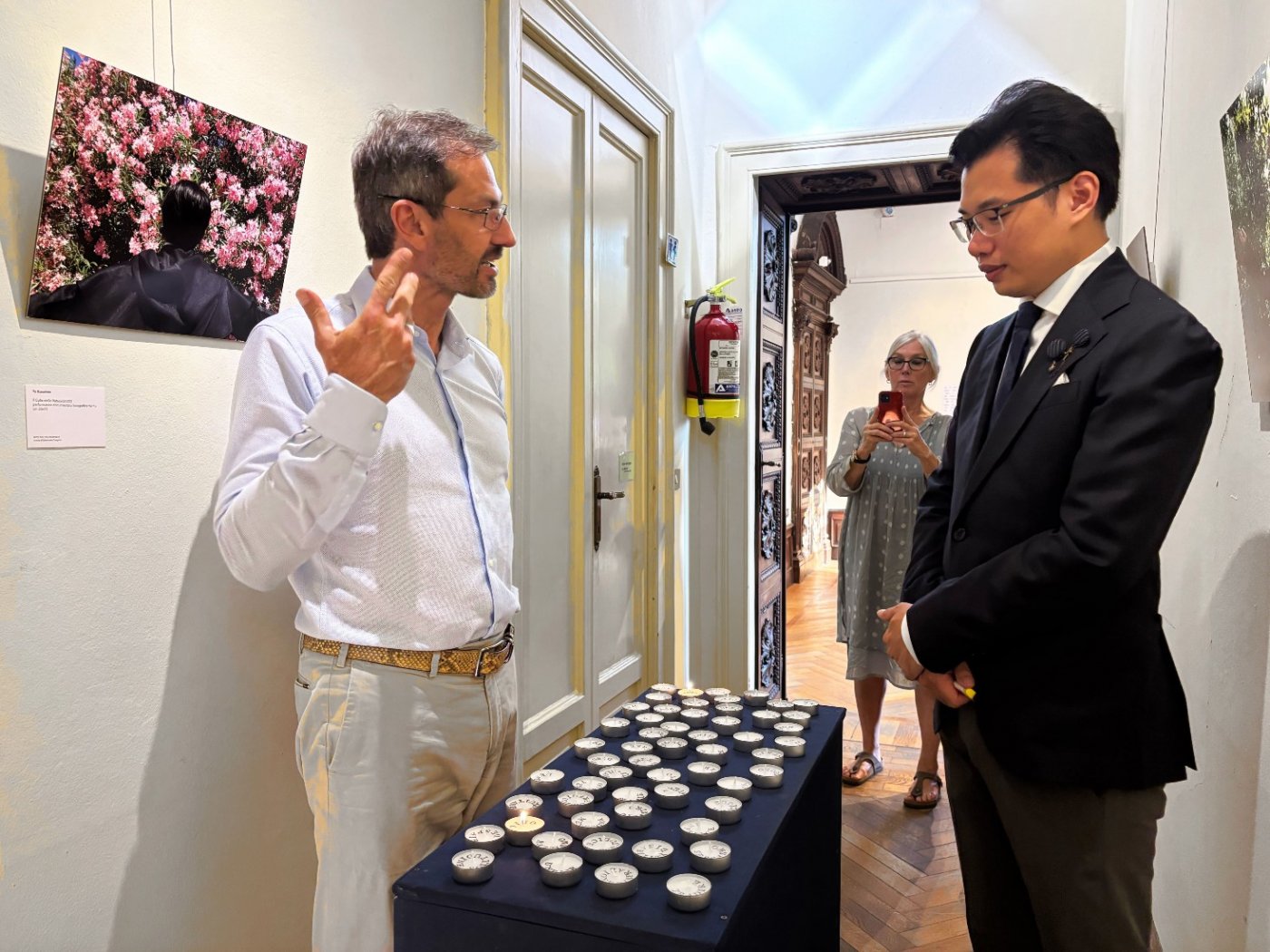
Two months ago, my former professor at the Academy of Fine Arts of Florence, Massimo Orsini, contacted me to introduce a young artist whose visual language and creative perspective immediately struck him as remarkably distinctive: Ye Xiaozhou. Throughout our correspondence, Professor Orsini repeatedly expressed his admiration for his former student and encouraged me to consider organizing a solo exhibition for him in an important institutional venue.
At that time, we had just concluded Segni d'Africa, the solo exhibition of the Italian artist Emanuela de Franceschi at the Museo Arte e Scienza (MAS) in Milan. After discussing the proposal with the museum's director, Peter Matthaes, we agreed that this represented an exceptional opportunity. The study and collection of traditional East Asian art has long been one of the museum's principal research directions, and this shared interest ultimately made the present exhibition possible.
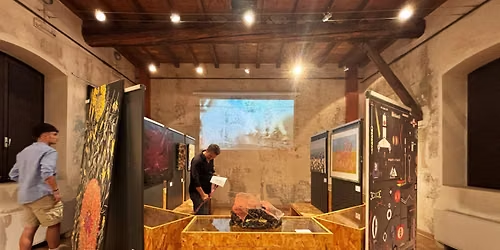
For this exhibition, curator Emanuele Gregolin chose to emphasize the continuity of Ye Xiaozhou's artistic development. The exhibition therefore brings together paintings, performances, video works, photographs, installations, and participatory projects created continuously by the artist since 2020. Rather than organizing the exhibition according to medium, the display functions as an "open archive" of the artist's intellectual and creative trajectory. Although these works differ considerably in form, they collectively reveal a coherent methodology: art is not merely an object to be observed, but an ongoing social relationship that is constantly being produced and renegotiated.
The first time I systematically examined Ye Xiaozhou's work from recent years, the reference that came to mind was not another artist, but a single word: action. If performance art of the 1960s and 1970s emphasized the body as a medium of resistance against social order, Ye Xiaozhou's performative practice functions more as a mechanism for generating public discourse. His works are not centered on the execution of a singular gesture; rather, they construct new environments for communication, environments deeply embedded within the social realities in which we live.
Among these works, Domino stands as perhaps the clearest example. Employing a small number of fundamental materials—a burned map, domino tiles, and a lighter—Ye Xiaozhou reflects upon the instability of a world marked by geopolitical turbulence. The simple act of burning becomes a metaphor for the uncertainty that defines contemporary global affairs, recalling, in certain respects, the vision of today's world presented in Mona Hatoum's exhibition Over, Under and In Between at Fondazione Prada in Milan.
In Domino, what burns is not merely the domino pieces but the very order inscribed upon the world map. The domino game traditionally signifies a chain reaction, while the map evokes political borders and geopolitical structures. As the flames spread, the viewer witnesses not only the combustion of materials but also a visual metaphor for the fragility of the global order itself. The work offers no definitive answers. Instead, it reminds us that war, economics, politics, and human destiny are all interconnected components of a single, complex system of mutual influence. The charred remains preserved within the exhibition—the burnt dominoes, the scorched map, and the lighter—transform the ephemeral performance into enduring evidence, allowing viewers to confront not merely documentation, but the tangible traces of an event that has genuinely taken place.
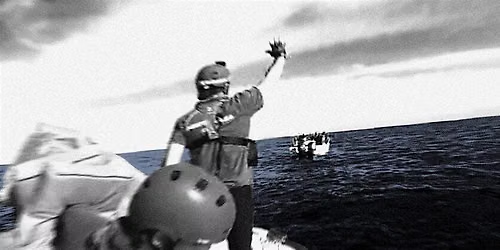
The performance Eat Wars addresses the relationship between the body and the experience of war even more directly. Ye Xiaozhou repeatedly chews and swallows the word "war" in different languages until language itself gradually loses meaning. In the age of mass media, war has become endlessly reproduced information: we read about it, watch it, and discuss it every day, yet paradoxically it becomes increasingly detached from lived reality. Rather than producing images of violence, the artist returns war to the body itself. Language becomes food; information becomes digestion. Ultimately, the work leads viewers to recognize that what we consume daily is not merely news, but the emotional conditions continuously produced by the media systems of our time.
This investigation into the relationship between language and the body continues in TAG. In today's digital society, labels have become one of the primary mechanisms through which identity is constructed. The internet constantly assigns us new categories and identities, and the same process unfolds within everyday social life. In this participatory work, Ye Xiaozhou invites visitors to attach labels to one another. Through this seemingly simple action, the work immediately exposes a fundamental question: Who defines who we are? Does identity originate from self-perception, or is it produced through the names and classifications imposed by others? Rather than staging a dramatic confrontation, the work reveals, through an ordinary act of interaction, one of the most pervasive forms of power operating within contemporary society.
It is precisely here, in my view, that the greatest value of Ye Xiaozhou's artistic practice resides. His works never seek to produce visual spectacle. Instead, they investigate systems: the logic of games, social mechanisms, systems of communication, modes of spectatorship, and ultimately the mechanisms through which art itself operates. This concern becomes particularly evident in Into the Color World and C.C.S. (Contemporary Culture Society).
In recent years, participatory art has become an increasingly prominent subject of discussion. Yet relatively few artists have succeeded in making participation the structural core of the artwork itself. Much of what is described as interactive art ultimately requires viewers only to complete an experience predetermined by the artist. Ye Xiaozhou's game-based works operate according to an entirely different logic.
In Into the Color World, visitors are encouraged to continuously modify the work itself. The artwork possesses no definitive or final state. It refuses the condition of becoming a fixed object preserved permanently within the museum, functioning instead as a living organism in constant transformation. Every intervention by a participant rewrites part of the work's history. Through this openness, the artwork shifts from being a finished object to becoming a collective event whose meaning is continuously renegotiated.
Among all the works presented in this exhibition, I consider C.C.S. (Contemporary Culture Society) to be the most conceptually sophisticated. At the beginning of the exhibition, Ye Xiaozhou introduced us to the rules governing the project. Although I am not particularly familiar with board games, I was immediately struck by the complexity of the system the artist had constructed to simulate the functioning of the contemporary art world. Artists, collectors, museums, critics, and social events—elements that normally exist within the real ecosystem of art—are translated into the rules of a game.
The participants are not simply learning art history; they experience, through play, how the art world actually functions. It is an exceptionally intelligent strategy. Games possess an inherent educational capacity, yet they avoid the didacticism often associated with formal instruction. Art thus becomes a mode of producing knowledge rather than merely transmitting it. In my opinion, this marks one of the most significant developments in Ye Xiaozhou's recent practice: he has begun to conceive of art itself as a system, one that can be observed, experienced, questioned, and continuously reconfigured.
If the earlier works primarily addressed social issues, then Pendolo – Domande e Risposte and Il Culto della Natura mark a shift toward a more spiritual dimension of Ye Xiaozhou's practice. The Pendolo series immediately recalls the imagery of ancient divinatory rituals. Allowing the pendulum to swing freely across the paper, the artist relinquishes control and embraces unpredictability, leaving behind traces that cannot be predetermined. Here, neither absolute control nor pure rationality exists. The work revives a question that contemporary society seems to have gradually abandoned: when confronted with the unknown, are we still willing to embrace chance? At the same time, the work reminded me of the meditative artistic exercises I practiced with Massimo Orsini during my years at the Academy of Fine Arts of Florence, where intuition and contemplation were understood as integral components of artistic research.
A similar spiritual inquiry unfolds in Il Culto della Natura. Wearing garments reminiscent of religious vestments, Ye Xiaozhou establishes with plants a relationship that resembles a ritual of devotion. This is not a return to religion; rather, it is an attempt to reconsider whether, in an era increasingly defined by ecological crisis, nature itself has become a new object of spiritual contemplation. While modern civilization has long celebrated the conquest and domination of nature, Ye Xiaozhou chooses instead to kneel before it. It is an extraordinarily simple gesture, yet one of profound symbolic power.
Looking back across the exhibition as a whole, one can clearly trace the evolution of the artist's research. Works produced around 2020 were primarily concerned with public issues such as the pandemic, war, and social order. From 2022 onward, his practice gradually shifted toward more complex relationships between humanity and nature, technology, and play. In his most recent works—including Beautiful Promise, I Exist, and Little Hope—the focus appears to return to the artist himself. Yet this "self" is no longer understood as a traditional self-portrait. Instead, it emerges as a subject continuously constructed through interactions with society, the media, and the gaze of others.
For this reason, I believe that what Ye Xiaozhou ultimately investigates is not artistic form, but modes of existence. As a young Chinese artist who has lived and worked in Italy for many years, he inhabits two cultures, two systems of knowledge, and two artistic traditions simultaneously. Yet this intercultural experience does not confine his work to questions of identity alone. On the contrary, it enables him to engage with themes of universal significance: war, the environment, technology, rules, education, play, belief, and the constantly evolving relationship between human beings and the world.
For this very reason, Ye Xiaozhou's work possesses a remarkable ability to transcend cultural boundaries. His practice engages meaningfully with contemporary European artistic discourse while simultaneously preserving an Eastern understanding of relationality, process, and wholeness. I have always believed that the greatest value of contemporary art does not lie in the invention of new forms, but in its capacity to help us perceive reality anew. Ye Xiaozhou's works do not seek to tell viewers what the world should be. Instead, they continuously construct new ways of seeing, encouraging us to reconsider what is real, what participation truly means, and what it means to create collectively. Perhaps this is precisely where the most profound significance of art resides today.
When we encounter Ye Xiaozhou's work, we are not confronted with an artist's answers, but with the questions that continue to define our own time. Truly significant art has never begun with conclusions; it has always begun with the courage to ask questions.
Where is it happening?
EUR 0.00