How to Change a Memory - Steve Ramirez

Advertisement
Free and open to the public. There will be a reception with good food and drinks at 5 P.M.
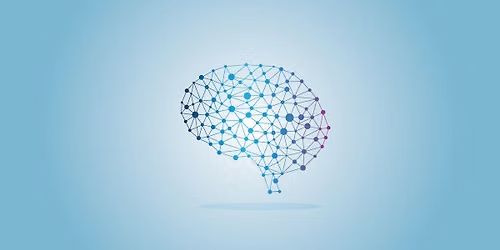
Memories are the threads that stitch together who we are — our past, our identity, and our sense of self. This lecture will explore how modern neuroscience has begun to do something once thought impossible: identify the physical building blocks of memory in the brain, and manipulate them with surprising precision. Scientists can now turn specific memories on and off, alter them, strengthen them, weaken them, and in some cases, even create memories that never actually happened.
Professor Ramirez will discuss how researchers discovered that memories are not fixed records of the past, but living, dynamic processes. Each time we recall a memory, it can change subtly or sometimes entirely. Memories can fade, be reactivated, rewritten, or under certain experimental conditions falsely implanted in the laboratory. Drawing from his own research, he will describe how we study these “memory cells” in the brain and what they reveal about learning, fear, imagination, and resilience. Along the way, he will reflect on his own journey as a neuroscientist and ask some of the deeper questions this science forces us to confront. If we could erase a traumatic memory, would we want to? Would doing so change who we are, or free us to become who we were meant to be? And, if we gain the power to control memory, how should we use it responsibly?
This talk will blend cutting-edge neuroscience with big philosophical questions, offering a glimpse into how memory works, why it is so fragile, and how understanding it may reshape medicine, mental health, and our understanding of what it means to be human.
BIOGRAPHY
Steve Ramirez is an associate professor of Psychological and Brain Sciences at Boston University and a former junior fellow of Harvard University. He received his B.A. in neuroscience from Boston University and began researching learning and memory in the laboratory of Howard Eichenbaum. He went on to receive his Ph.D. in neuroscience in the laboratory of Susumu Tonegawa at MIT, where his work focused on artificially modulating memories in the rodent brain.
Professor Ramirez's current work focuses on imaging and manipulating memories to restore health in the brain. Both in and out of the lab, He is also an outspoken advocate for making neuroscience accessible to all. He’s passionate about magnifying the voices in his field through intentional mentorship — an approach for which he received a Chan-Zuckerberg Science Diversity Leadership Award.
Professor Ramirez has also received an NIH Transformative Award, the Smithsonian’s American Ingenuity award, National Geographic’s Breakthrough Explorer prize, Forbes and Technology Review’s Top 35 Innovators Under 35 award, and has given a TED talk. His first book, "How to Change a Memory: One Neuroscientist’s Quest to Alter the Past" (Princeton University Press, 2025), has received widespread praise.
FMI: https://www.une.edu/events/2026/how-change-memory
Girard Innovation Hall
UNE Portland Campus for the Health Sciences
716 Stevens Avenue
Portland, ME 04103
United States
Memories are the threads that stitch together who we are — our past, our identity, and our sense of self. This lecture will explore how modern neuroscience has begun to do something once thought impossible: identify the physical building blocks of memory in the brain, and manipulate them with surprising precision. Scientists can now turn specific memories on and off, alter them, strengthen them, weaken them, and in some cases, even create memories that never actually happened.
Professor Ramirez will discuss how researchers discovered that memories are not fixed records of the past, but living, dynamic processes. Each time we recall a memory, it can change subtly or sometimes entirely. Memories can fade, be reactivated, rewritten, or under certain experimental conditions falsely implanted in the laboratory. Drawing from his own research, he will describe how we study these “memory cells” in the brain and what they reveal about learning, fear, imagination, and resilience. Along the way, he will reflect on his own journey as a neuroscientist and ask some of the deeper questions this science forces us to confront. If we could erase a traumatic memory, would we want to? Would doing so change who we are, or free us to become who we were meant to be? And, if we gain the power to control memory, how should we use it responsibly?
This talk will blend cutting-edge neuroscience with big philosophical questions, offering a glimpse into how memory works, why it is so fragile, and how understanding it may reshape medicine, mental health, and our understanding of what it means to be human.
BIOGRAPHY
Steve Ramirez is an associate professor of Psychological and Brain Sciences at Boston University and a former junior fellow of Harvard University. He received his B.A. in neuroscience from Boston University and began researching learning and memory in the laboratory of Howard Eichenbaum. He went on to receive his Ph.D. in neuroscience in the laboratory of Susumu Tonegawa at MIT, where his work focused on artificially modulating memories in the rodent brain.
Professor Ramirez's current work focuses on imaging and manipulating memories to restore health in the brain. Both in and out of the lab, He is also an outspoken advocate for making neuroscience accessible to all. He’s passionate about magnifying the voices in his field through intentional mentorship — an approach for which he received a Chan-Zuckerberg Science Diversity Leadership Award.
Professor Ramirez has also received an NIH Transformative Award, the Smithsonian’s American Ingenuity award, National Geographic’s Breakthrough Explorer prize, Forbes and Technology Review’s Top 35 Innovators Under 35 award, and has given a TED talk. His first book, "How to Change a Memory: One Neuroscientist’s Quest to Alter the Past" (Princeton University Press, 2025), has received widespread praise.
FMI: https://www.une.edu/events/2026/how-change-memory
Girard Innovation Hall
UNE Portland Campus for the Health Sciences
716 Stevens Avenue
Portland, ME 04103
United States
Advertisement
Where is it happening?
716 Stevens Ave, Portland, ME, United States, Maine 04103
Event Location & Nearby Stays:
Know what’s Happening Next — before everyone else does.
Host or PublisherUNE Center for Global Humanities