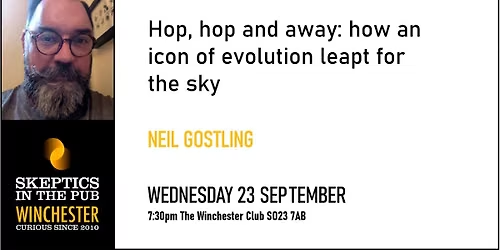
Hop, hop and away: how an icon of evolution leapt for the sky

Advertisement
Archaeopteryx might just be the most important fossil ever found. It was hailed as the ‘proof’ of Darwin’s evolution by Natural Selection when it was discovered just 2 years after On the Origin of Species had predicted the existence of such fossils.
While the feathers and wings were unmistakably bird features, to the 19th Century scientists who first observed it, it had characteristics that were not like any living bird: a long bony tail, three separate and clawed fingers, and a beakless tooth-filled jaw demonstrated a direct link between dinosaurs and birds.
For all of its birdiness, the dinosaur traits meant that it wasn’t a ‘fully formed bird’. How did it achieve the quality, most associated with birds: flight?
Lacking a large sternum, for big wing muscles, and a less mobile shoulder, how could it get off the ground?
In order to assess how Archaeopteryx could have taken off, the speaker and colleagues turned their attention to its closest relatives, birds themselves.
Dr Neil Gostling is an Associate Professor in Evolution and Palaeobiology. He is an evolutionary-developmental biologist (evo-devo) by training and a palaeobiologist by research. He has used this diverse background to answer questions from the evolution of animals to the development of root systems. Currently, Neil is working to address questions about the origins of avian flight, and the diversity of dinosaurs in southern England. Neil contributes to the teaching of evolution and palaeobiology across the Faculty of Environmental and Life Sciences. This talk is based on the recent paper by Erik Meilak, Neil J. Gostling*, Pauline Provini, Colin Palmer and Markus O. Heller published in Developmental Biology.
While the feathers and wings were unmistakably bird features, to the 19th Century scientists who first observed it, it had characteristics that were not like any living bird: a long bony tail, three separate and clawed fingers, and a beakless tooth-filled jaw demonstrated a direct link between dinosaurs and birds.
For all of its birdiness, the dinosaur traits meant that it wasn’t a ‘fully formed bird’. How did it achieve the quality, most associated with birds: flight?
Lacking a large sternum, for big wing muscles, and a less mobile shoulder, how could it get off the ground?
In order to assess how Archaeopteryx could have taken off, the speaker and colleagues turned their attention to its closest relatives, birds themselves.
Dr Neil Gostling is an Associate Professor in Evolution and Palaeobiology. He is an evolutionary-developmental biologist (evo-devo) by training and a palaeobiologist by research. He has used this diverse background to answer questions from the evolution of animals to the development of root systems. Currently, Neil is working to address questions about the origins of avian flight, and the diversity of dinosaurs in southern England. Neil contributes to the teaching of evolution and palaeobiology across the Faculty of Environmental and Life Sciences. This talk is based on the recent paper by Erik Meilak, Neil J. Gostling*, Pauline Provini, Colin Palmer and Markus O. Heller published in Developmental Biology.
Advertisement
Where is it happening?
The Winchester Club, Highfield Lodge, Worthy Lane, Winchester, SO23 7AB, United Kingdom
Event Location & Nearby Stays:
Know what’s Happening Next — before everyone else does.
Host or PublisherSkeptics in the Pub - Winchester