Foundations and Futures: Art Therapy and Counseling Conference - 6 CE
Schedule
Sun Apr 12 2026 at 10:00 am to 05:00 pm
UTC-04:00Location
Caldwell University | Caldwell, NJ

About this Event
Registration: Werner Lecture Hall
6 Hours of NBCC CE
Caldwell University is an approved Continuing Education Provider for NBCC
ACEP#4598
Annette Vaccaro, Conference Coordinator has been approved as an AATCEP provider by the ATCB 34542633
Enjoy a dynamic day of reflection and vision at our Art Therapy and Counseling Conference, Foundations and Futures. The morning program honors 25 years of growth and innovation in the field across our state, celebrating the pioneers whose dedication shaped clinical training, professional identity, and community impact. Through brief historical presentations followed by live expressive therapy responses, we will collectively witness the evolution of the profession and the foundations that sustain it today. In the afternoon, internationally recognized clinician and researcher Unnur Öttarsdóttir will present her groundbreaking work on memory drawing research, sharing her technique and structured protocol that bridges neuroscience, trauma-informed practice, and expressive modalities. As we commemorate the achievements of the past quarter century, we also look ahead—announcing the development of a new doctoral program that marks our transformation from a training-focused institution into a center for research, scholarship, and leadership. This conference invites participants to honor the past, engage the present, and step boldly into the future of the field.
Sponsored by
Clinical Mental Health Counseling with Art Therapy Concentration
& Post Graduate Master’s in Art Therapy Degree Programs
Announcing Intent to Launch PhD in Counselor Education and Supervision
With Emphasis in Expressive Therapies
Conference Schedule - Morning Program
8:30 - 10:00 am Registration and Group Experiential, Mary Jo Rolli Codey Center
Werner Lecture Hall Lobby, Center Director Cindy Concannon/Interns
9:00 - 10:50 am Annual Membership Meeting NJATA
New Jersey Art Therapy Association, Werner Lecture Hall
10:00 - 10:15 am Welcome, Dr. George Abaunza, Vice President of Academic Affairs
Announcements, Dr. Annette Vaccaro, Program Coordinator,
MA in Clinical Mental Health Counseling with Art Therapy Concentration
Post Graduate MA in Art Therapy
Werner Lecture Hall
10:15 am - 12:30 pm A Historical, Multi-Modal Expressive Arts Presentation,
Werner Lecture Hall
Honoring Sister Catherine Waters, Founding Program Coordinator, Counseling
Bonnie Berkowitz, Founder, NJATA
Student Response, Gabrielle Kucel
Marie Wilson, Founding Program Coordinator
Student Response, Sofia Autore
Cindy Lou Nelson, NJATA President
Student Response, Elisa Corniell
Mary Ellen McAlevey, NJATA President
Student Response, Rachel Eisenberg
Rita Klachkin, NJATA President
Student Response, Remi Nichols
Laura Salley, NJATA President
Student Response, Savhana Hood
Pamela Ullman, NJATA President
Student Response, Bianca Piccinini
Suzanne DuFour, NJATA President
Student Response, Summer Bryson
Traci Bitondo, NJATA President
Student Response, Isabelle Wolf
Annette Vaccaro, Program Coordinator
Student Response, Cassidy Predale
Daniel Summer, Counseling Department Chair
Student Response, Nehama Rosenberg
Cindy Concannon, Founding Director, Codey Center
Student Response, Stephanie Cantor-Espinosa
Mending America, Storycloth - Renee Folzenlogen and Maria Lupo
12:30 - 1:30 pm Lunch in the Dining Hall, Tours of the Mary Jo Rolli Codey Center
Afternoon Program
1:30 - 4:30 pm
KEYNOTE:
Drawing the Past, Shaping the Future: Memory Drawing for Emotional Well-Being and Coursework Learning
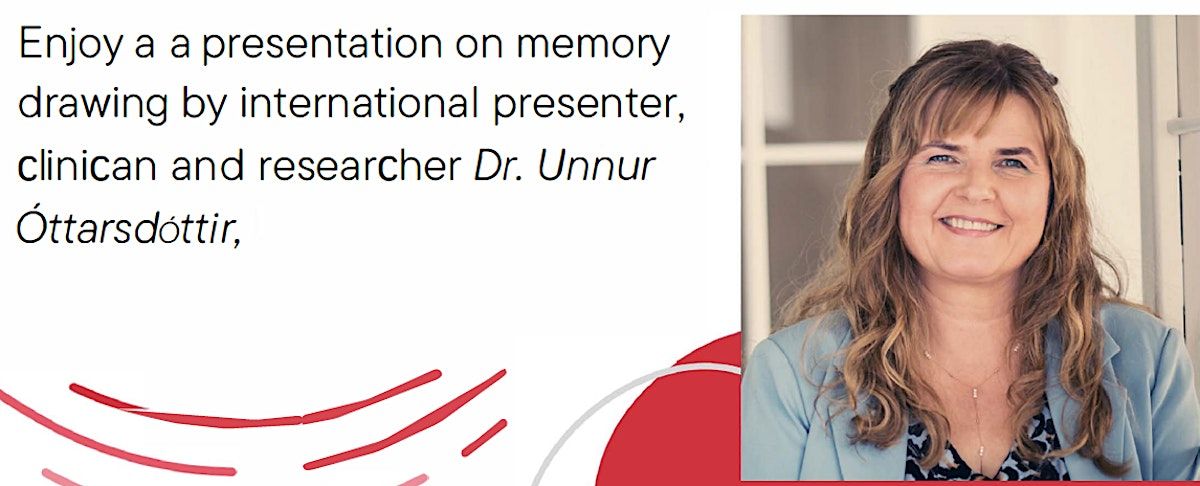
Dr. Unnur Óttarsdóttir
Werner Lecture Hall
This two-part workshop is designed to outline the research-based underpinnings of the memory drawing protocol as both a clinical and educational tool. In Part 1, participants explore the personal and therapeutic functions of memory drawing, grounding the practice in core art therapy theories and methods while examining its dual capacity to strengthen recall and facilitate emotional processing.
In Part 2, attendees analyze research on memory retention, comparing drawing and writing over time, and examine how memory drawing supports individuals with diverse memory abilities. Across both sessions, participants gain practical insight into how this approach serves as an effective long-term learning strategy and a meaningful intervention for processing experiences.
4:30 - 5:30 pm
Program Evaluation
Doctoral Program Information Session
Drawing the Past, Shaping the Future: Memory Drawing for Emotional Well-Being and Coursework Learning
The potential of memory drawing, developed by Dr. Unnur Guðrún Óttarsdóttir as a method for enhancing memory retention and supporting emotional well-being, will be reviewed in the presentation.
The research presented involved 134 children and 262 adults, and it demonstrated that drawing generally enhanced memory recall compared to writing for the participants, particularly for the individuals who struggled with memorizing written words. According to the study results, those who easily remembered written words also generally recalled their drawings more easily than the written words in the long run. Additionally, the study examined memory retention over various time intervals, showing that drawing was generally five times more effective than writing when the participants recalled after nine weeks.
Memory drawing holds particular relevance in therapeutic and educational settings, offering the dual benefit of improving recall while providing a medium for processing emotions. Case material will be presented on how memory drawing can be integrated into both education and clinical practice, offering a dual function: supporting emotional well-being and enhancing memory-based learning. The potential of memory drawing, to strengthen memory and facilitate emotional well-being, marks it as an innovative approach in educational and therapeutic settings.
Participants will engage in experiential drawing activity to deepen their understanding of the mechanisms of memorising through drawing and to experience the way in which the research was conducted.
References
Óttarsdóttir, U. G. 2024 Experiments on the Efficacy of Drawing for Memorization among Adults and Children with Varying Written Word Memory Capacities: A Two-Way Crossover Design. Education Sciences, 14(5), 470. https://doi.org/10.3390/educsci14050470
Óttarsdóttir, U. G. 2024 Memory drawing for children who have experienced stress and/or trauma and have specific learning difficulties. In: M. Cao, R. Hougham and S. Scoble (Eds.) Memory: shaping connections in the arts therapies (pp. 118-141). Oxfordshire: Routledge.
Ottarsdottir, U. 2018 Processing Emotions and Memorising Coursework through Memory Drawing. ATOL: Art Therapy OnLine, 9(1). https://journals.gold.ac.uk/index.php/atol/article/view/486
Where is it happening?
Caldwell University, 120 Bloomfield Avenue, Caldwell, United StatesEvent Location & Nearby Stays:
USD 100.00