Fall Tutorial: Defining Needs and Requirements for Resilient Systems

About this Event
in-person: Clicking “Reserve a Spot” here before Oct 29 helps with sizing the catering order. (no need to show a ticket)
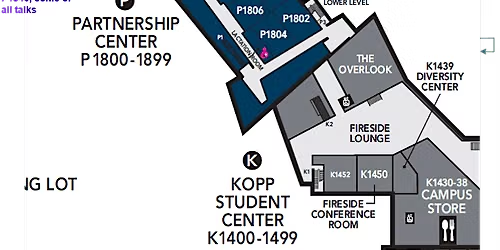
9547 Collegeview Road is not a mailing address but makes a good navigational reference, near the Japanese Garden;
between Lot 5 and the south lot off 98th, but not well accessible from either.
Abstract
Resilience is a fairly new topic in SE practice. As a result, most sets of needs and requirements are incomplete in that they do not account for resilience and loss scenarios when the system is faced with some type of adversity and associated stressors. To be complete, depending on the system and possible adversities, needs and requirements concerning detecting adversities and stressors, as well as capabilities involved in avoiding, withstanding, and/or recovering from adversity must be included in the Integrated Set of Needs and resulting set of system Design Input Requirements transformed from those needs that address what the system must do to realize those needs.
When addressing why organizations should be interested in addressing resilience engineering and loss-driven engineering, ask: What system capabilities and assets can the organization or customers NOT afford to lose? and “What is the organization willing to pay to make their systems more resilient to avoid those losses?
This full-day tutorial builds on these concepts in two integrated sessions.
Attendees will leave with both a firm understanding of the underlying concepts and direct, hands-on experience applying a practical methodology — one they can put to use on their own projects the very next day, whether those projects are just getting started, already underway, in active development, or involve existing systems where resilience and loss must to be assessed and strengthened.
Speaker – Fall Tutorial
Lou Wheatcraft is a senior consultant and managing member of Wheatland Consulting, LLC and is an international expert in systems engineering with a focus on needs and requirements development, management, verification, and validation across the system lifecycle. Lou’s goal is to help systems engineers practice better systems engineering from a needs and requirements perspective across all lifecycle stages of system/product development. Getting the needs and requirements right upfront is key to a successful project.
Lou has over 50 years’ experience in systems engineering, including 22 years in the United States Air Force. Lou has taught over 200 requirement seminars over the last 26 years. Lou supports clients from government and industries involved in developing and managing systems and products including aerospace, defense, medical devices, consumer goods, transportation, and energy.
Lou is very active in the INCOSE and is the current co-chair of the Requirements Working Group (RWG). Lou is a principal author of several RWG manuals and guides including the Needs and Requirements Manual (NRM), Guide to Needs and Requirements GtNR), Guide to Verification and Validation (GtVV), and newly released version 4 of the Guide to Writing Requirements (GtWR).
Lou has a BS degree in Electrical Engineering from Oklahoma State University; an MA degree in Computer Information Systems; an MS degree in Environmental Management; and has completed the course work for an MS degree in Studies of the uture from the University of Houston – Clear Lake.
Agenda
🕑: 08:00 AM
continental breakfast and networking
Host: Tiffin Man Catering
Info: coffee, orange juice, breakfast sandwiches—menu: https://tiffinmanmn.catertrax.com/menuGrid.asp?mode=p&a=3&cg=9&intCustomerID=
🕑: 08:30 AM
morning session: Foundational Theory and Practical Methodology
Host: Lou Wheatcraft (remote)
Info: tutorial introduction
Part 1: Basic concepts and key definitions from both Resilience Engineering (RE) and Loss-Driven Engineering (LDE) perspectives
Part 2: Tools for assessing the ability to identify adversities and stressors
• assessing a system’s Risk Susceptibility to various adversities and associated stressors
• developing a Resilience Matrix that identifies possible adversities and stressors for your SOI
• computing a Resilience Index score for each of the adversities and stressors in terms of the system’s ability to avoid, withstand, and/or recover from each of those adversities and associated stressors included in the Resilience Matrix
morning session ct’d
Host: Lou Wheatcraft (remote)
Info:
Part 3: Organizational enablers for Resilience and Loss-Driven Engineering defining the organization’s policies concerning resilience and loss-driven engineering and associated processes and re-quirements on the developers concerning RE and LDE.
Part 4: RE and LDE Needs and Requirements
and how they fit into the broader SE process
Part 5: Case study - Texas Electrical Power Grid
Ample time will be devoted to open discussion so that attendees fully understand the material before being asked to apply it.
lunch
Host: Tiffin Man Catering
Info: chicken fajita buffet—menu: https://tiffinmanmn.catertrax.com/menuGrid.asp?mode=p&a=3&cg=9&intCustomerID=
🕑: 12:45 PM
afternoon session: small group exercises
Host: Lou Wheatcraft (remote)
Info: focused on applying the concepts and tools discussed during the morning session.
• Each group will select a use case and SOI based on the interest of the group members.
• A series of exercises will be assigned to apply the concepts and tools to develop resilience and loss-driven needs and requirements appropriate to the selected use case and system of interest.
A rich cross-section of applications is generated that illustrates a central insights of resilience and loss-driven engineering: every system is different from a resilience and loss perspective, and the concepts a d tools must be thoughtfully applied to the uniqueness of each situation to ensure the needs and require-ment sets are complete.
Where is it happening?
Event Location & Nearby Stays:
USD 0.00 to USD 310.29