EWC Environmental Speaker Series "Meet the Giant Pacific Octopus"

About this Event
University of Washington neuroscientist Dr. David Gire explores the remarkable intelligence of the Giant Pacific Octopus during Annie Crawley's Environmental Speaker Series
The giant Pacific octopus has inspired myths, legends, books, documentaries, and countless stories of sea monsters. Yet the real animal may be even more extraordinary. With three hearts, blue blood, nearly 500 million neurons, and a nervous system that extends throughout its eight arms, the giant Pacific octopus challenges nearly everything scientists thought we knew about intelligence.
On Thursday, October 8, 2026, the Edmonds Waterfront Center welcomes David Gire, PhD, professor of Psychology and Neuroscience at the University of Washington, for an unforgettable evening exploring the fascinating science behind one of the Salish Sea's most iconic marine animals. Hosted by award-winning producer, photographer, filmmaker, author, and ocean advocate Annie Crawley as part of her Environmental Speaker Series, this engaging presentation will take audiences inside the mind of the giant Pacific octopus, revealing how these extraordinary animals perceive the world, solve problems, hunt, learn, and interact with their environment.
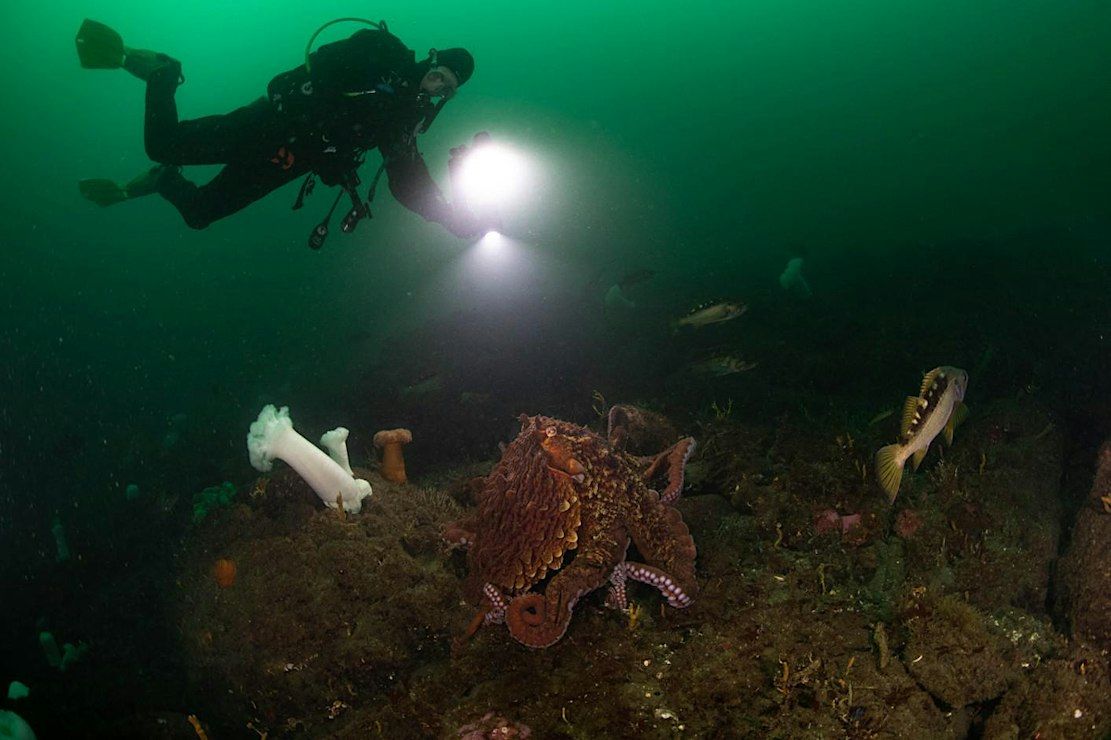
During the evening, Dr. Gire will take audiences inside the remarkable world of the giant Pacific octopus, exploring how these extraordinary animals perceive and interact with their environment through one of the most sophisticated and unusual nervous systems in the animal kingdom. Drawing from research conducted at the University of Washington and Friday Harbor Laboratories, he will share how octopuses use chemical cues, touch, and the remarkable flexibility of their arms to locate food, navigate dark and complex underwater environments, and explore the world around them. His research is helping scientists better understand how intelligence can emerge from a nervous system organized in a fundamentally different way from our own, offering new perspectives on perception, cognition, and the remarkable diversity of ways life has evolved to make sense of the world.
Rather than relying solely on a centralized brain, octopuses possess one of the most unusual nervous systems on Earth. Nearly two-thirds of their neurons are distributed throughout their eight arms, allowing each arm to independently sense, explore, and respond to its surroundings while remaining connected to the animal as a whole. Scientists refer to this as a distributed nervous system, and it is transforming our understanding of intelligence itself.
"Every presentation in this series helps us see our underwater backyard through a new lens," says Crawley. "The giant Pacific octopus reminds us that intelligence comes in many forms. By understanding these extraordinary animals, we not only deepen our appreciation for the Salish Sea but also strengthen our commitment to protecting the ocean that connects us all."
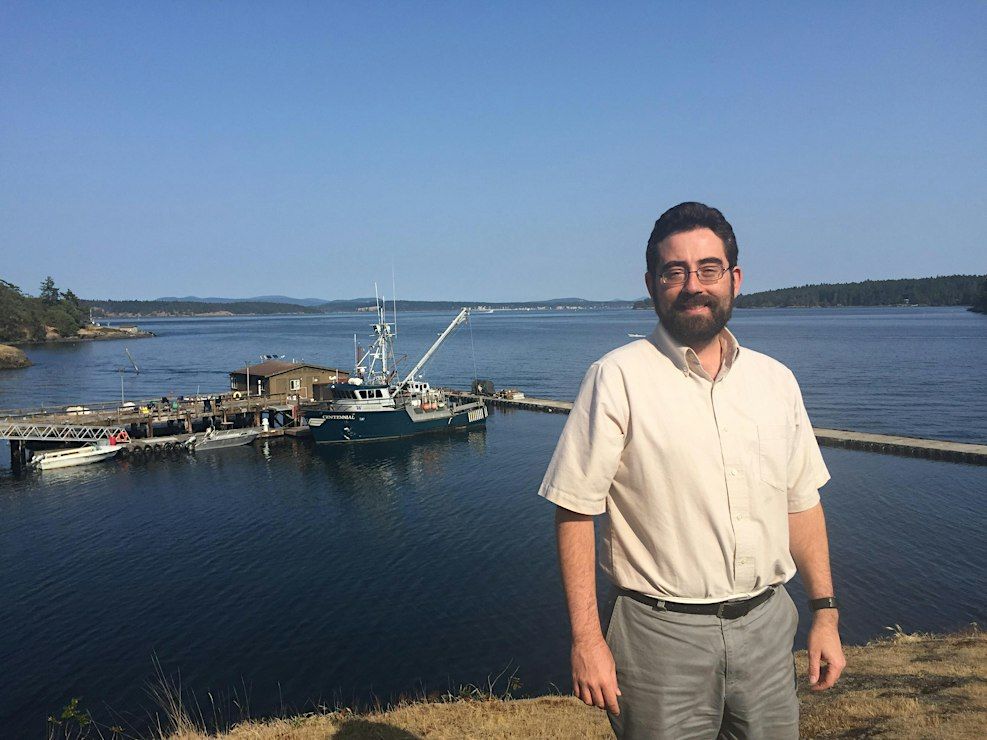
About Dr. David Gire
David Gire, PhD, is a professor of Psychology and Neuroscience at the University of Washington. His research explores how brains make sense of the world, from the neural circuits that guide animal behavior to the broader principles of perception and cognition. Much of his recent work focuses on octopuses and other marine animals, investigating how these remarkable creatures use their distributed nervous systems to sense, explore, and interact with their environment.
Working with collaborators at Friday Harbor Laboratories, Dr. Gire studies how octopuses use chemical cues and flexible arm movements to locate food and navigate complex underwater environments. Through both scientific research and public outreach, he seeks to better understand intelligence, perception, and the many different ways nervous systems solve the challenges of life.

About Annie Crawley
Annie Crawley—known as Ocean Annie—is an award-winning filmmaker, underwater photographer, author, and educator who connects people to nature through visual storytelling, education, and ocean advocacy. A member of the Women Divers Hall of Fame, she leads the Our Ocean and You campaign and curates this Environmental Speaker Series, bringing science and storytelling together to inspire environmental stewardship. Learn more at www.AnnieCrawley.com and www.YouTube.com/AnnieCrawley
Subtitles and Closed Captioning will be provided for our guests who are deaf and hard of hearing. The EWC also offers Assistive Listening devices available to check out or connect with your smart phone.
Reserve your seat online ~ walk-ins are welcome the night of the event based on available seating.
ONLINE TICKET SALES END AT 4pm ON THURSDAY, OCTOBER 8
Special thank you to our sponsors and
Where is it happening?
Event Location & Nearby Stays:
USD 0.00 to USD 7.50