Creative Applications in Virtual Acoustics

About this Event
Creative Applications in Virtual Acoustics
Instructors: Cobi van Tonder // Luna Valentin
Duration: 5 Days
Are you interested in utilizing sound, space, and specifically virtual acoustics to create authentic listening experiences for both research and artistic applications? This hands-on course focuses on interdisciplinary applications in the field of virtual acoustics and immersive sound.
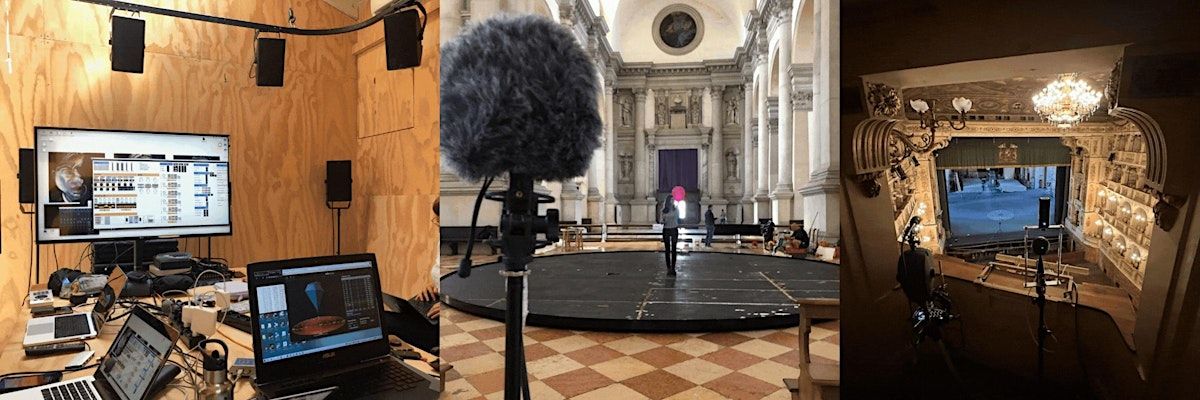
We will start with principles of virtual acoustics within heritage, VR/XR, composition and sound design contexts. The workshop will cover theory, history and philosophy of the digital twin, as well as practical aspects such as conducting acoustic measurements, analysis, simulation, and manipulation of sound through space. We will practically explore space (or qualities of space) as compositional elements. Furthermore, we will examine auralization in the context of digital archaeology and intangible natural and cultural heritage, alongside other immersive listening use cases.
The course curriculum combines lectures, practical sessions on selected technologies and workflows, group discussions, and listening sessions. After 2 days of intensive lectures and listening, each participant will propose a project idea. There will be plenty of opportunity for guided experimentation, discovery, and exploring aesthetics. The course will result in an informal presentation of projects realized by the participants.
Timeline
Day 1: Listening, reading and analysis of existing projects in auralization, sonic archaeology, and cultural/natural heritage acoustics. Selected technologies and systems for virtual acoustics available at CCRMA will additionally be presented. Listening sessions will range from binaural listening to various speaker configurations and Higher Order Ambisonics in the CCRMA multi-channel Listening Room.
Day 2:
Morning: A deep dive into the tools, microphones, recording techniques, and digital environments available to experiment and execute projects. We will utilize primarily open-source and free tools available to participants.
Afternoon: We will contemplate the design, prototyping, and manipulation of acoustic space. We will investigate how space can be used as a sculptural element for expressive and functional goals, and how dynamic transformations between acoustic spaces can create compelling sonic morphologies.
Days 3-5 (Lab Sessions): Participants will present their ideas for individual or collaborative projects. Instructors will support students during the following three days of lab sessions to help execute these projects.
Afternoon of the last day: Presentations, supportive group discussions, and contemplation of the outcomes.
Key Elements
Participants will gain an understanding of the following:
- Space & design: Defining space sonically and its importance in design and art.
- Perception: Acoustical Scale, Depth, Layers, Proximity, and Information.
- Positioning: Listener-versus-source positions, 3DoF, and 6DoF.
- Acoustics: Echo, reverberation, resonance, vibration, envelopment.
- Analysis: Interpretation of acoustic parameters (Reverberation Time, Clarity & Definition, Frequency response, …).
- Configurations: Ambisonics, multi-channel, and other speaker arrays.
- Capture: Capturing the acoustic properties of a space—recording Impulse Responses (IRs) with various configurations.
- Auralization: Convolution reverb and the creative manipulation of Impulse Responses (IRs) for artistic effect and environmental simulation.
- Workflow: Editing environments, tools, and workflows.
- Transitions: Understanding spatial transitions as compositional or interface-based events.
- Implementation: Practical implementation of auralization, panning strategies, and spatialization algorithms in Max and Reaper.
- Web Audio: Possibilities in the browser with WebAudio and Node.js.
Practical Techniques and Tools
The instructors will work mostly in Reaper, Ableton, and Max/MSP, utilizing open-source ambisonics and spatial audio plugins including:
- Plugins: IEM Plug-in Suite, Sparta Suite, Ambix plug-ins, ICST Ambisonics Plugins, MCFX.
- Environments: Spat~ (IRCAM’s spatialization engine for Max/MSP), ICST Ambisonic tools for Max/MSP, Envelop for Live.
- Additional Examples: Unity, Unreal, WebAudio + Node.js, HOA Library, Earshot, Iannix, and more.
Note: After registration, participants will receive a preparation document containing download links and installation information. During the course, templates of workflows will be provided to assist in quick set-up. Equipment (including computers) will be made available, but bringing a personal laptop for further work is highly recommended.
Considerations and Prerequisites
This course is designed for participants from diverse backgrounds, including music, sound design, engineering, archaeology, architecture, and digital arts. No prior experience in acoustics or programming is required. Core concepts are introduced from first principles through hands-on exploration.
Coding: If planning to create a software application, existing fluency in the coding language of your choice is required.
Focus: While covering introductory and theoretical aspects, this course will not focus on advanced mathematics or acoustics. Instead, we will focus on the practical implementation of acoustic principles: experimenting, listening, and discovering through doing.
Interaction design and visual interfaces: While interaction design and visualization or 3d models of spaces may form a key part of projects, the primary focus during the course will be to realize the 3d immersive audio aspects.
Design & Creative Application
- Project Planning & Prototyping: Designing for various output modalities (headphones, mobile devices, headsets, loudspeaker arrays). Keeping in mind the timeframe for your prototype - i.e. plan a segment or shorter version of an idea.
- Tailored Approaches: Discussing individualized project approaches for composition, accessibility, or interactive media.
- Aesthetic Considerations: Awareness of the media and its historical and philosophical roots. How to create a convincing sonic reality? How to frame an artwork? The artist’s reality.
Schedule
9AM-5PM PDT
Instructor Bios
Dr. Cobi van Tonder
Dr. Cobi van Tonder is an artist-researcher whose work bridges virtual acoustics, spatial audio, and experimental composition. A current research fellow at the Department of Architecture, University of Bologna, she creates immersive sound works that merge acoustic modelling with creative practice, often transforming heritage sites, from cathedrals to caves, into instruments for microtonal drone composition. Her ongoing project Acoustic Atlas—Cultivating the Capacity to Listen, aims to make audible and accessible research in heritage acoustics by integrating real-time auralization in the browser for interacting with acoustic digital twins.
An alumna of Stanford University (MFA in Art Practice), she also holds a PhD in Music Composition from Trinity College Dublin and a BHons in Musicology from the University of the Witwatersrand. Van Tonder’s work has been commissioned and exhibited internationally, with recent immersive installations for Roger Ballen in Venice and Rome. Her teaching spans sound art, spatial audio, digital production, and sonic archaeology, and she is now for the 3rd time the organising chair of the Immersive and 3D Audio (I3DA) Conference in Italy. Furthermore, from June 2026, she will be starting a new Marie S Curie funded project titled: OCEAN EARS - Sound swimming with Whales at the University of Sorbonne.
Luna Valentin
Luna Valentin is a 4th year PhD researcher at Stanford University’s CCRMA, where she works on virtual acoustics, spatial audio, and immersive auralization for archaeological, architectural, and artistic applications. Her research focuses on impulse-response-based measurement and the integration of acoustic data into GIS-linked digital twins. Her doctoral dissertation, Acoustic Affordances in Archaeological Spaces: A GIS-Based Approach, develops data-driven methods for analyzing, mapping, and creatively re-deploying acoustic measurements as immersive listening environments.
At CCRMA, Luna leads the PaleoAcoustics research team. She has contributed to fieldwork and analysis at a wide range of archaeological and heritage sites, including Chauvet Cave and Saint-Marcel Cave (France), decorated caves in the South of France, heritage and archaeological sites in Peru, the Saqqara necropolis (Egypt), and rock art and canyon landscapes in Utah (USA).
In parallel with her research, Luna develops creative and experimental projects that treat acoustic space as a compositional and dramaturgical material. Her work includes virtual acoustic reconstructions, electroacoustic performance, and spatial sound design for architectural contexts, including projects engaging the acoustics of Le Corbusier’s buildings, where measured and simulated spaces are used as dynamic compositional elements.
Where is it happening?
Event Location & Nearby Stays:
USD 468.44