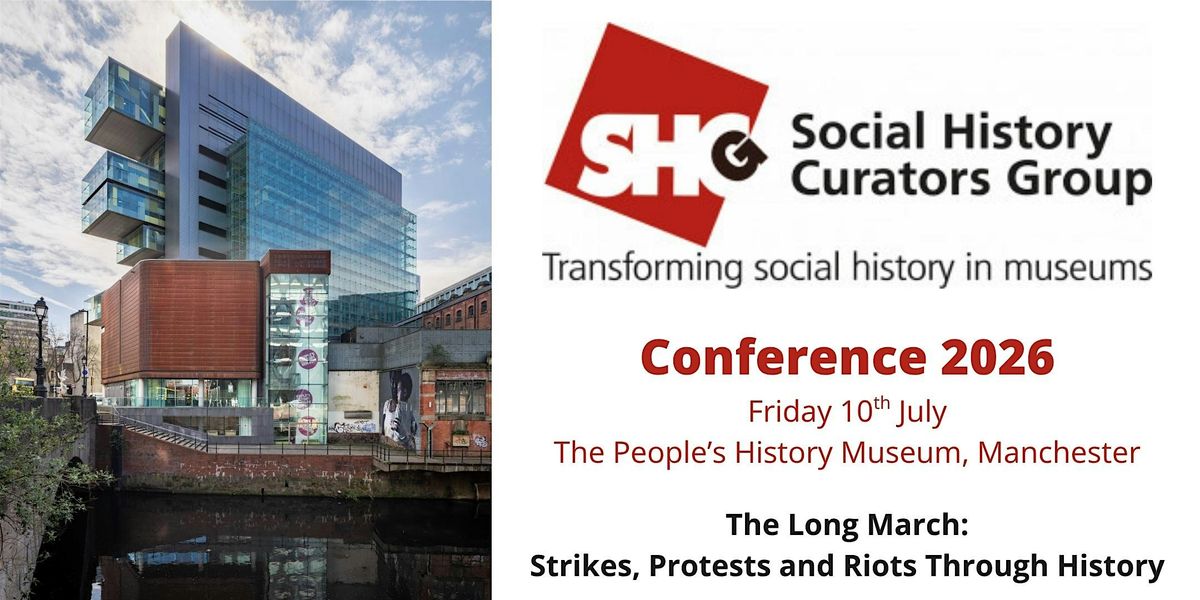
Conference 2026: The Long March: Strikes, Protests & Riots Through History
About this Event
Inspired by the centenary of the 1926 General Strike, this year’s conference will examine how museums and heritage sites engage with stories of strike, protest, rebellion, and resistance. We will explore the immediate and enduring effects of such events on individuals and communities, and how these impacts can be identified, interpreted, and made visible through museum practice.
Conference schedule
Thursday 9th July - Pre-conference social at in Manchester's vibrant Northern Quarter between 6-8pm. A great way to start conference.
Friday 10th July - Main conference at the People's History Museum. For the full programme please see the Agenda section below.
Site visits - There is so much choice for places to visit in Manchester that we have decided not to arrange any formal excursions but will provide details to all attendees of the top SHCG picks for visits while you are in the city so you can explore independently.
Ticket prices
Early Bird tickets are available until midnight on 12th May - grab them while you can.
- Early Bird Member - £90
- Early Bird Non-Member - £105
- SHCG Member - £105 - from 13th May onwards
- Non-Member - £120
We can invoice for conference places if paying via Eventbrite is not possible. PLease contact [email protected] to arrange.
Bursary places
We would like to thank for offering bursary places to this year's event. These are available through their Applications are now open and are assessed on a rolling basis. Please allow at least a fortnight for your application to be reviewed and a decision made. These bursaries are available for those in the MDN region.
Other CPD bursaries are available via:
- Museums in England - via alternative
- Museums in Wales - via Federation of Museums and Art Galleries of Wales (Museums Federation Cymru)
Professional development support is also available from the
About our theme: The Long March: Strikes, Protests & Riots Through History
The theme is intentionally broad, encompassing personal experiences as well as mass movements, local actions and international contexts, and narratives spanning from the historical record to contemporary moments. We will also be encouraging reflection on how approaches to these subjects have shifted over time, particularly in response to changing social, political, and ethical frameworks and understanding.
We would like to acknowledge the complexity of the causes and catalysts of these events, the challenges in collecting tangible and intangible heritage as well as the multiplicity of perspectives which exist, and the role of curatorial voice, that can be difficult to capture and communicate to our audiences.
We will encourage organisations and individuals to question established narratives and foregrounding voices that have been marginalised or overlooked through community engagement. This could be through exhibition development, public programmes, collections-based research, or participatory initiatives that engage ourselves and others in critical dialogue or collective reflection.
To see the full programme please see the Agenda section below.
Attendees showcase space
We are all working on amazing collections, exhibitions, projects and much more. If you would like to share what you are working on with everyone at conference we will have space for leaflets and pop up banners or anything else you would like to bring!
(Please note this will be an unattended space so is not suitable for items of value which cannot be left)
Agenda
🕑: 09:30 AM
Registration & refreshments
🕑: 09:50 AM
Welcome
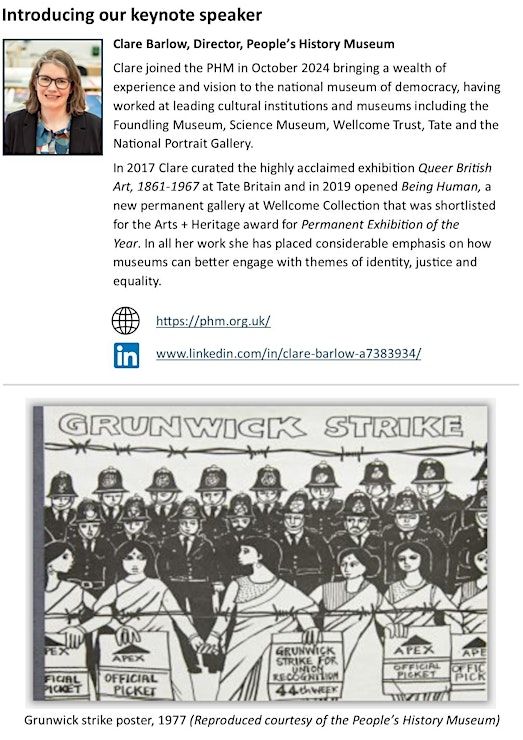
Keynote speaker
Host: Dr Clare Barlow, Director, People's History Museum
Info: We are thrilled to have Dr Barlow to open this year's conference. Clare will help set the tone for the conference by exploring the importance of capturing community and individual involvement acts of resistance now more than ever.
With an outstanding track record of programming ground-breaking exhibitions across world-class museums, Clare brings deep experience alongside a strong commitment to inclusivity, social justice and creating platforms for unheard voices. Her work reflects the People’s History Museum’s mission to champion the compelling stories of those seeking a fairer world for all.As the home of ideas worth fighting for, the People’s History Museum offers the perfect setting to explore how museums can work with communities to understand the past, engage the present and help shape a fairer future together.
🕑: 10:15 AM - 10:35 AM
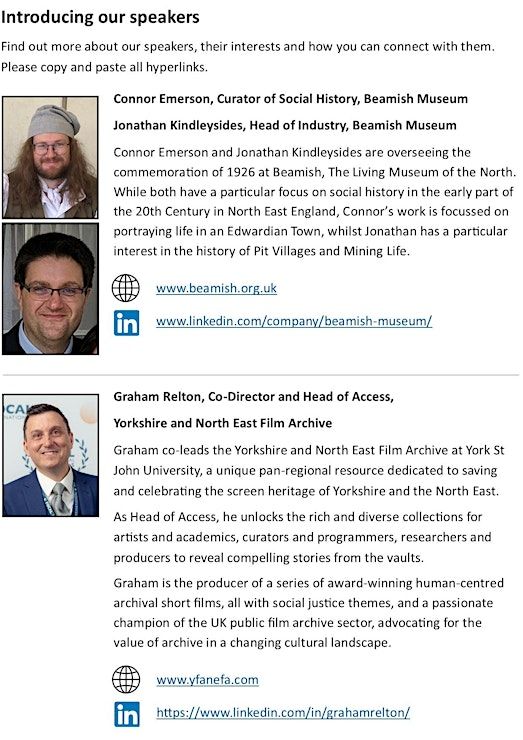
Case study: Tension, Tears and Protests - Portraying 1926
Host: Connor Emerson &
Info: Beamish, The Living Museum of the North, has launched a year of programming to mark 1926, focusing on the Lock-Out and General Strike. Using living history and scenario-based engagement, it will explore key moments and the experiences of North East communities.
The museum has previously interpreted events such as the Silksworth Evictions, Female Suffrage, and women’s roles in the 1984 Miners’ Strike, shaping its approach to emotive histories and strengthening its storytelling.
Across the year, Beamish will involve local communities to present a balanced view of how the strike affected mining areas and wider society, focusing on the General Strike, Burnhope gathering, soup kitchens, and return to work.
Our presentation reflects on lessons learned and how they inform this centenary programme and evolving practice.
🕑: 10:35 AM
Case study: In the Veins - getting to the heart of community curation
Host: Graham Relton, Yorkshire and North East Film Archive
Info: Four decades on, the impact of the Miners’ Strike still resonates. Marking the 40th anniversary of the 1984/85 coal strikes, this session explores how a regional film archive uncovered collections, co-curated content and meaningfully connected with mining communities.
Though experienced in archive research and visual storytelling, the key challenge was the responsibility of telling a sensitive, human-centred story about a proud, often overlooked community built on coal.
Focusing on the ‘In the Veins’ project, the session examines unlocking collections and engaging audiences across former mining communities in Northern England, many still affected by the strike’s legacy.
Central was a diverse group of 13 volunteer community curators who co-produced the film. Their lived experience ensured authenticity, integrity and trust.
The session shares how collaboration shaped a representative, meaningful film, and offers insight for those creating impactful, community-focused social history.
🕑: 10:55 AM
Case study: Intersectional Solidarity in the 84-85 Miners' Strike
Host: Jaime Starr, Queer Britain
Info: This session will be an exploration of LGBTQIA+, feminist, and Black and Asian solidarity campaigns supporting the 1984-85 Miners' Strike. This is based on my work caring for and curating from the collections of Lesbians and Gays Support the Miners (LSGM), including conducting extensive oral history interviews with key surviving LGSM members, and curating temporary exhibitions on LGSM, and on women's activism in the Miners' Strike for People's History Museum.
Attendees can expect to learn how intersectional solidarity was pivotal to the continuance of the strike, the ways in which Black and Asian, LGBTQIA+ and feminist groups supported striking miners and their families, the impacts of engaging with marginalised communities on miners and the lasting legacy of these connections on UK civil rights legislation.
🕑: 11:30 PM - 11:50 AM
Tea break
🕑: 11:50 AM
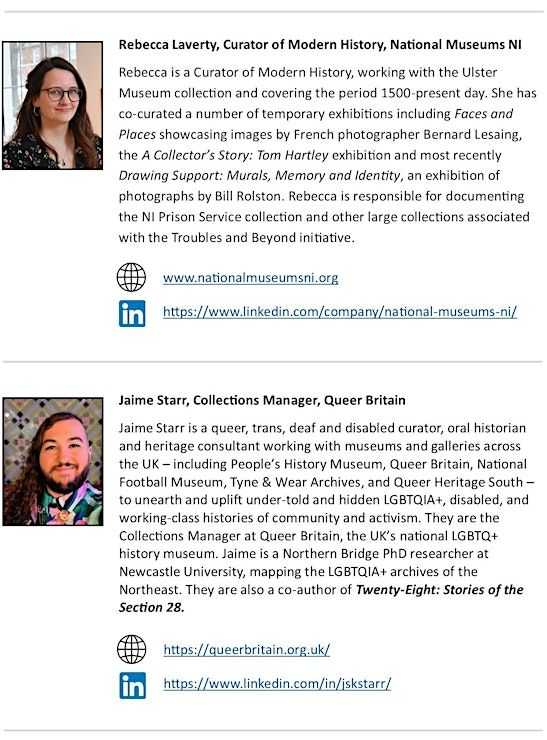
Case study: Murals, Memory and Identity
Host: Rebecca Laverty, National Museums NI
Info: Political murals in Northern Ireland began in 1908, commemorating King William III’s victory at the Boyne within Unionist communities. The tradition remained largely Unionist until the 1981 hunger strikes, when Republican supporters turned to mural painting to “draw support.”
In 2024, National Museums NI opened *Drawing Support: Murals, Memory and Identity*, part of the Troubles and Beyond initiative. Co-curated with Bill Rolston, it featured photographs of murals across Northern Ireland, presenting perspectives on conflict and everyday life.
Murals can reflect division, creating tension between opposing views, but also act as forms of popular protest, continually evolving with social, political and cultural change.
As Rolston noted, the exhibition affirmed: this is your museum, and this is your city too.
🕑: 12:10 PM
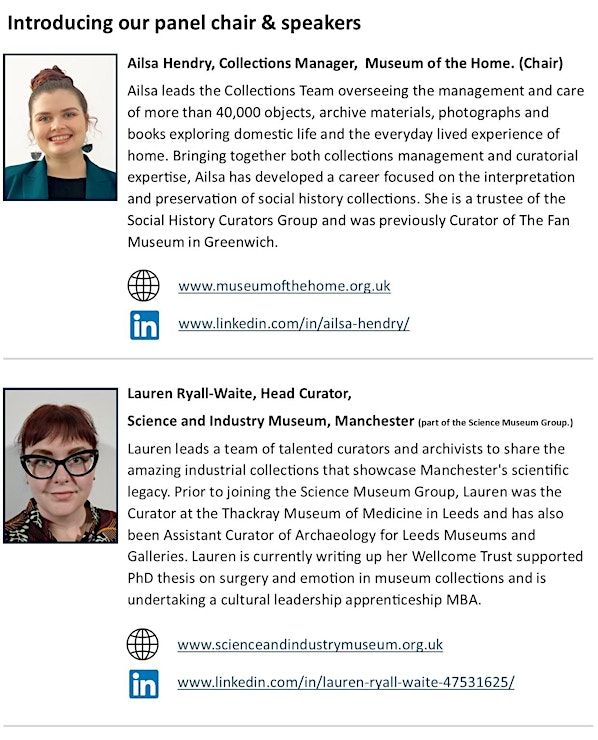
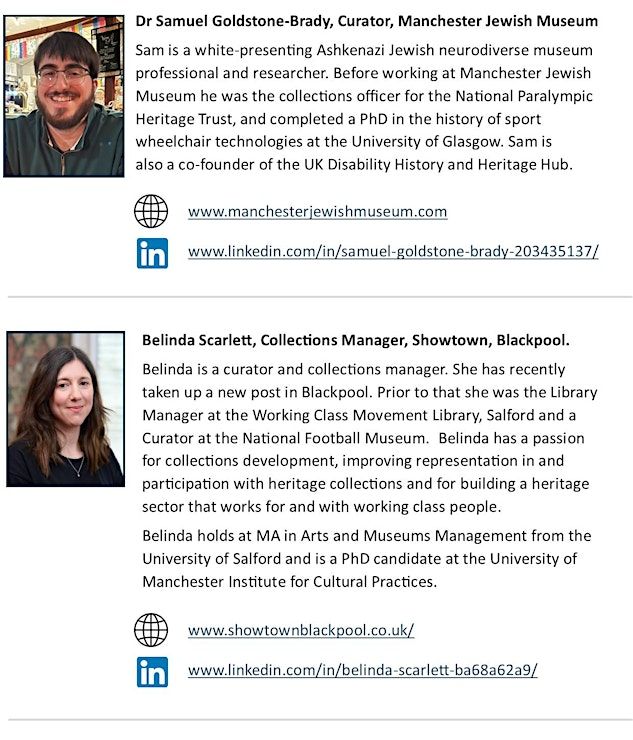
Panel discussion
Info: The panel will discuss the importance of collecting protest material and explore the different ways we can address the challenges of collecting. Panels member and chair to be announced soon.
🕑: 12:55 PM - 01:55 PM
Lunch
Info: An opportunity to watch the 'In the Veins' film from the Yorkshire & North East Film Archive; network with friends and colleagues and explore the museum.
🕑: 01:55 PM
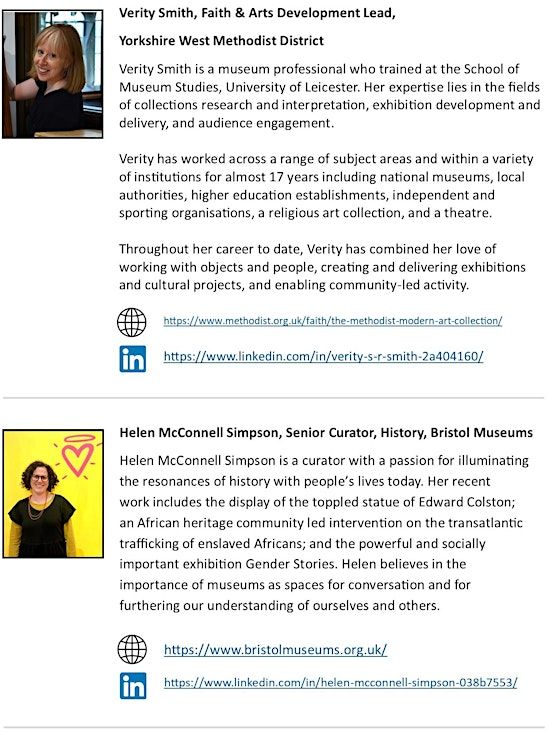
Case study: From Rubble Reborn: Art responding to art & contemporary conflict
Host: Verity Smith, The Methodist Church - Yorkshire West Dist
Info: Through the Yorkshire West District of the Methodist Church, Verity developed & delivered an exhibition drawn from the Methodist Modern Art Collection (MMAC) across 5 venues under the theme *Everything Is Connected*, linking communities during Bradford City of Culture 2025.
Engagement included residents, schools, artists, a chamber choir, galleries, and church congregations across the Bradford District, enabling visitors to explore and share experiences of faith, art, conflict and protest.
A ceramic artist was invited to respond to a MMAC painting, producing a sculptural response to the Israel–Gaza conflict. The work was considered potentially controversial, evoking strong reactions, yet it aimed to present a lived reality for open interpretation and discussion rather than a fixed viewpoint.
The session explores the varied aspects of managing multi-site exhibitions with sensitive content, while highlighting how local practice reflects global events and their impact on communities.
🕑: 02:10 PM
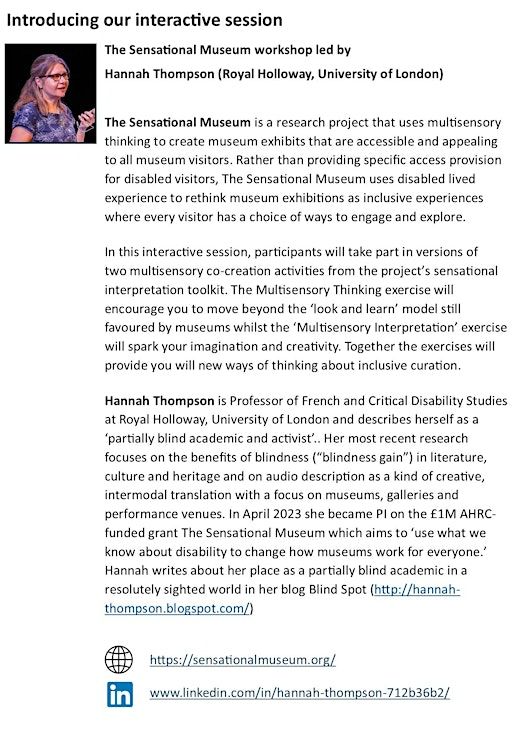
The Sensational Museum interactive session
Host: Hannah Thompson
Info: "Using what we know about disability to change museums for everyone" The Sensational Museum is a research project that uses multisensory thinking to create museum exhibits that are accessible and appealing to all museum visitors. Rather than providing specific access provision for disabled visitors, The Sensational Museum uses disabled lived experience to rethink museum exhibitions as inclusive experiences where every visitor has a choice of ways to engage and explore.
In this interactive session, we will take part in versions of two multisensory co-creation activities from the project’s sensational interpretation toolkit. The Multisensory Thinking exercise will encourage us to move beyond the ‘look and learn’ model still favoured by museums whilst the ‘Multisensory Interpretation’ exercise will spark our imagination and creativity. Together the exercises will provide us with new ways of thinking about inclusive curation.
🕑: 03:00 PM - 03:20 PM
Tea break
🕑: 03:20 PM
Case study: Displaying contemporary protest
Host: Helen McConnell Simpson, Bristol Museums
Info: This session will explore M Shed’s recent work in displaying contemporary protest and contentious social issues including the toppling the Colston statue and rioting in the streets of Bristol. It will explore the community consultation, expert input and curatorial decision-making behind recent displays which record the toppling of the statue of the enslaver Edward Colston; the anti-capitalist Stokes Croft riots; and the K*ll the Bill protest against the curtailment of peaceful protest, which resulted in the largest number of people charged with Riot since the 1980s.
M Shed situates these stories within a longer history of protest on civil rights issues in Bristol, and encourages visitors to reflect on the threads which connect experiences across time. These contemporary events offer particular challenges to curation, however.
🕑: 03:40 PM
Case study: How to Talk About Anti-Vaxxers at the Birthplace of Vaccination
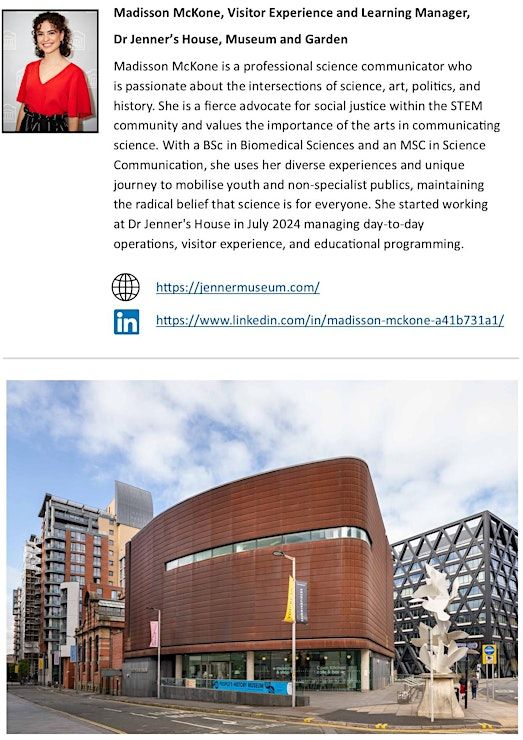
Host: Madisson McKone, Dr Jenner's House, Museum and Garden
Info: Dr Jenner's House is preparing a temporary exhibition on anti-vaccination and its legacy, from 1853 riots against mandatory vaccination, through Andrew Wakefield and the MMR scandal, to Covid-19 “Plan-demic” narratives and current rises in measles cases.
The museum dedicated to celebrating the eradication of disease and the invention of vaccination must navigate dialogue with those who hold opposing views. Behavioural science and science communication suggest this is a necessary conversation.
Can co-creation happen between groups assumed to be in conflict? Is there space for nuance in an increasingly politicised society? Can a charitable museum act as a safe space for concern while maintaining a pro-vaccination stance?
Opening on 14 May, the 230th anniversary of Edward Jenner’s first vaccination in rural Gloucestershire, the presentation will explore the makingof the exhibition, the challenges faced, and lessons in empathy amid resistance in it.
🕑: 04:00 PM
Conference reflections and looking forward
🕑: 04:20 PM
Closing words
🕑: 04:30 PM
Event ends
Where is it happening?
Event Location & Nearby Stays:
GBP 90.00 to GBP 120.00