Cartography of Shadow
Schedule
Wed, 04 Feb, 2026 at 10:30 am to Tue, 03 Mar, 2026 at 12:30 pm
UTC+01:00Location
vanities gallery | Paris, IL
Solo Exhibition
February 4 – March 3, 2026
Opening reception: Wednesday, February 4, 2026, from 6:30 pm
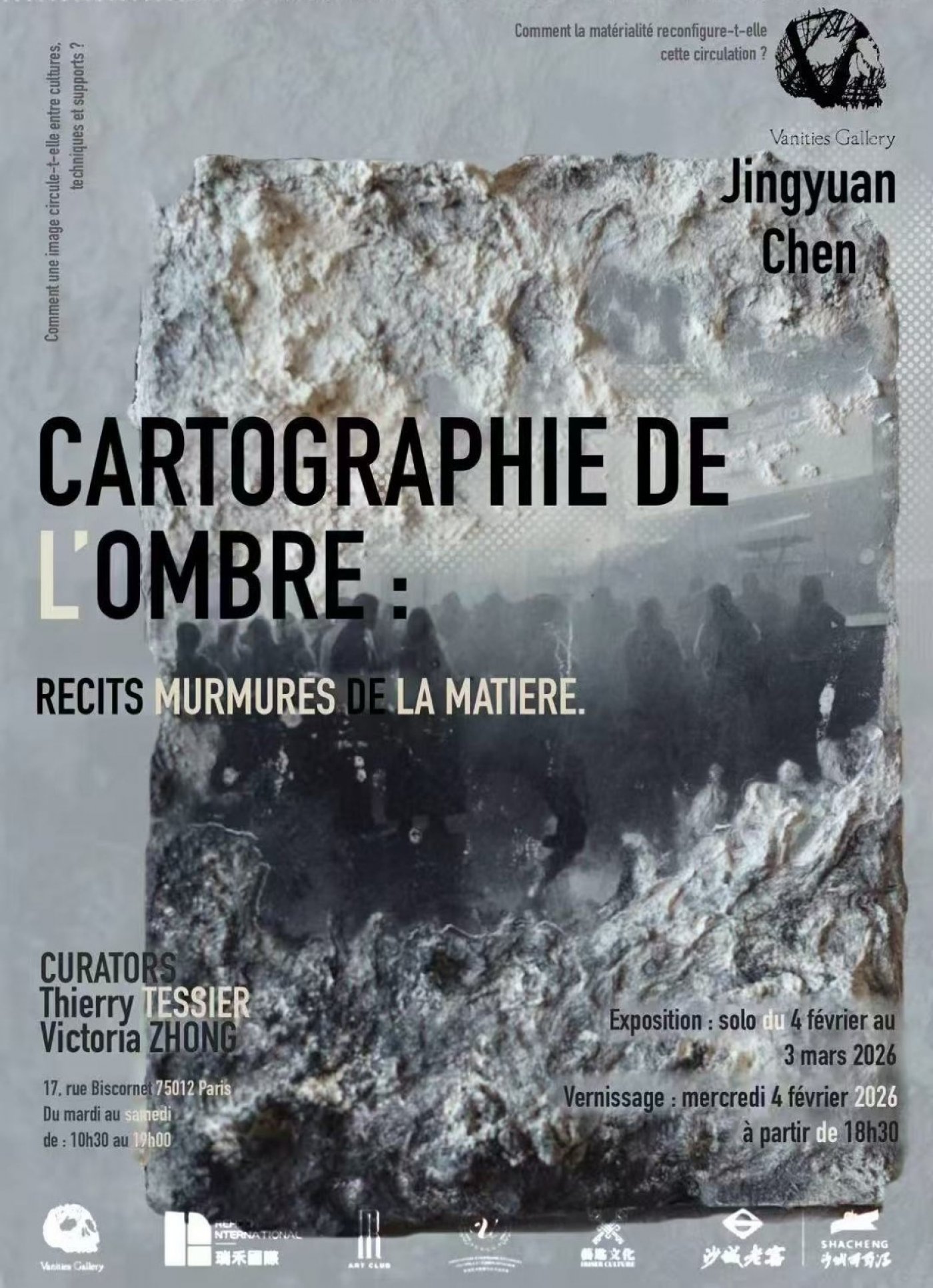
The exhibition presented by Vanities Gallery brings together a selection of recent works by Jingyuan Chen (born 1997). Born in 1997, Jingyuan Chen received his initial training at the Central Academy of Fine Arts in Beijing (2015–2019), before continuing his studies at the European Academy of Art of Brittany, Brest campus (2020–2023). His work has been presented in several group and solo exhibitions in France and China, notably Les sombres chuchotements (IANJI, Lyon, 2023) and Corps pop, esprit dada (Appartement Renoma, Paris, 2024). This dual geographical and institutional grounding informs a practice in which European references and Asian visual heritages intersect—not as a juxtaposition of identities, but as a field of inquiry: how does an image circulate across cultures, techniques, and media? How does materiality reconfigure this circulation?
This plurality of media does not arise from a desire for spectacular fusion, but from a methodical questioning of the ways in which an image is constructed both materially and mentally.
The exhibition is structured around a group of works in which plaster, acrylic paint, and printed images coexist within a discreet regime of layers and deposits. The surfaces do not seek effect, but rather the slow activity of matter: they accommodate withdrawal, erasure, fissure, and reworking. Through the interplay of black and white, Jingyuan Chen does not reiterate the classical rhetoric of binary opposition; instead, he establishes a continuous gradation in which darkness and light function as operators of reading, almost as analytical tools. Black here is not a dramatic value; it acts as a field of inscription and restraint, while white functions as reserve, interval, or suspension of the visible.
Materiality and Image: Between Inner Cartography and Visual Sequence
In his recent series, the artist develops visual sequences that may be read as inner cartographies, in which memory and fiction are not opposed but articulated. Fragments of photographic images integrated into plaster-coated surfaces are partially covered, sometimes absorbed by the pictorial matter: the reproduced image is no longer a document, but a surface event.
This approach is part of a broader reflection on the status of the image in an environment saturated with visual devices. By introducing material slowdowns—plaster thickness, surface resistance, drying time—Jingyuan Chen reinstates a temporality of attention. The works do not offer an explicit narrative; they generate an openness to interpretation, in which figures emerge and recede according to the movement of the viewer’s gaze.
Dialogues with the Twentieth Century: Continuities and Divergences
Jingyuan Chen’s works are situated within a longer history of material-based painting and the use of black. One may first think of Pierre Soulages (1919–2022): the use of black as an operative field rather than a simple color opens a visual space in which light is produced by texture itself. However, whereas Soulages works toward the unity of a surface oriented toward a luminous phenomenon, Jingyuan Chen introduces discontinuities, photographic insertions, and collages, shifting the question of light toward that of image heterogeneity.
Another point of proximity appears with Antoni Tàpies (1923–2012), for whom matter—sand, dust, impasto—engaged both a physical and mental dimension of painting. Chen shares this attention to modest supports and rough textures. Yet, unlike Tàpies, who often inscribed quasi-calligraphic signs with symbolic value, Chen avoids the stabilization of the sign: he leaves the surface in a state of partial legibility, refusing interpretive closure.
Thus, references to the twentieth century are not citations but critical points of comparison. The artist positions himself within a field where painting is neither abandoned nor simply reactivated; it is reexamined through materiality, the role of technical images, and the viewer’s relationship to the duration of looking.
Works and Display
The works presented at Vanities Gallery include large- and medium-scale pieces made with plaster, acrylic, and photographs printed on paper. Some assert an almost architectural frontal presence; others adopt a serial structure, as if each element constituted a methodical variation on themes of covering, fracture, and continuity.
In several ensembles, the compositions remain close to black and white—not as an ascetic choice, but as an operative restriction allowing for the examination of minimal differences: variations in gray, layer porosity, transitions between matte and gloss. This chromatic economy reinforces attention to texture: grooves, strata, zones of absorption or opacity.
The exhibition does not seek to produce a synthesis or to establish a “period.” It proposes a series of viewing situations. Each work functions as a transitional space: between reproduced image and worked surface, between appearance and erasure, between continuity and interruption. The spectator’s role is not to identify motifs, but to accept a form of sustained attention, in which materiality conditions reading.
Within this framework, the dialectic of black and white is not merely visual. It engages the relationship between presence (what is given to be seen) and reserve (what remains withdrawn). Texture acts as a mediation between these poles; it renders perceptible the way an image is made rather than simply shown.
Where is it happening?
vanities gallery, 17 Rue Biscornet, 75012 Paris, France, ParisEvent Location & Nearby Stays:



![[Visite guid\u00e9e] Parties communes](https://cdn-ip.allevents.in/s/rs:fill:500:250/g:sm/sh:100/aHR0cHM6Ly9jZG4tYXouYWxsZXZlbnRzLmluL2V2ZW50czQvYmFubmVycy8xNzY0ZjJiMDQzZDRiNGM5ZDhmMTIzOTEwN2EzYTEzYWUwZTEzNjRkZDYxY2NkZjRjMzcwMDc0NmQyNDVhNmIzLXJpbWctdzc2MC1oNTA3LWRjMDUwNzA0LWdtaXIuanBnP3Y9MTc2OTA3NDY1OA.avif)