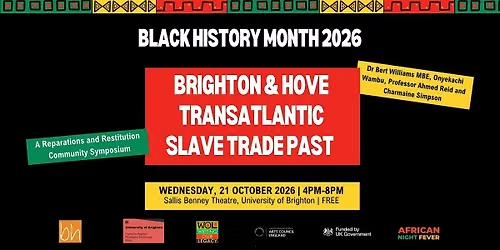
Brighton and Hove City’s Transatlantic Slave Trade Past

About this Event
The Reparations and Restitution Community Symposium aims to provide an accessible public platform during UK’s annual Black History Month to examine how Britain's involvement in the transatlantic slave trade continues to shape contemporary racial, social and economic inequalities. The symposium will bring together internationally recognised scholars, campaigners and local community leaders, connecting global debates on Reparatory justice with Brighton and Hove's own historical relationship with transatlantic slavery and empire.
More than a commemorative event, the symposium is designed as a catalyst for policy dialogue, civic engagement and institutional change, encouraging Brighton & Hove City Council and other public bodies to consider meaningful Reparative approaches to addressing the city's historical legacy.
Brighton and Hove possesses significant historical links to Britain's imperial and slave-trading past through its maritime economy, commercial networks, investment histories and civic institutions. Yet these histories remain relatively absent from public consciousness and local policymaking.
By placing Brighton and Hove's own history at the centre of the conversation, the project seeks to help the city become a national leader in developing thoughtful, inclusive and evidence-based approaches to historical justice.
The symposium is organised by Brighton and Hove Black History, in partnership with the Centre for Applied Philosophy, Politics and Ethics (CAPPE) at the University of Brighton and supported by Writing Our Legacy.
Dr Bert Williams MBE
Dr Bert Williams MBE is co-founder of Brighton & Hove Black History. Born in Jamaica, Bert has lived in Brighton since 1967. He served in the RAF, then worked for the NHS. After retiring, he chaired Black & mixed parentage family charity Mosaic. Bert has also organised Chattri Memorial service to honour WW1 Indian Soldiers.
In 2011, Bert was awarded a MBE in the Queen’s Birthday Honours. In 2017, he received an honorary Doctor of Letters from the University of Sussex.
For over 40 years, he has dedicated himself to recording the stories of Black communities in Brighton & Hove and across Sussex. You can find out more about his project Echoes of Brighton’s Past.
Onyekachi Wambu
Onyekachi Wambu is an Associate for Special Projects at the African Foundation for Development (AFFORD), where he encourages the contribution of the African diaspora to African and international development and contributes to initiatives advancing justice and reparatory action. He has been actively engaged in the UK debate on African reparations, connecting grassroots campaigning with policy and political advocacy.
His work contributes to efforts to place reparations, restitution, and historical justice more firmly within public and parliamentary discourse in Britain, including through engagement with the All-Party Parliamentary Group for Afrikan Reparations. Wambu brings a strong commitment to addressing the enduring legacies of slavery, colonialism, and racial inequality, and to building meaningful pathways towards recognition, repair, and justice.
Wambu is also the editor of the anthology Empire Windrush: Reflections on 75 Years & More of the Black British Experience, published in June 2023.
Professor Ahmed Reid
Professor Ahmed Reid is a historian, author, and leading scholar of reparatory justice, with a particular focus on the history and contemporary legacies of slavery, colonialism, and racial injustice in the Caribbean and the wider African diaspora. He is a Professor at the Centre for Reparation Research at The University of the West Indies, where his work contributes to advancing scholarship and public debate on reparations and historical justice.
Professor Reid has also served as Chair of the United Nations Working Group of Experts on People of African Descent, contributing to international discussions on racial justice, human rights, and reparatory action. His research and public engagement connect historical scholarship with contemporary struggles for justice, accountability, and the advancement of the rights and wellbeing of people of African descent globally.
In 2024, Professor Reid was appointed as a Programme Manager to investigate the Guardian's historical links to transatlantic enslavement, including the newspaper's historical activities and connections in Jamaica and the Sea Islands of the United States. This work forms part of broader efforts to examine institutional histories of involvement in slavery and to consider questions of historical accountability and repair.
Charmaine Simpson
Currently works with the Church Commissioners of the Church of England on Project Spire as a Research Engagement Coordinator, supporting and overseeing research exploring the Church of England’s historical connections to transatlantic African chattel enslavement. Charmaine is also the Chief Executive Officer and cofounder of Black History Studies and the Director of Black History Study Tours Limited, which is dedicated to promoting cultural tourism to areas of African Heritage.
A historian, author, publisher, researcher, film exhibitor and avid social networker, Charmaine has spent the last 20 years popularising the study of Black History and Black Studies. Charmaine Simpson is also a Financial Educator and Financial Literacy Advocate who organises courses, workshops and events to improve Financial Literacy in the Community.
The University of Brighton's Centre for Applied Philosophy, Politics and Ethics (CAPPE) works across the globe to understand the major issues of the day. What challenges do climate, decoloniality , LGBTQI+, care and many others present to philosophy, politics and ethics?
Founded in 2005, CAPPE intervenes in the public arena extending beyond conventional academic boundaries. We host regular public events linking a transnational public to the cutting edge debates of the day. We collaborate with colleagues across the world and are open to future proposals, whether small- or large-scale. Join CAPPE as a Visiting Scholar for periods between one week and a year. Or join our mailing lists, and participate in our many events.
https://www.brighton.ac.uk/cappe/index.aspx
In 2003, Ebou Touray from the Gambia and David Sijale from Tanzania, launched a monthly music night at the Babylon Lounge in Hove, showcasing the music and culture of Africa and the African diaspora.
African Night Fever became a hub for local talent as people flocked to the nights in order to dance, mingle and experience a mix of Live bands and DJ sets. From that, sprang friendships, sharing and genuine community spirit.
African Night Fever continues to evolve and partners with local venues and promotors throughout the UK to share a taste of African and Caribbean culture, belonging and community to a diverse range of audiences.
https://www.africannightfever.co.uk/
Founded in 1868, TUC brings together more than 5.3 million working people across their 47 member unions. It exists to make the working world a better place for everyone. Working people joining together can change things. For more than 150 years, unions have fought for safer workplaces and wages you can build a life on. And today we’re needed more than ever to make sure every job is a decent job and everyone at work is treated with respect.
Writing Our Legacy CIC is an arts and heritage organisation that enables Black, Asian and ethnically diverse/BPOC* people to tell their stories through writing and the creative arts. We were established in 2012 and are an Arts Council National Portfolio Organisation 2023-28.
We give writers and other creatives a platform and community to feel supported, nurtured and evolve their work through the creative pipeline, from start to publication. We share stories and heritage of diaspora communities and bring them to life through various art forms for audiences to learn and take part in cultural heritage.
Over the past 14 years, we’ve produced a wide range of activities, such as literary events and festivals, theatre productions, residencies, workshops and publications.
https://writingourlegacy.org.uk/
About Brighton & Hove Black HistoryBrighton and Hove Black History was formally launched in Brighton in October 2002. The group’s existence owes a lot to the passion and persistence of Bert Williams MBE, who has spent much of his retired life researching and presenting the multicultural history of the city.
The group has now expanded to encompass a thriving team of local volunteers from a variety of cultural backgrounds.
https://black-history.org.uk/about/
How to get hereThe Sallis Benney Theatre is situated within the University of Brighton’s Grand Parade campus, in the heart of Brighton, just a few minutes' walk from the seafront and city centre.
- By train to Brighton and then on foot. From Brighton railway station: turn left down Trafalgar Street. At the bottom of Trafalgar Street turn right onto Grand Parade. Cross to the other side of Grand Parade and keep walking towards the sea. The university's Grand Parade building is on the left, almost opposite the Royal Pavilion.
- By bike: The city centre cycle lane network provides easy access to the Grand Parade site. Cycle stands are provided at the rear of the Grand Parade, off William Street. There is a cycle cage in front of the Circus Street Annexe, accessed via Kingswood Street.
- By bus: Grand Parade's central location places it at the heart of the Brighton and Hove bus network and makes it easy to reach the site from any area of the city. Visit the Brighton and Hove Company website for timetables and more on special tickets.
- By car: From the A23 or A27: Follow signs for the city centre and seafront. As you enter the city, a one-way system will lead you towards the sea via Grand Parade. The university's Grand Parade building is on the left, almost opposite the Royal Pavilion. Due to the site's central location, car parking is extremely limited. There are a number of clearly sign-posted NCP car parks located nearby.
Where is it happening?
Event Location & Nearby Stays:
GBP 0.00