Big Three Bon Odori Workshop in English (Free Public Program)

About this Event
Important Notes:
Note 1:
There have been cases where multiple reservations were made using the same email address, which prevents other participants from having the opportunity to attend. To ensure that this Free Public Program can be enjoyed by as many people as possible, please make one reservation per person using one email address per person.
If we find two or more reservations made with the same email address, Eventbrite has instructed us that we may cancel those reservations. Please do not make multiple reservations using a single email address.
Note 2:
If the number of participants exceeds the room capacity, we may have to refuse admission on the day of the workshop. If you would like to participate, please arrive early.
Note 3:
Please be aware that the venue locations for the Japanese-language workshop and the English-language workshop are different. Please carefully check the event information and make sure you attend the correct location.
Note 4:
Please wear comfortable clothing that allows you to move freely during the workshop. If you own a yukata and would like to wear it, you are welcome to do so.
Note 5:
Photography and video recording are not permitted during the workshop.
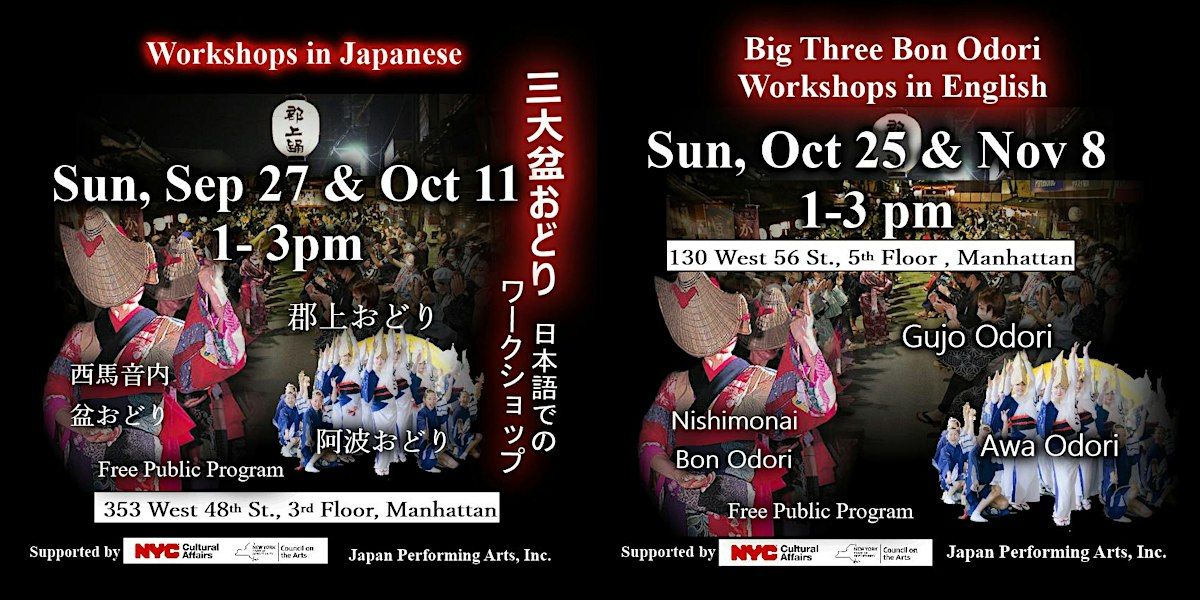
Japan Performing Arts, Inc. (JPA) will be hosting Free Public Program workshops featuring the Big Three Bon Odori of Japan: Nishimonai Bon Odori from Akita Prefecture, Gujo Odori from Gifu Prefecture, and Awa Odori from Tokushima Prefecture.
There will be two types of workshops: one conducted in Japanese and one conducted in English.
The Japanese-language workshops will be held on Sunday, September 27, and Sunday, October 11, from 1:00 PM to 3:00 PM (2 hours). The location is Andy’s Studios / 353 West 48th Street, 3rd Floor, Manhattan.
The English-language workshops will be held on Sunday, October 25, and Sunday, November 8, from 1:00 PM to 3:00 PM (2 hours). The location is City Center / 36 West 56th Street, 5th Floor, Manhattan.
Those who are comfortable regardless of language are welcome to participate in both the Japanese and English workshops.
If you would like to participate in the workshops, please register through Eventbrite. These workshops are a Free Public Program supported by the New York City Department of Cultural Affairs and the New York State Council on the Arts.
This workshop is also a program designed to prepare participants to enjoy dancing at JPA’s cultural event on November 21 (the location will be announced at a later date). We encourage you to join the workshops with the November 21 event in mind.
Participation in the workshops requires registration through Eventbrite. A maximum of 120 participants will be allowed on the day of the event. We cannot accommodate additional participants beyond this capacity, so please arrive early.
The Big Three Bon Odori will be introduced one by one, explaining each dance in order from the northernmost region of Japan to the southernmost region.
NISHIMONAI BON ODORI (Akita Prefecture)
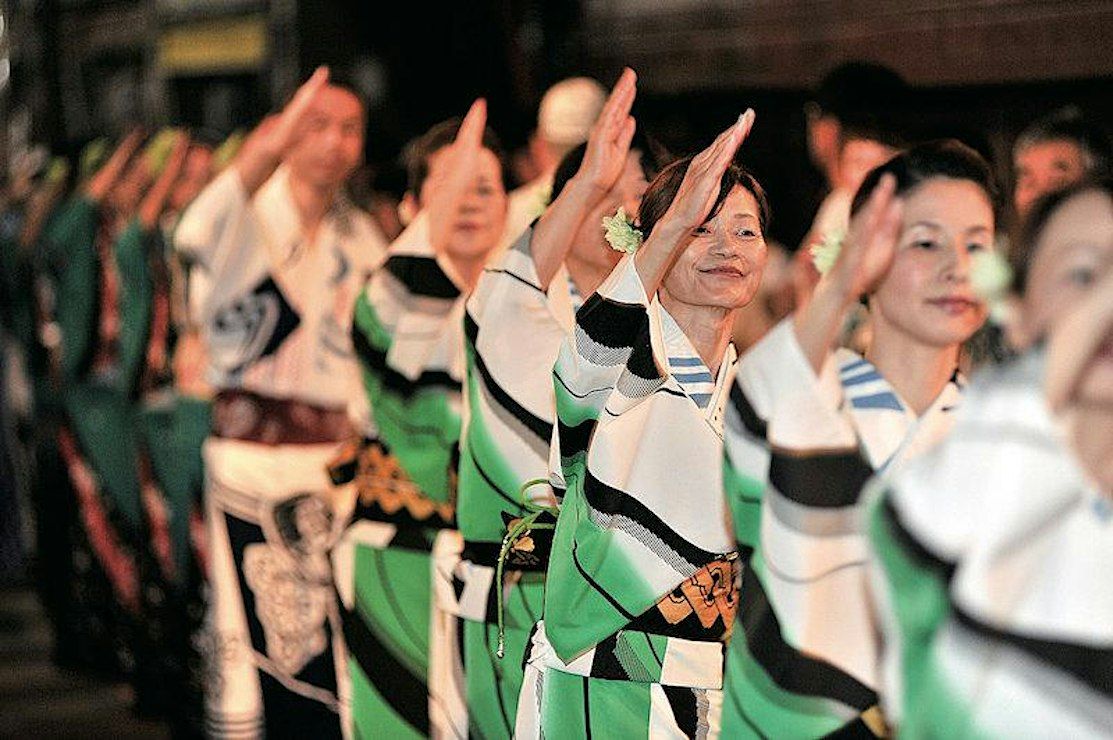
Nishimonai Bon Odori is a traditional Bon dance with a history of approximately 700 years, and it was registered as a UNESCO Intangible Cultural Heritage in 2020.
Akita Prefecture, located in the northern part of Japan, is well known throughout the country for producing delicious rice and sake. Because Akita faces the Sea of Japan, it had historical connections with Kyoto through maritime trade and travel. For this reason, it is said that even in Akita, far from Kyoto, people were once able to hear the Kyoto dialect. The refined style and elegant movements of Nishimonai Bon Odori suggest that it may have been influenced by Kyoto culture.
Although the dance consists of only two songs, the choreography is considered somewhat more challenging compared with Bon Odori dances from other regions. The two songs of Nishimonai Bon Odori are highly unique pieces sung in the Akita dialect. They resemble what we might call rap music today, as the lyrics can reflect current events and allow singers the freedom to create their own verses.
The contrast between the graceful, delicate movements of the dance and the uniquely cheerful melodies of the songs makes Nishimonai Bon Odori a truly one-of-a-kind Bon dance.
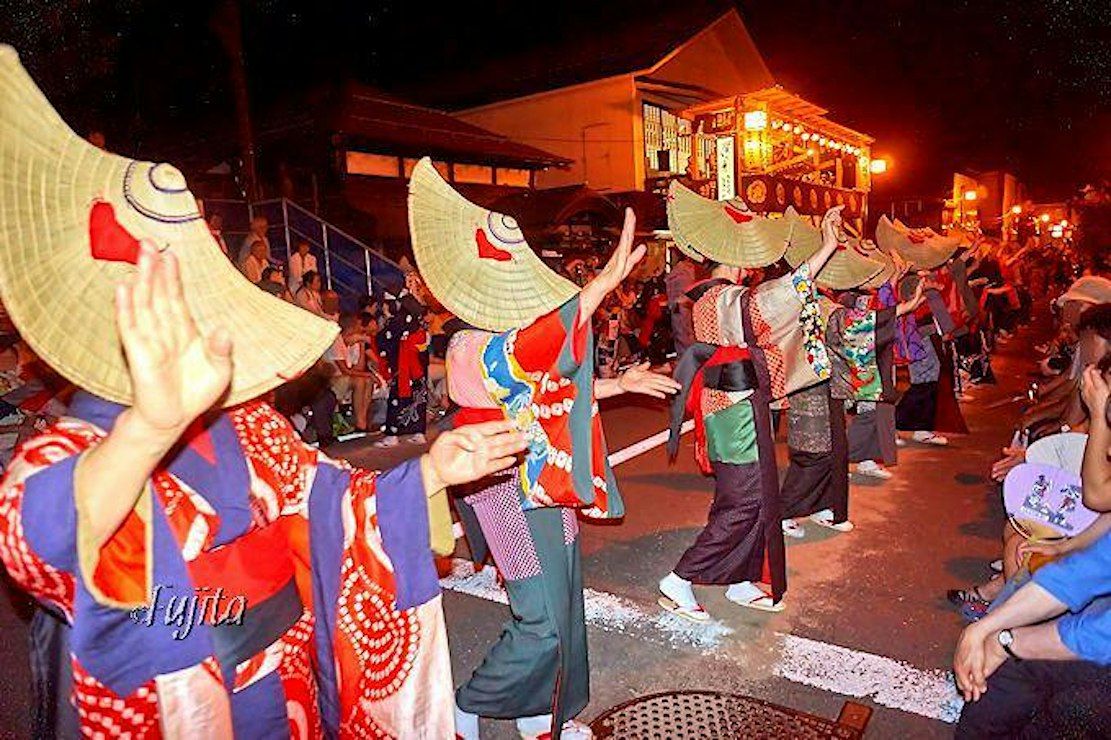
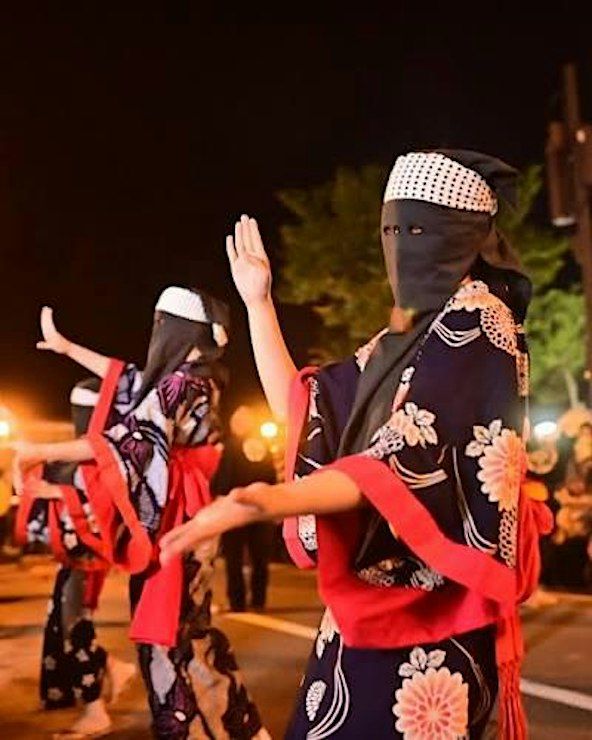
Many Japanese people have the image that Bon Odori is a dance that anyone can join. However, in some regions of Japan, there are traditional dances where participants are expected to know the movements correctly and wear appropriate attire before joining the dance circle. Nishimonai Bon Odori is one of these dances.
As a result, during the three days from August 16 to August 18, the small village of Nishimonai, with a population of approximately 1,500 people, becomes crowded with tens of thousands of visitors who come to experience this unique Bon Odori tradition.
GUJO ODORI (Gifu Prefecture)
Gujo Odori is a traditional Bon dance from Gifu Prefecture, located almost at the center of Japan. With a history of approximately 400 years, Gujo Odori was also registered as a UNESCO Intangible Cultural Heritage in 2020.
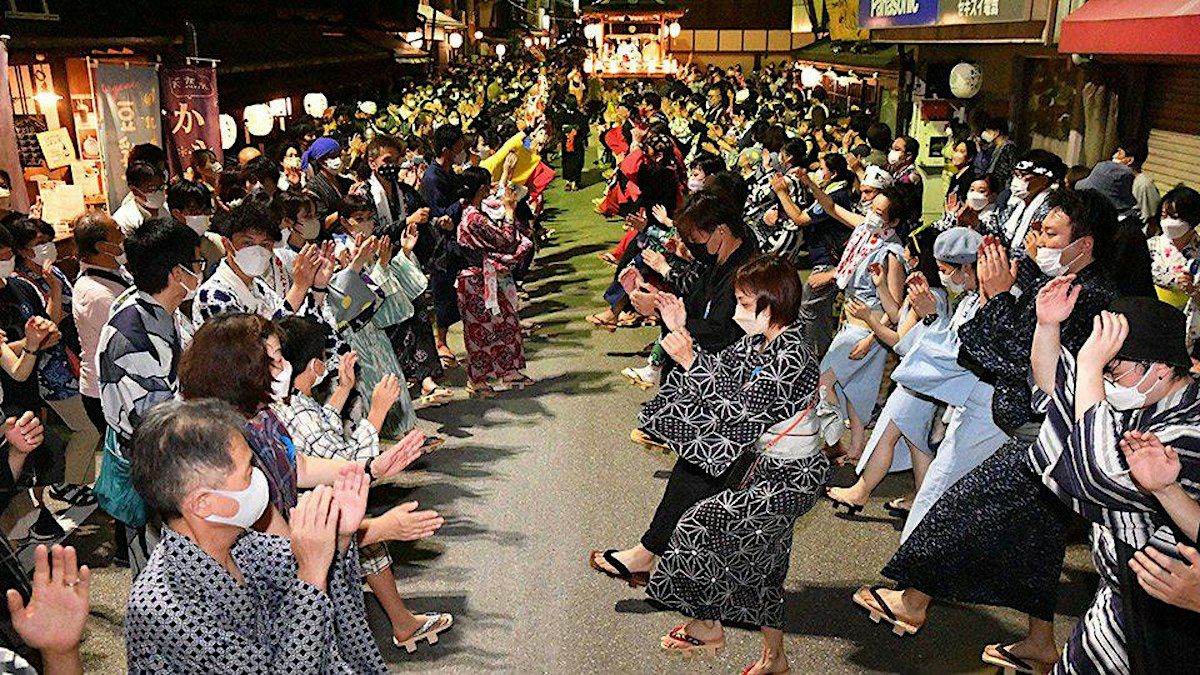
Among the three Bon Odori traditions introduced here, Gujo Odori is the most welcoming and accessible. Anyone can join the dance circle and participate. Although wearing a yukata is the traditional attire, there are no strict rules about what people must wear in order to dance.
Gujo Odori consists of 10 different dances. One of the greatest joys of Gujo Odori is learning and dancing all of these dances. The songs are based on the local landscape, customs, and stories passed down through generations, and some are even performed a cappella, creating a deeply atmospheric and beautiful musical experience.
Dancers wear wooden geta sandals while dancing, creating the distinctive “karan-koron” sound of the wooden soles. This sound is considered an essential part of the music of Gujo Odori itself.
In Gujo City, during the two summer months of the festival season, Bon Odori is held almost every day somewhere in the city, creating an atmosphere filled with energy and excitement. The dances take place continuously in locations such as the main streets of Gujo and the plaza in front of the former mayor’s residence. On weekends, there are special “Tetsuya Odori” (all-night dances), where people continue dancing until dawn.
Because Gujo Odori is a joyful and welcoming dance that anyone can enjoy, it has many fans throughout Japan. During these two summer months, visitors from across the country travel to Gujo City to experience and participate in this unique Bon Odori tradition.
AWA ODORI (Tokushima Prefecture)
Awa Odori is a traditional Bon dance from Tokushima Prefecture, located on the island of Shikoku in western Japan. It is considered one of the most popular summer Bon Odori festivals in Japan.
Awa Odori has a history of several hundred years, although the current style and form of the dance were established approximately 60 years ago. From August 12 to August 16, during the four-day festival period, it is said that around one million people gather in Tokushima Prefecture to experience this spectacular event.
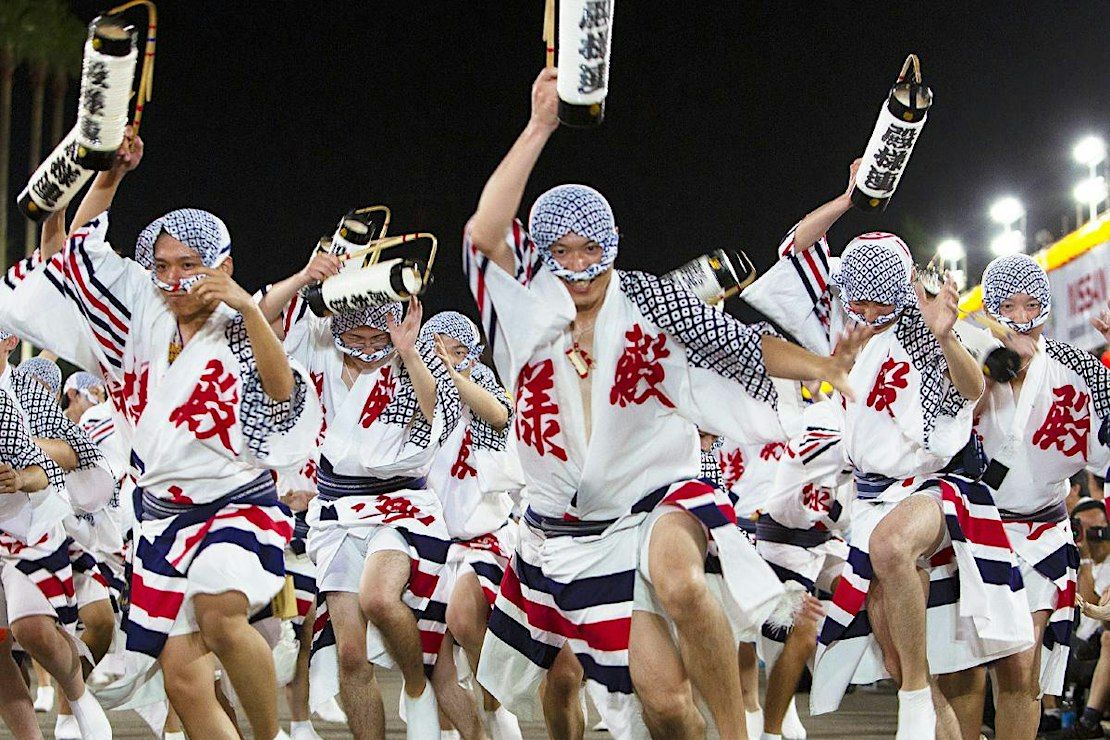
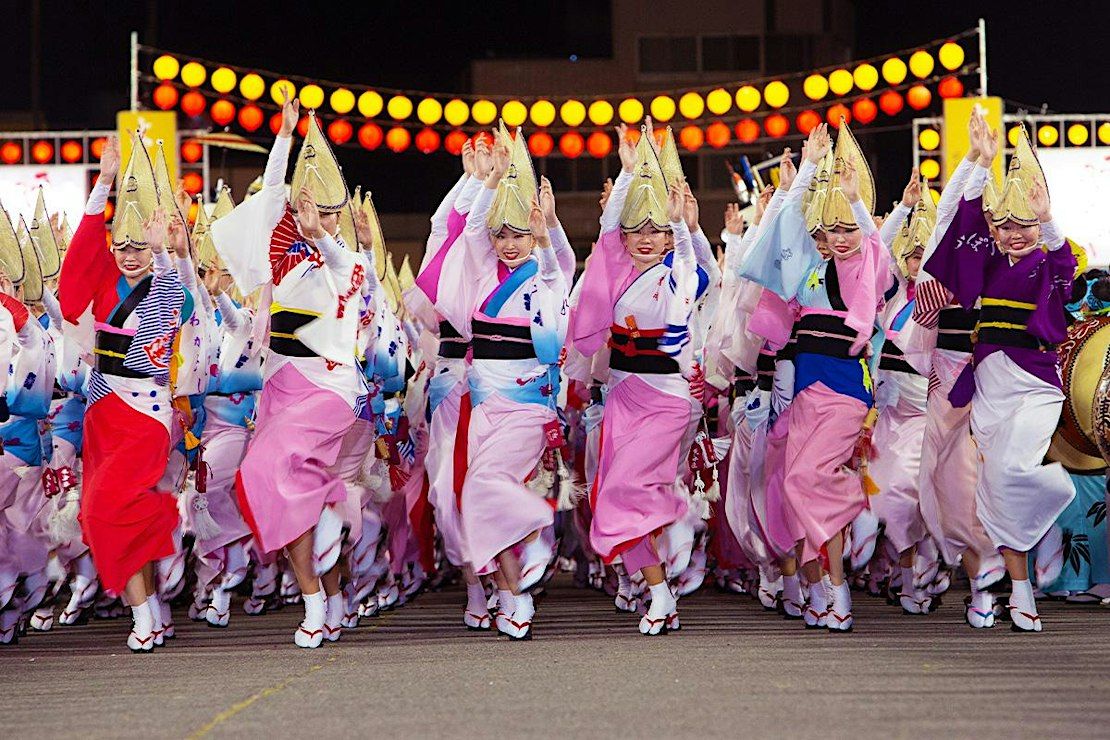
Unlike some Bon Odori traditions where individuals simply join the dance circle, Awa Odori is performed by organized groups called “Ren.” Dancers join a Ren and perform together as a group. Because the dancers must move in harmony, there are detailed rules and extensive practice required to master the choreography. It is said that there are more than 1,000 Ren groups throughout Japan.
Tokushima Prefecture is famous for its indigo dye production. Several hundred years ago, many wealthy merchants in the region made their fortunes through the indigo trade, and some were even ranked among the wealthiest people in Japan. Merchants traveled throughout the country for business and were influenced by the music they encountered in different regions. By incorporating the best elements of these musical traditions, they created new rhythms and songs that became a great success. The image of people dancing with their hands raised was even captured in ukiyo-e (traditional Japanese woodblock prints).
Originally, Tokushima Prefecture consisted of many small islands located close together, connected by bridges that allowed people to travel between communities. While Bon Odori is traditionally danced in a circle, these small islands did not have many open spaces for large dance circles. It is believed that people began dancing along the roads instead. This history is reflected in Awa Odori’s unique style as a one-directional dance, which is unusual among Bon Odori traditions and makes it especially suitable for parade-style festivals.
With both hands raised and dancers moving to its lively rhythm, Awa Odori is a joyful and energetic dance that brings people together through music and movement.

Where is it happening?
Event Location & Nearby Stays:
USD 0.00